

Alienware Was So Close: $4,650 Area-51 Pre-Built Gaming PC Review Leave a comment
They’ve QR codes in every single place to element how customers can service elements, which has been our primary Alienware grievance for a couple of decade now. They’ve switched to utilizing fewer proprietary elements, that means extra consumer serviceability. That’s an enormous enchancment.
However Alienware nonetheless had negatives, like the shortcoming to manually management the followers. The most important unfavorable is the value: We paid $4,650 for this, which on the time of buy, was $1,500 costlier than DIY on the time we put the pricing desk collectively. And that’s with “$400 off” the “estimated worth,” a quantity that Alienware claims relies on aggressive information however is clearly, as an alternative, based mostly on one thing we name, uh, “bullsh*t.”
The excellent news is that, in some way, that is still more price competitive than Origin’s high-end pre-built PCs. Underneath regular circumstances, on worth alone, we’d say this prebuilt is eradicated from consideration; nevertheless, Origin places Alienware into a brand new perspective the place, in some way, even a $1,500 increased value than DIY elements appears to be like doable.
The thermals and building are essentially the most fascinating for this one. Let’s get into it.
Alienware Space-51 Value Comparability vs. DIY
Alienware Space-51 AAT2250 Pre-built | Half and Value Breakdown | GamersNexus
| Half Identify | DIY Equal Half | DIY Half Value | |
| CPU | Intel Extremely 9 285K | Intel Extremely 9 285K | $589 |
| CPU Cooler | 360mm Liquid Cooler | Arctic Liquid Freezer III Professional 360 | $85 |
| Motherboard | Alienware Z890 ATX with WIFI7 | Gigabyte Z890 EAGLE WIFI7 | $225 |
| Reminiscence | 64GB DDR5-6400 (2x32GB) | 64GB DDR5-6400 (2x32GB) | $230 |
| Storage | 4TB NVMe M.2 PCIe 4 SSD | Teamgroup T-FORCE G50 4TB PCIe 4 SSD | $200 |
| GPU | NVIDIA RTX 5080 16GB | NVIDIA RTX 5080 16GB | $1,380 |
| Case | Alienware Space 51 Case | Lian Li Lancool 216 RGB | $103 |
| Energy Provide | 1500W Platinum ATX12VO | be quiet! Straight Energy 12 1500W Platinum | $235 |
| Followers | 2x180mm entrance and 2x140mm backside | 2x Arctic P14 PWM PST A-RGB | $44 |
| Pre-built Value: $4650 | DIY Complete: $3091 | ||
| Pre-built Premium Over DIY: $1559 |
We’ll begin with a value comparability. Costs for DIY elements have been taken on the finish of Could and have been as shut a match as we might discover to Alienware’s choice. We didn’t attempt to fine-tune.
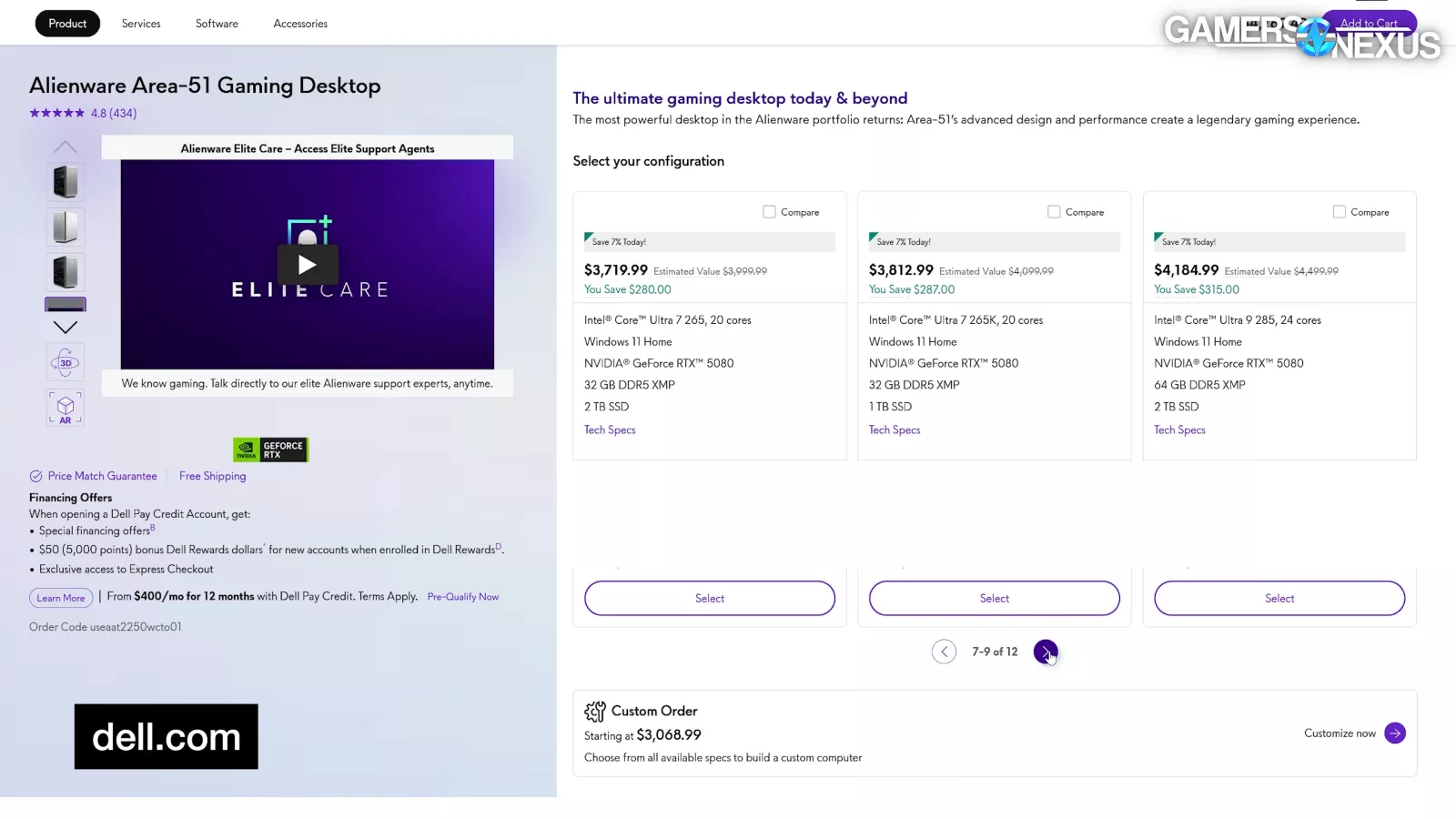
The brand new Space-51 is available in 13 completely different configurations, up from simply 3 after we ordered, all with Intel Core Extremely CPUs and NVIDIA RTX 50 Collection GPUs.
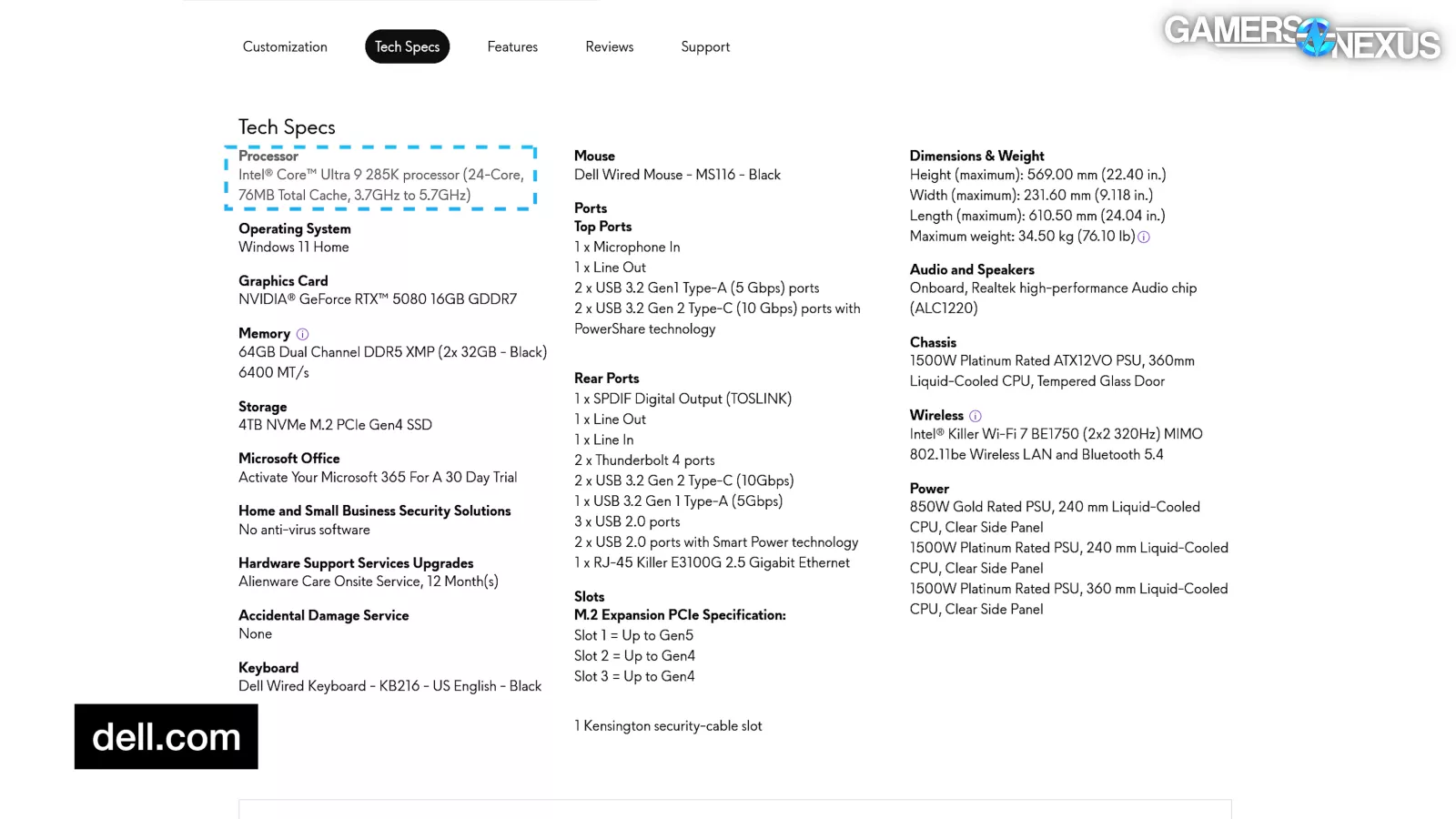
Our configuration has a 285K, an RTX 5080 (learn our review), 64GB of DDR5-6400, and a 4TB SSD.
Together with that may be a 360mm liquid cooler and a 1500W 80 Plus Platinum rated ATX12VO PSU.
Worth dialogue is a complete non-starter. The DIY complete involves $3,091 on the time of writing, making it $1,559 inexpensive than the Alienware’s ridiculous $4,650 price ticket. Expressed one other method, the Space-51 is 50% costlier than DIY elements value; there are cheaper pre-builts on the market. In the event you’re against DIY (and we don’t have an issue with folks shopping for pre-builts). We expect the Space-51’s case might be costlier to provide than the manufacturing value of our Lian Li Lancool 216 RGB substitution, however that’s clearly not sufficient to actually sway the maths. It’s additionally not related to an finish consumer.
Overview and Advertising and marketing
The most important updates to the Space-51 are the development, thermal options, and half selections. Alienware really had emailed us to ask if we wished to take a look at one, as the corporate felt assured in its adjustments. We rejected the supply and purchased one independently, as at all times for pre-built evaluations, as we wished the complete buyer expertise.
Alienware went with a historically laid out giant tower case with much more air flow than its previous designs. As a reminder of how unhealthy it’s been earlier than, we made a complete video “fixing” the dumpster fireplace referred to as the Alienware R13.
On the brand new system, the highest, entrance, and a lot of the backside are all air consumption areas, leaving the meshed-out rear as a very passive exhaust. Significantly fascinating are the 2 180mm followers within the entrance panel, harking back to the Fractal Torrent. There’s roughly 35mm of clearance within the entrance cutout, which must be ample to keep away from an excessive amount of restriction regardless of trying coated. It helps that the hub loses essentially the most entry to air, and but is the one a part of a fan that air can’t undergo. The mud filter contained in the panel is magnetically retained for simpler cleansing as effectively, which is a pleasant characteristic.
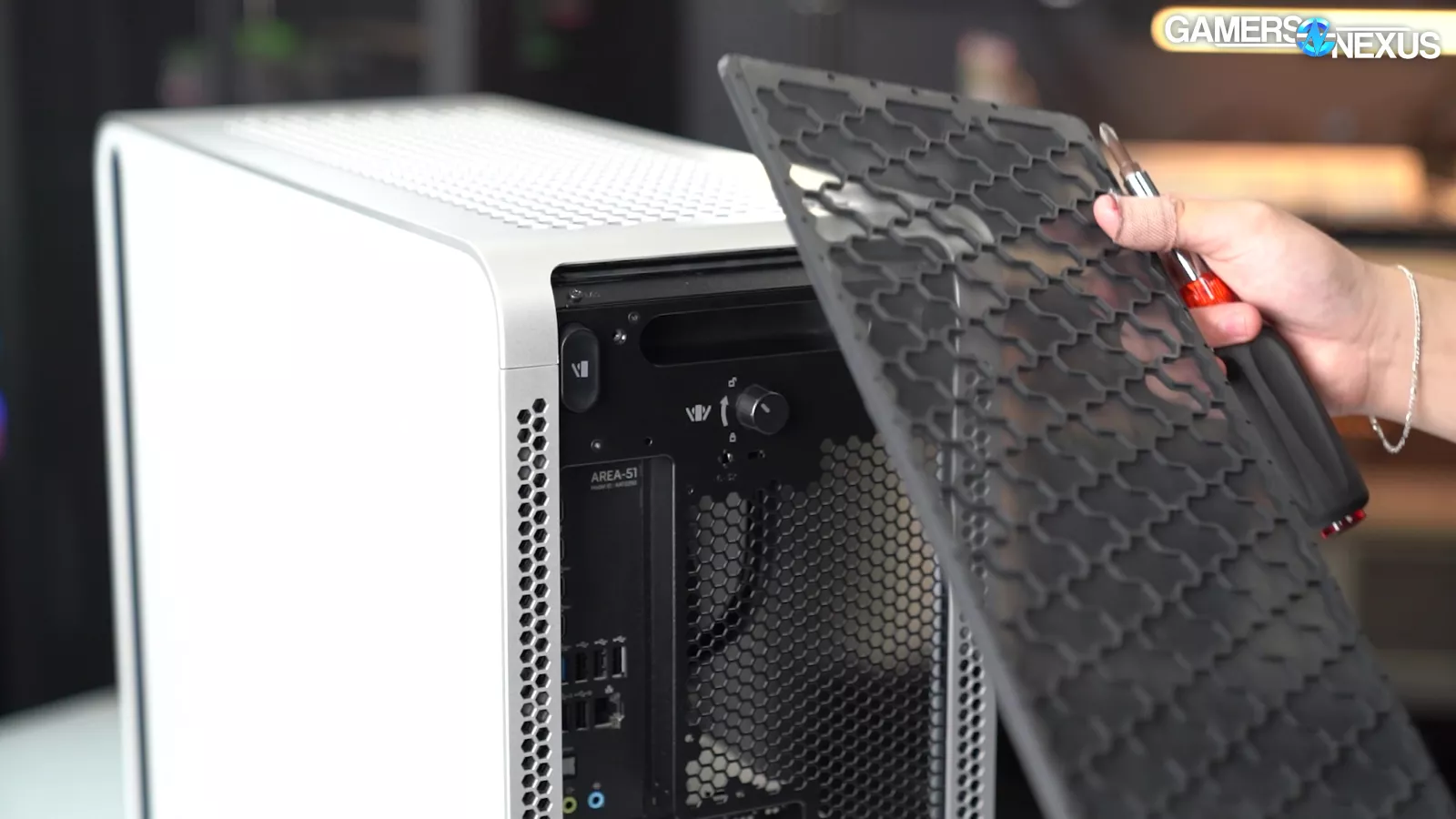
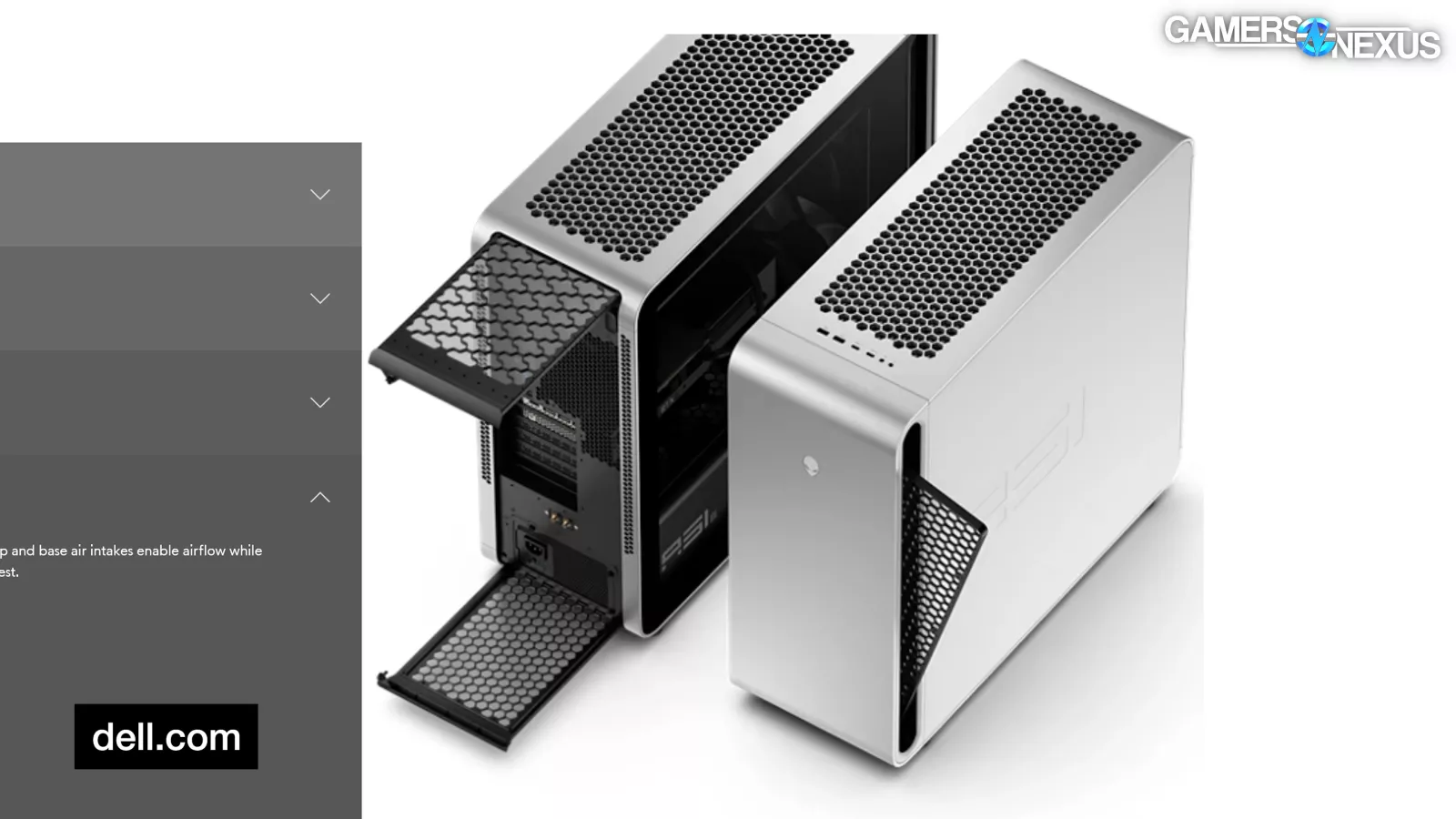
The CPU is cooled by a 360mm liquid cooler with entry to contemporary air by way of the highest, with a mud filter that slides out to the rear, retained by a screw. The underside has one as effectively.
Alienware Space-51 Tear-Down
The final couple of Alienware methods we’ve examined have been actually troublesome to take aside. This one is less complicated to work with.
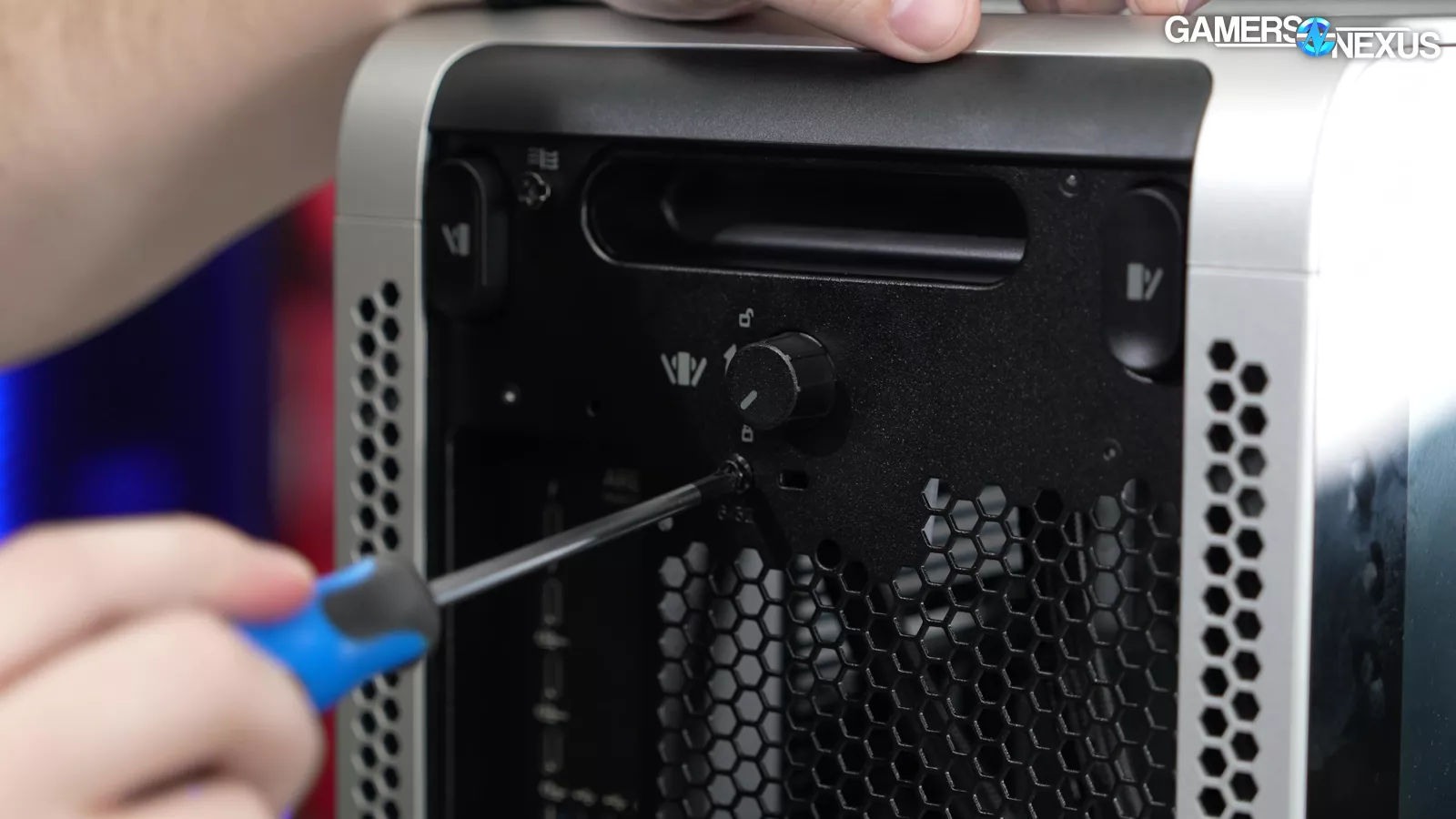
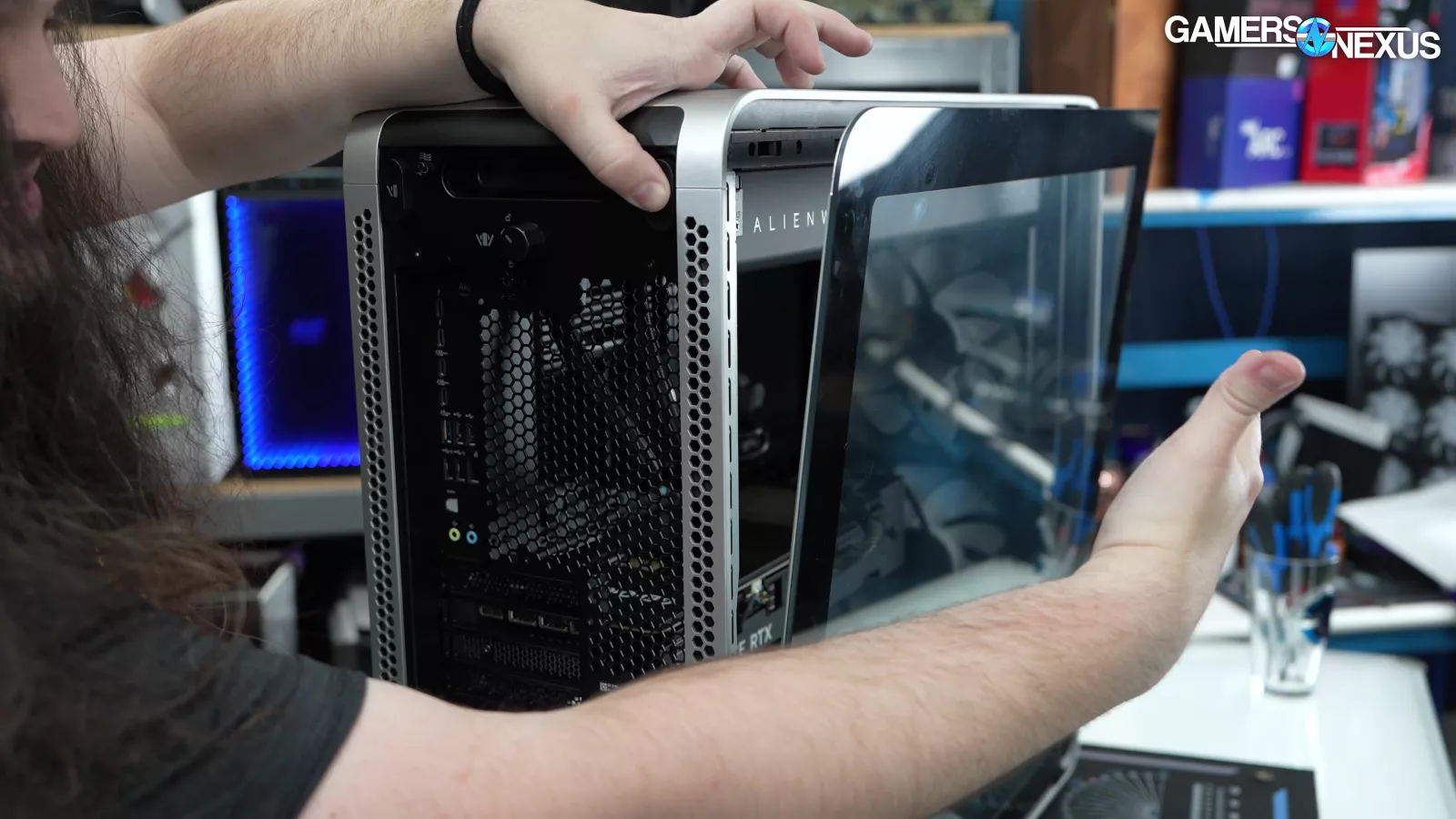
To get inside, you take away a screw, flip the lock knob, then press these spring-loaded buttons to launch the facet panels. Luckily, they relaxation in {a partially} opened place with out falling – then you definitely simply elevate up. Entry inside is fairly good, and the cable administration is general good.
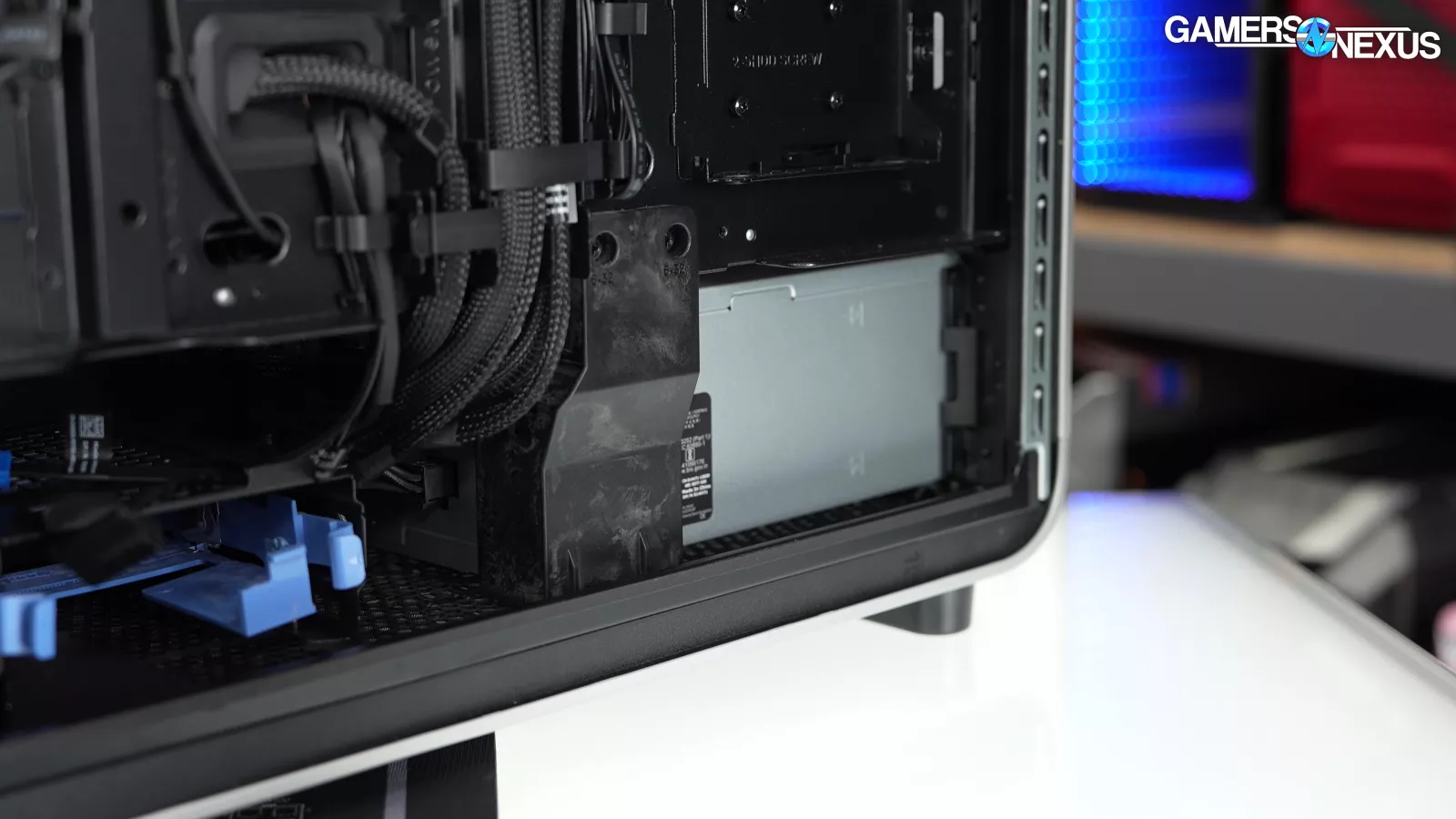
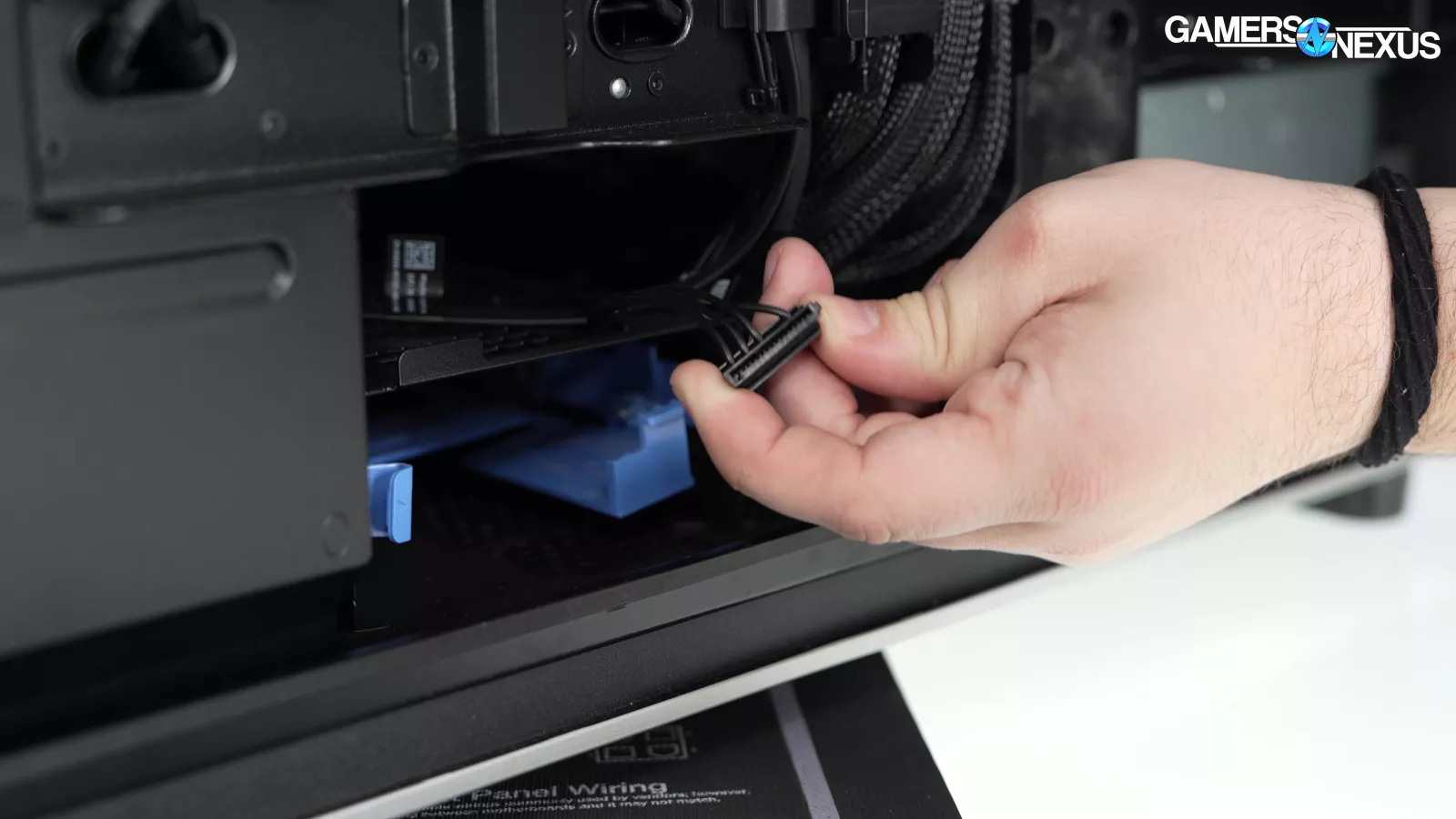
The following greatest factor following after thermals is the Space-51’s shift to straightforward ATX elements – effectively, largely. The motherboard is a customized Alienware mannequin with customary ATX mounting factors, however it’s really ATX12VO electrically. That additionally implies that the 1500W PSU is ATX12VO to match. You’ll be able to see how as an alternative of a 24-pin connector, the board has a 10-pin and a supplemental 6-pin alongside the precise edge.
In the event you don’t know what ATX12VO is, we have now a video from a pair years in the past that covers it, so go verify that out after this.
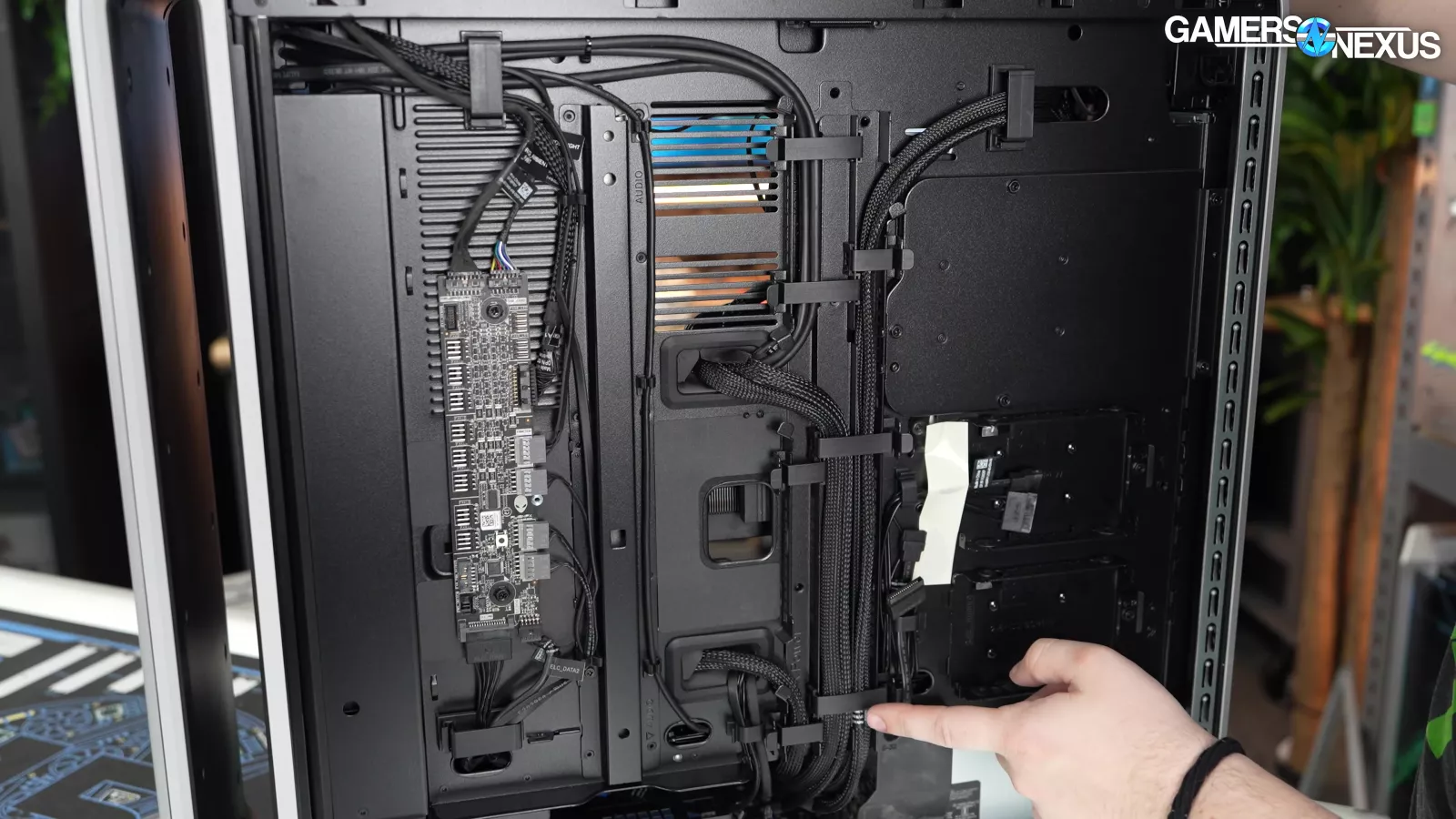
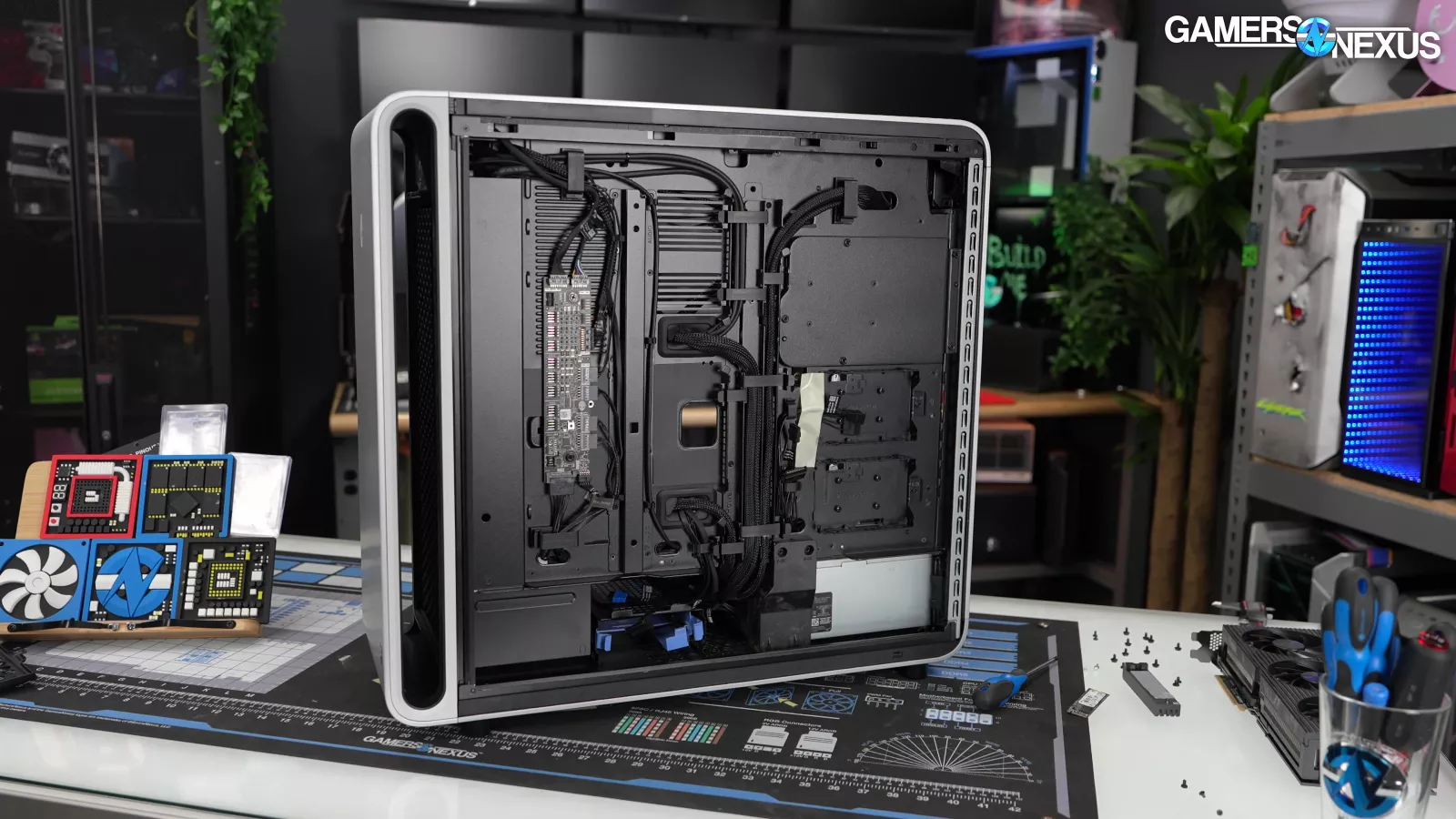
Cable administration is rather well achieved. That is an space the place pre-builts are inclined to do rather well.
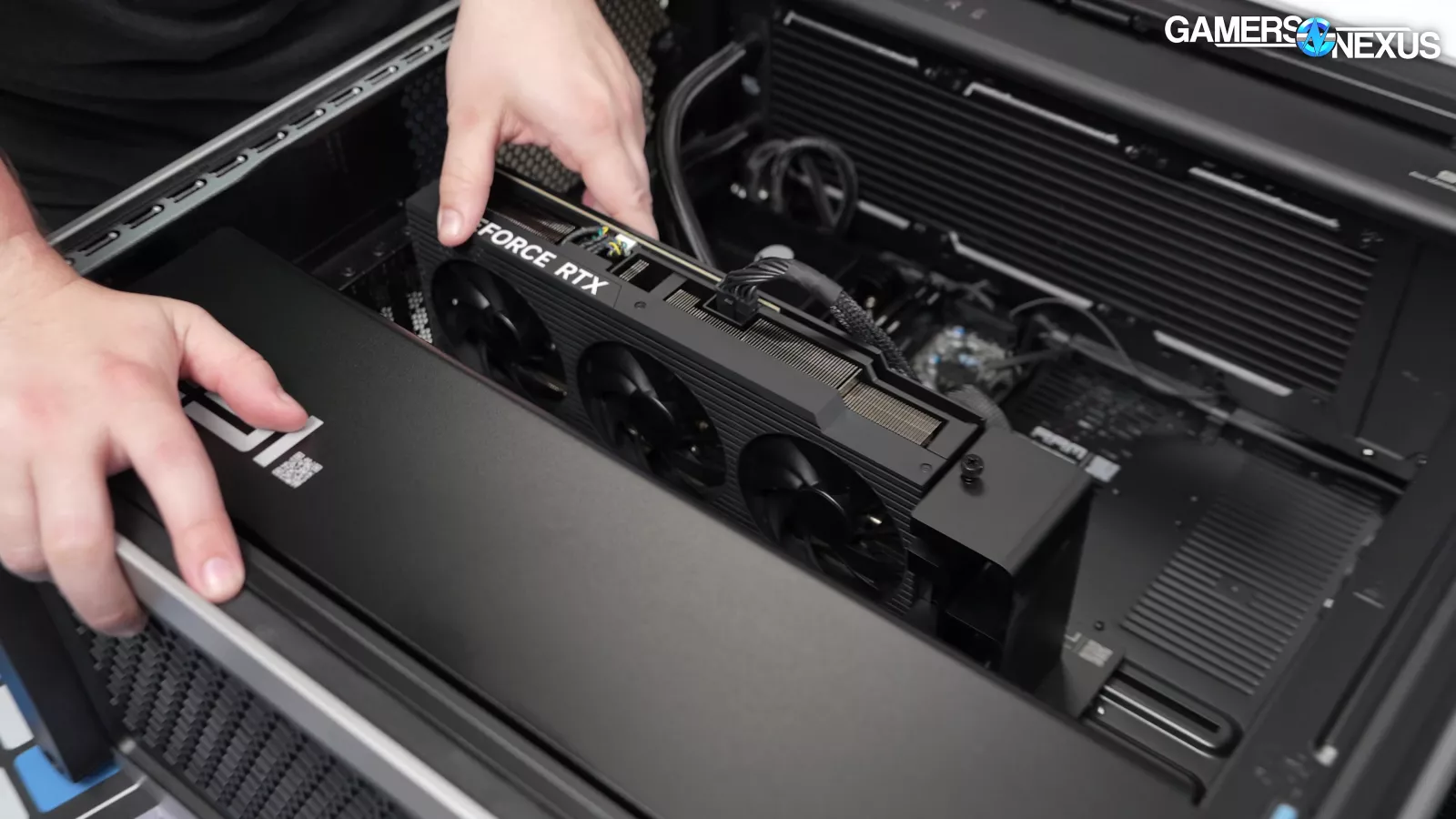
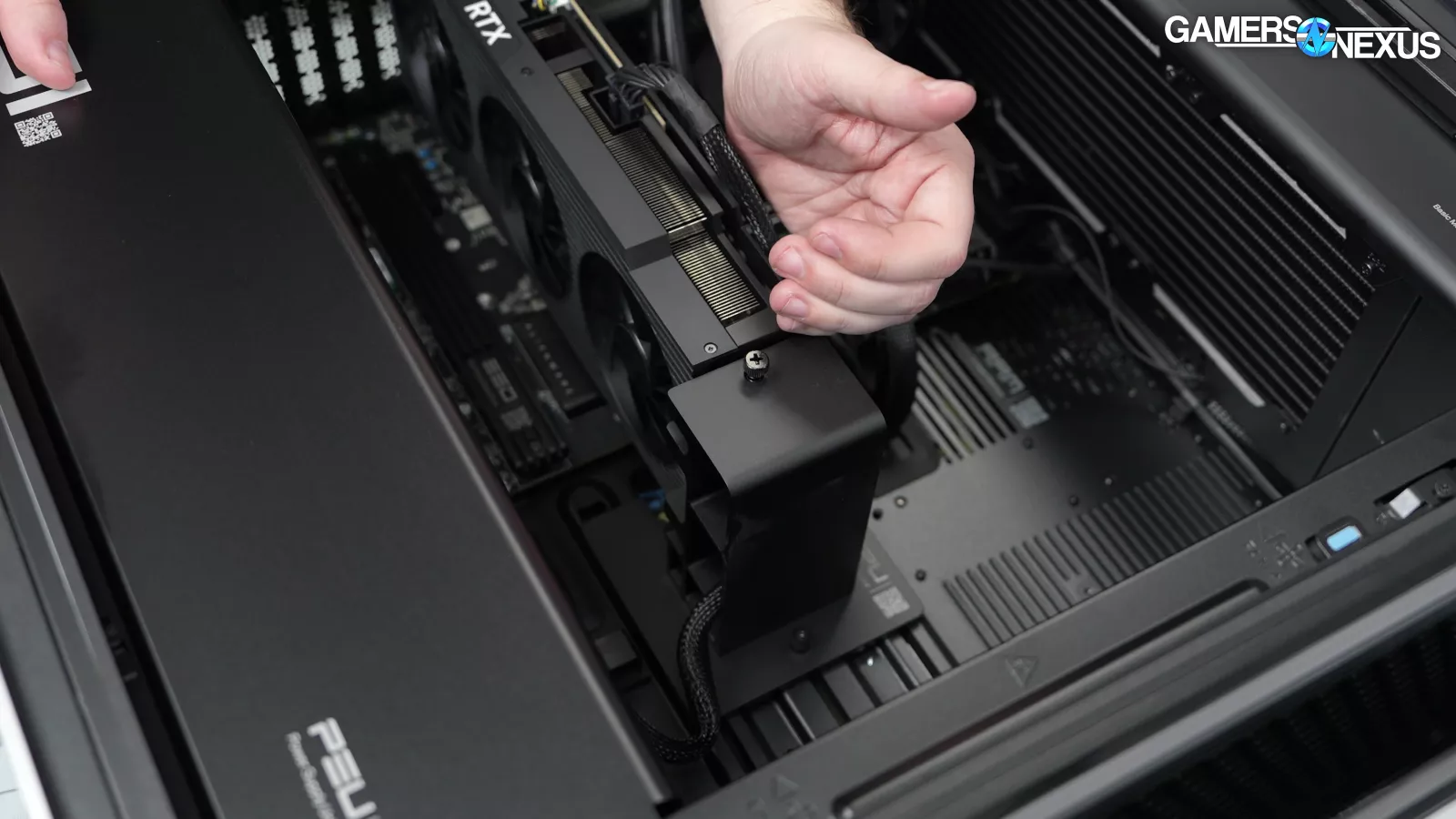
Wanting on the different facet and contained in the system, the video card is comparatively giant however there’s loads of room to improve.
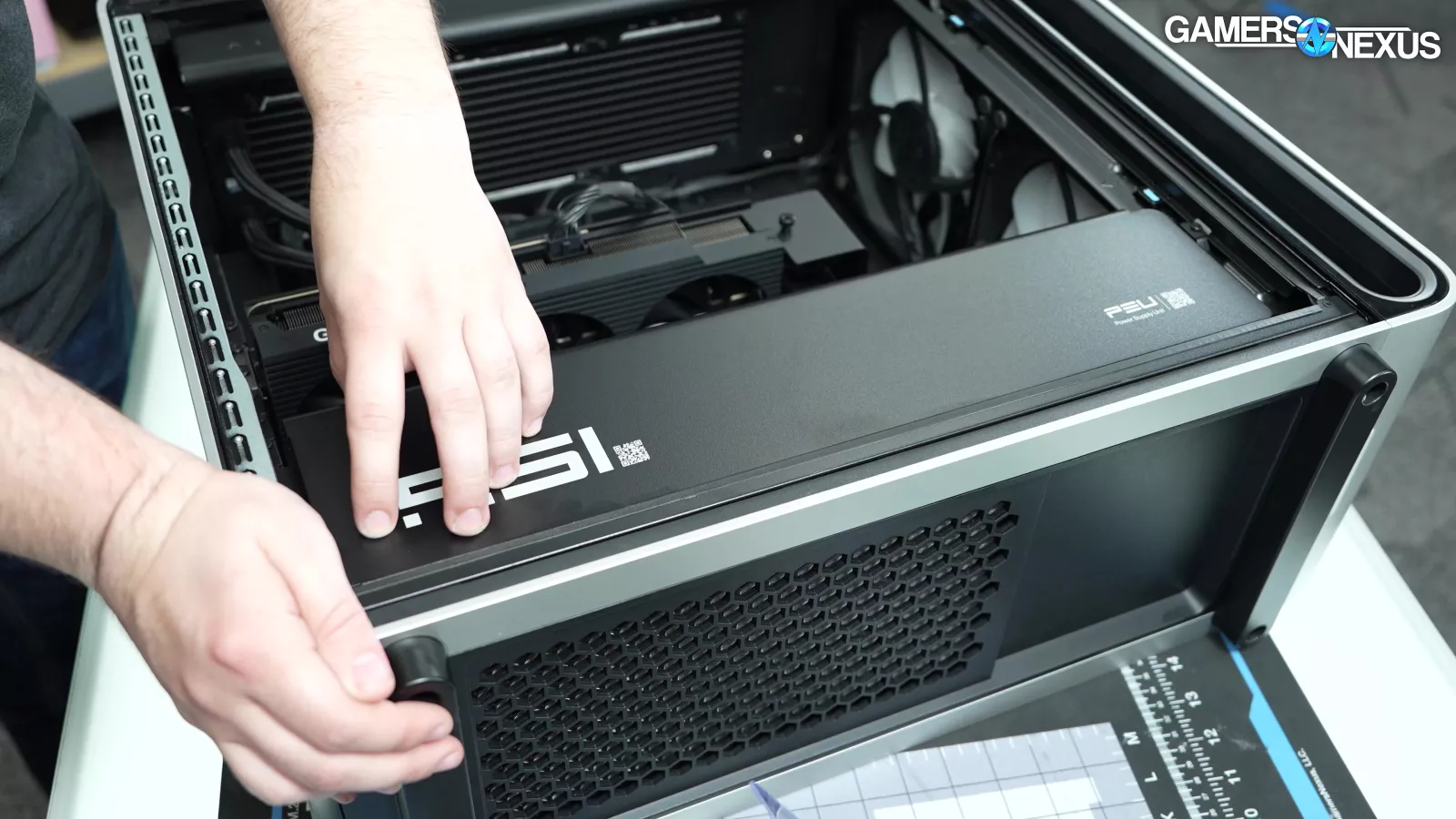
The underside of the system has a very enormous energy provide shroud, which has followers inside them.
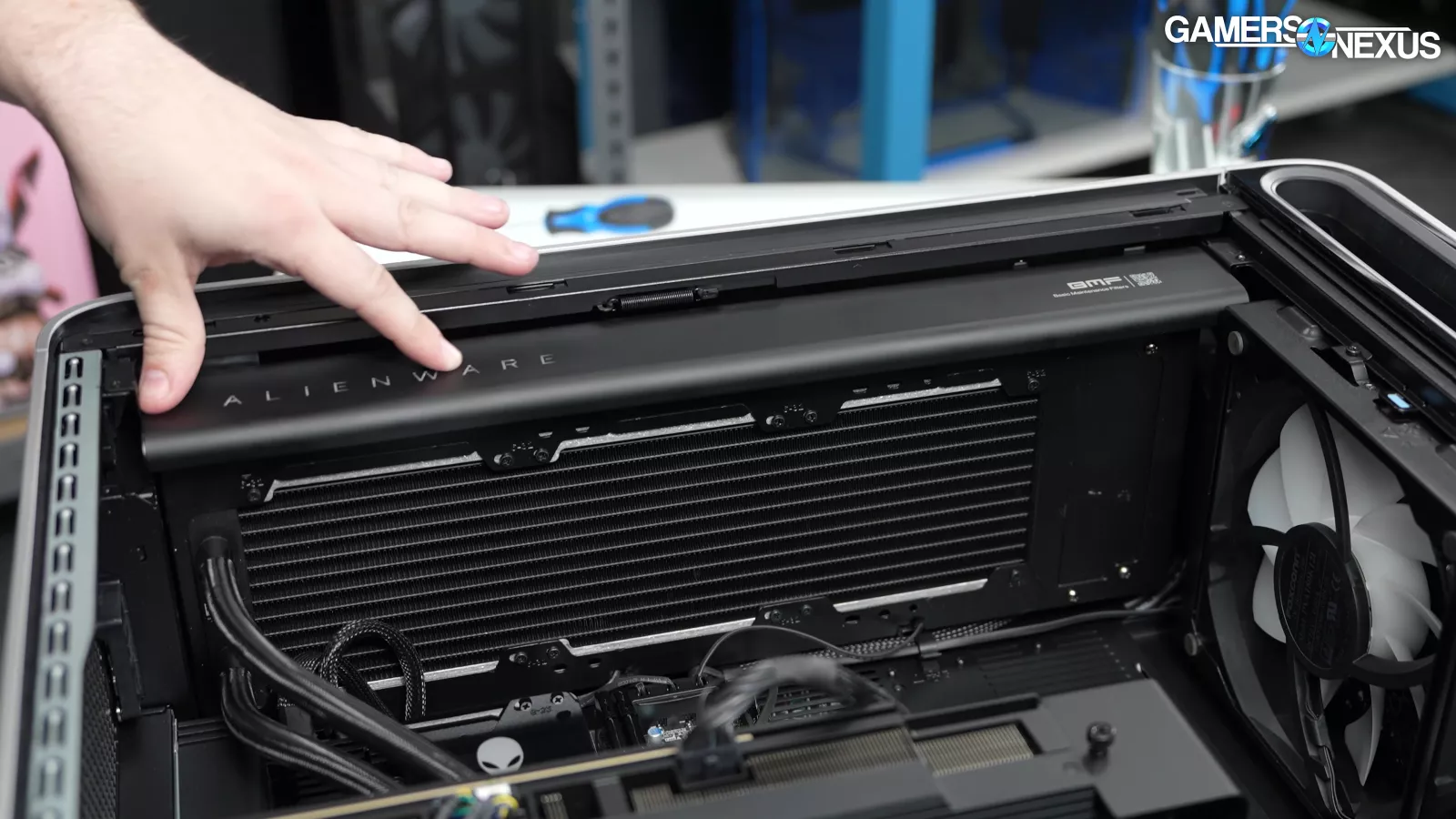
The highest of the case has a bar that covers the facet of the radiator, which has been in previous Alienware methods.
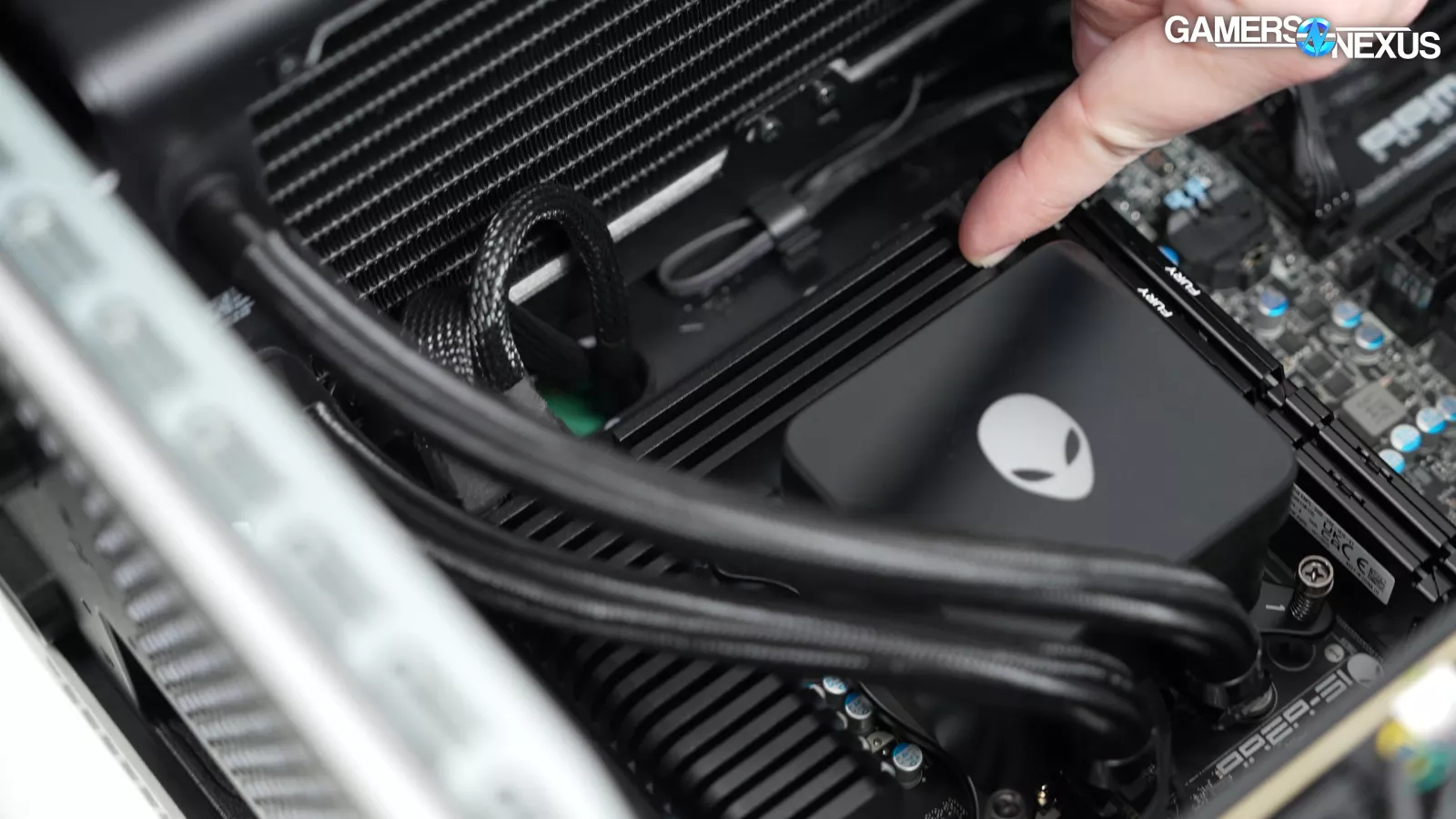
We typically like how the warmth sink for the VRM are finned.
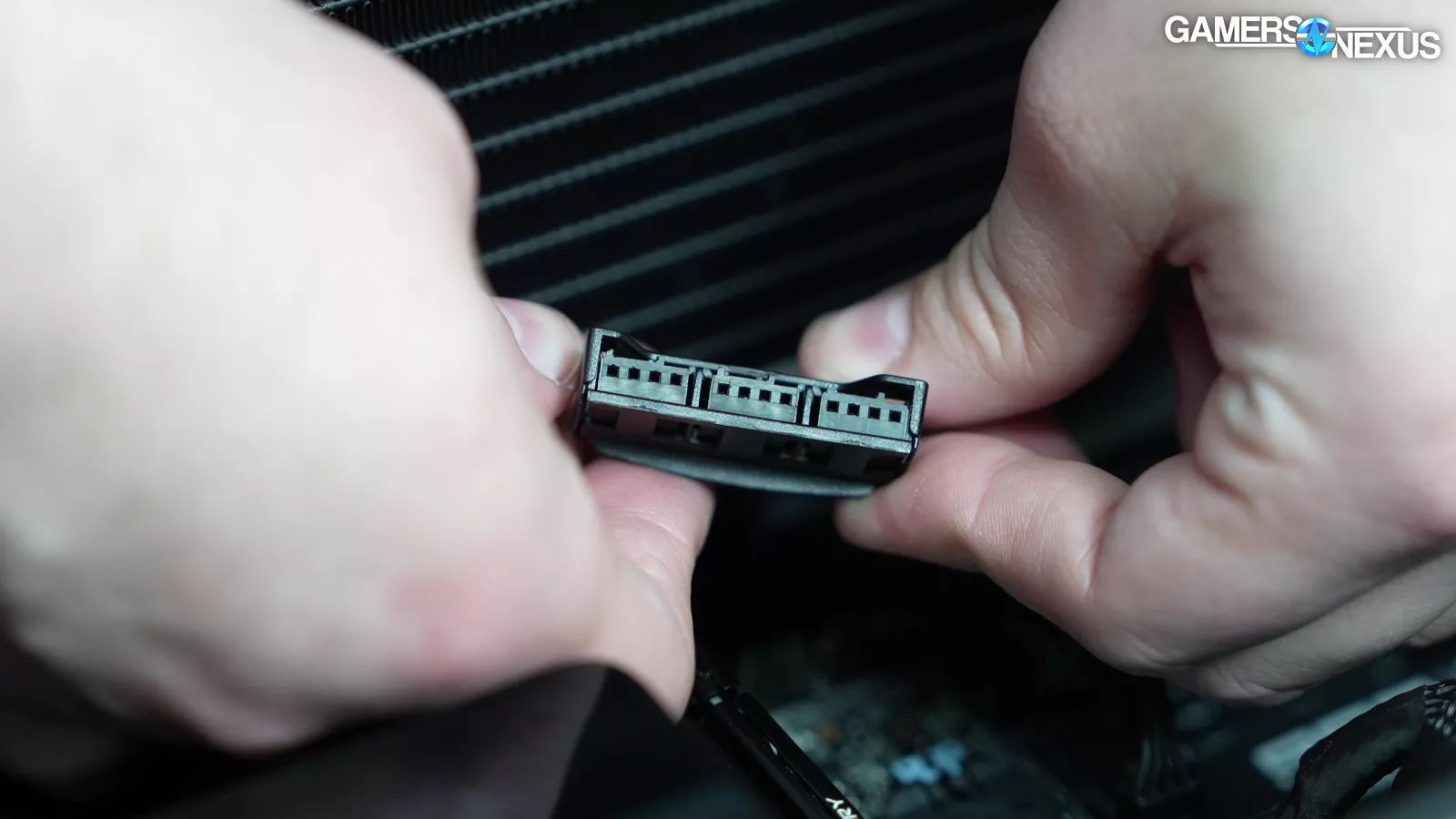
The system makes use of a fan header cage that creates a make-shift 12-pin connector.
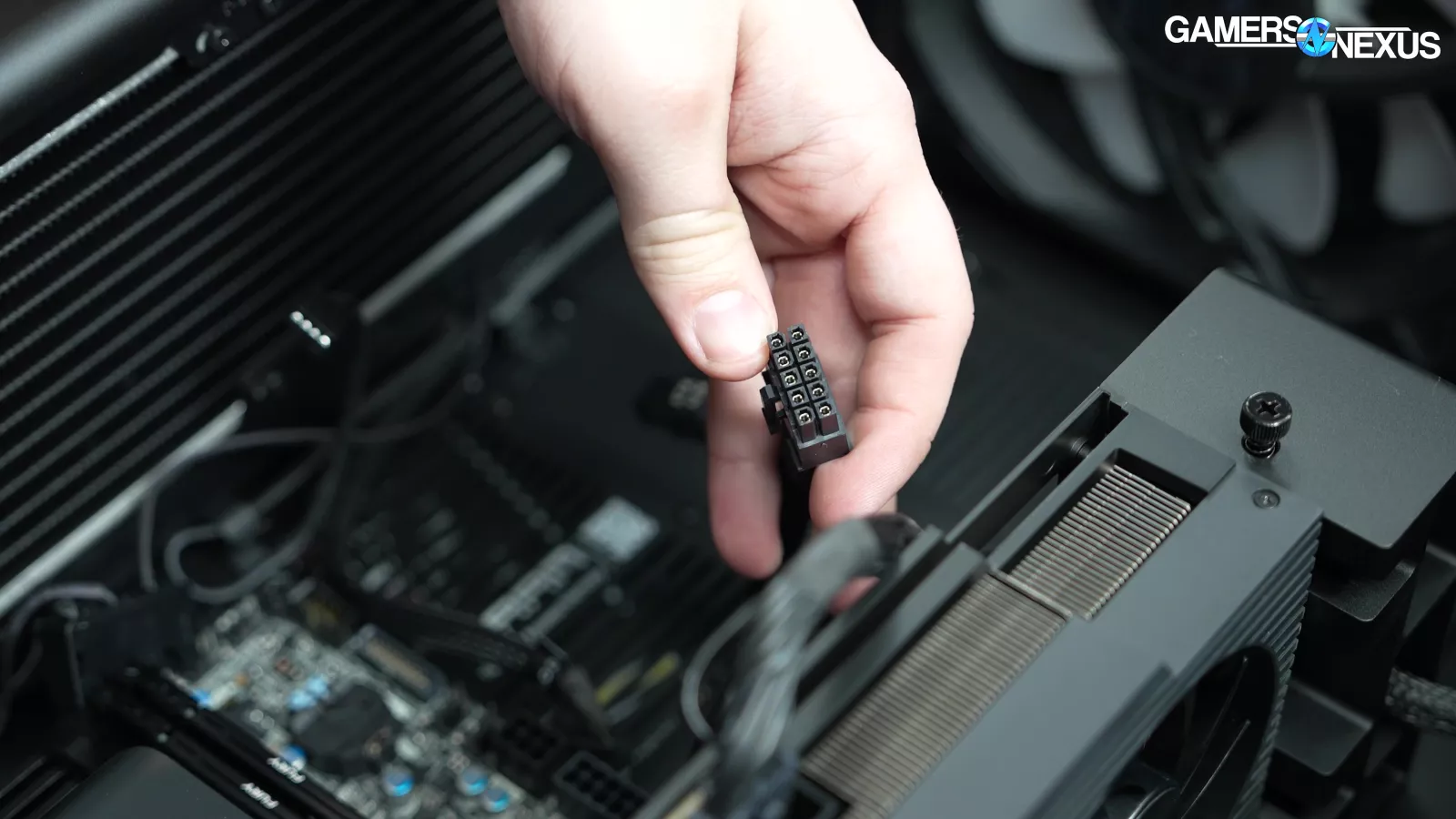
The PC doesn’t use any proprietary connectors and all of the connections into the motherboard have been safe.
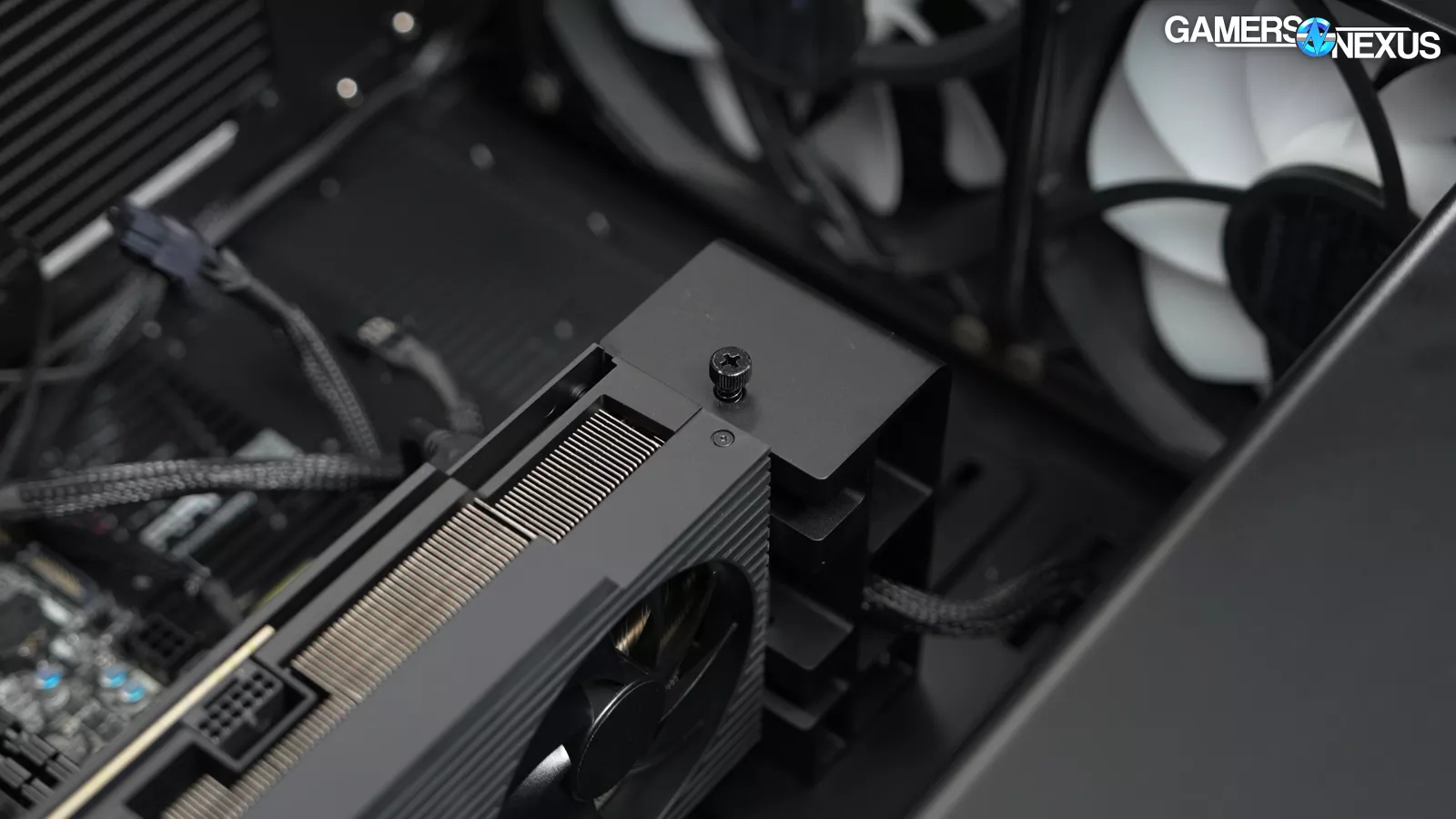
The RTX 5080 inside is held in place by essentially the most substantial GPU bracket we’ve ever seen. It’s a bit of stable steel connected to each the top of the GPU and the inner wall of the case and it slides into place. It’s fairly good, however completely pointless and provides to the expense. It does considerably make sense in a pre-built to forestall breaking throughout delivery, nevertheless.
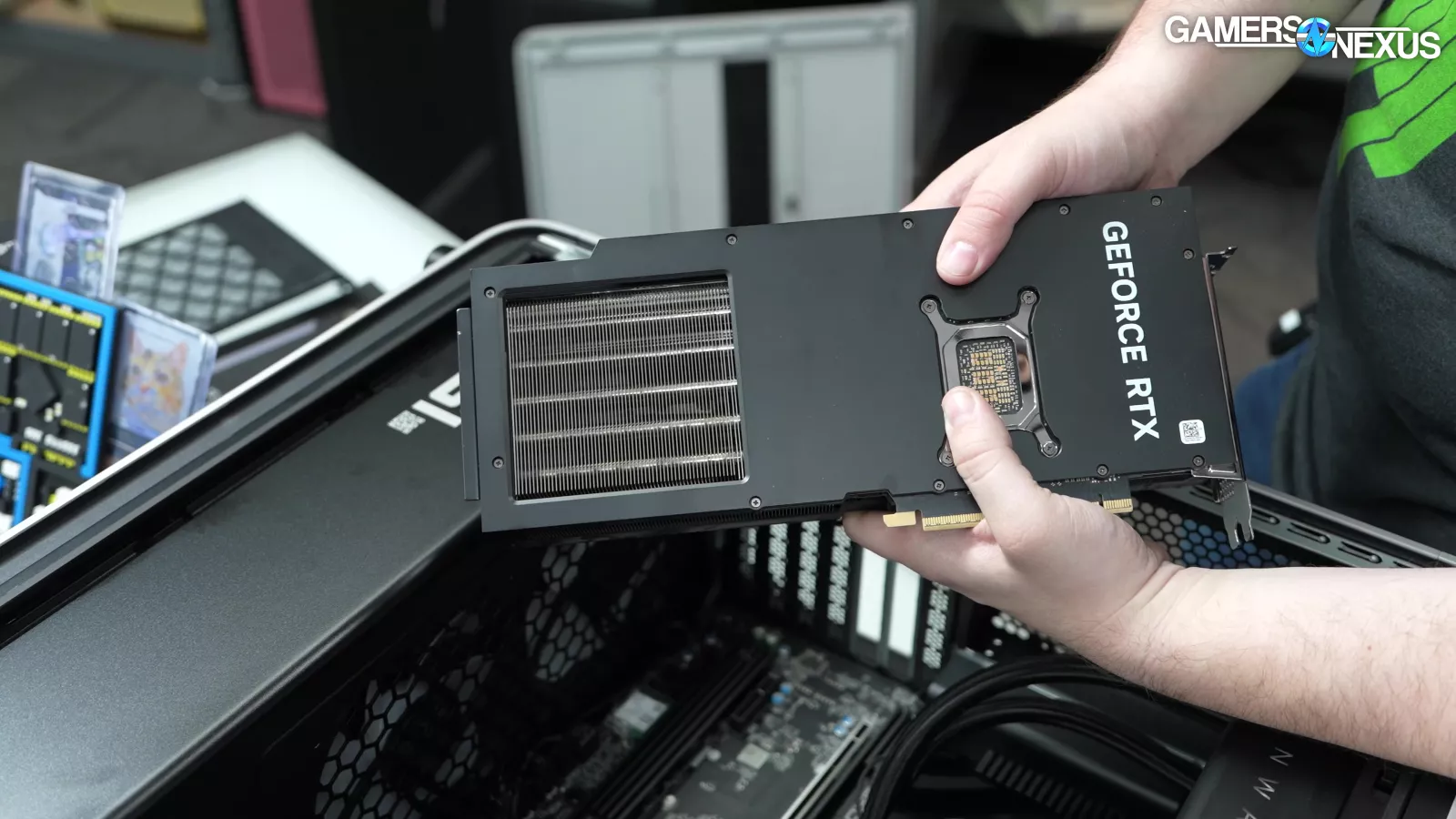
Wanting on the video card, it makes use of a really giant flow-through space, which is great. The final time we examined Dell’s video card, which was a 4090, the corporate’s design did surprisingly well for what it was.
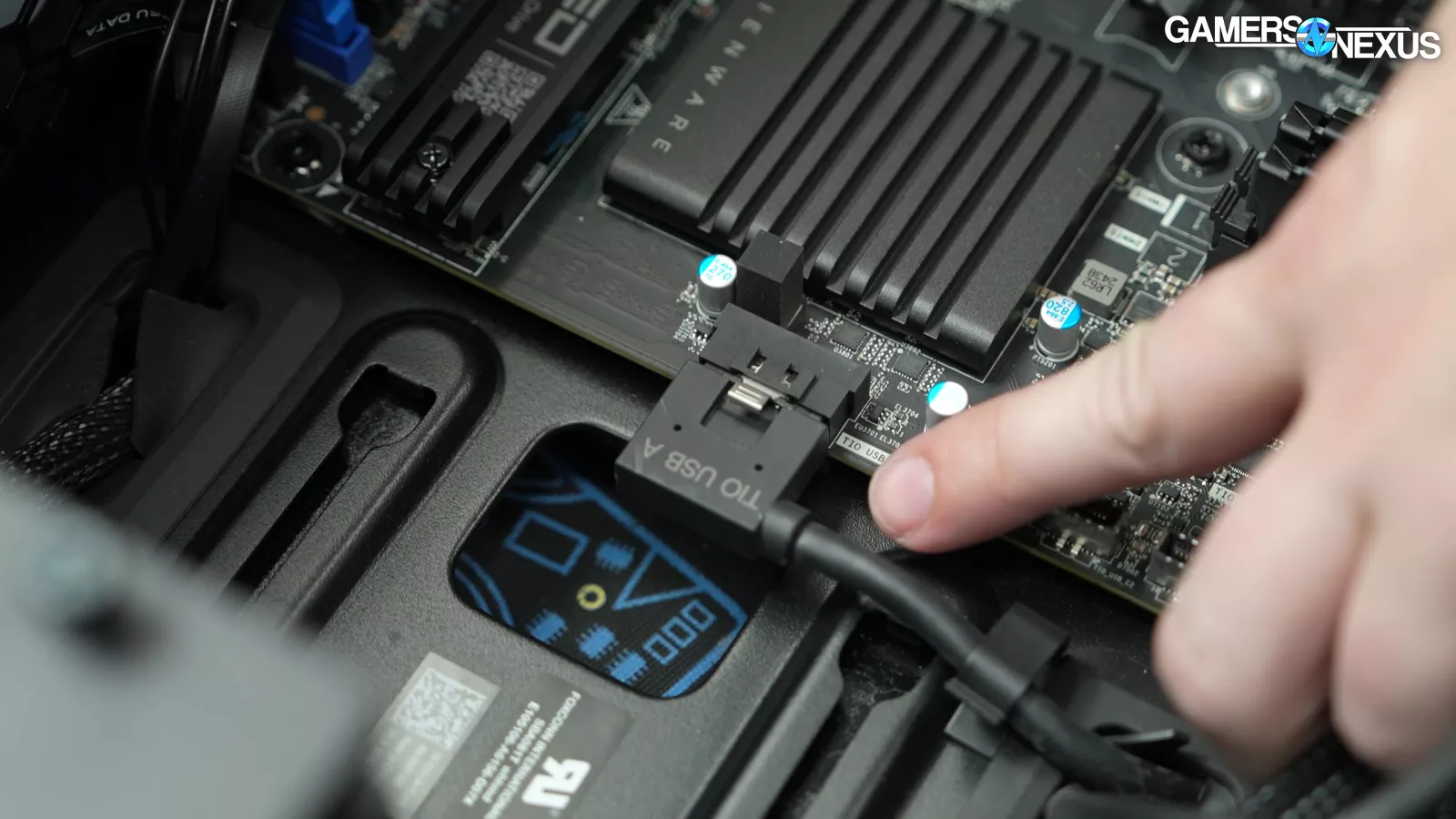
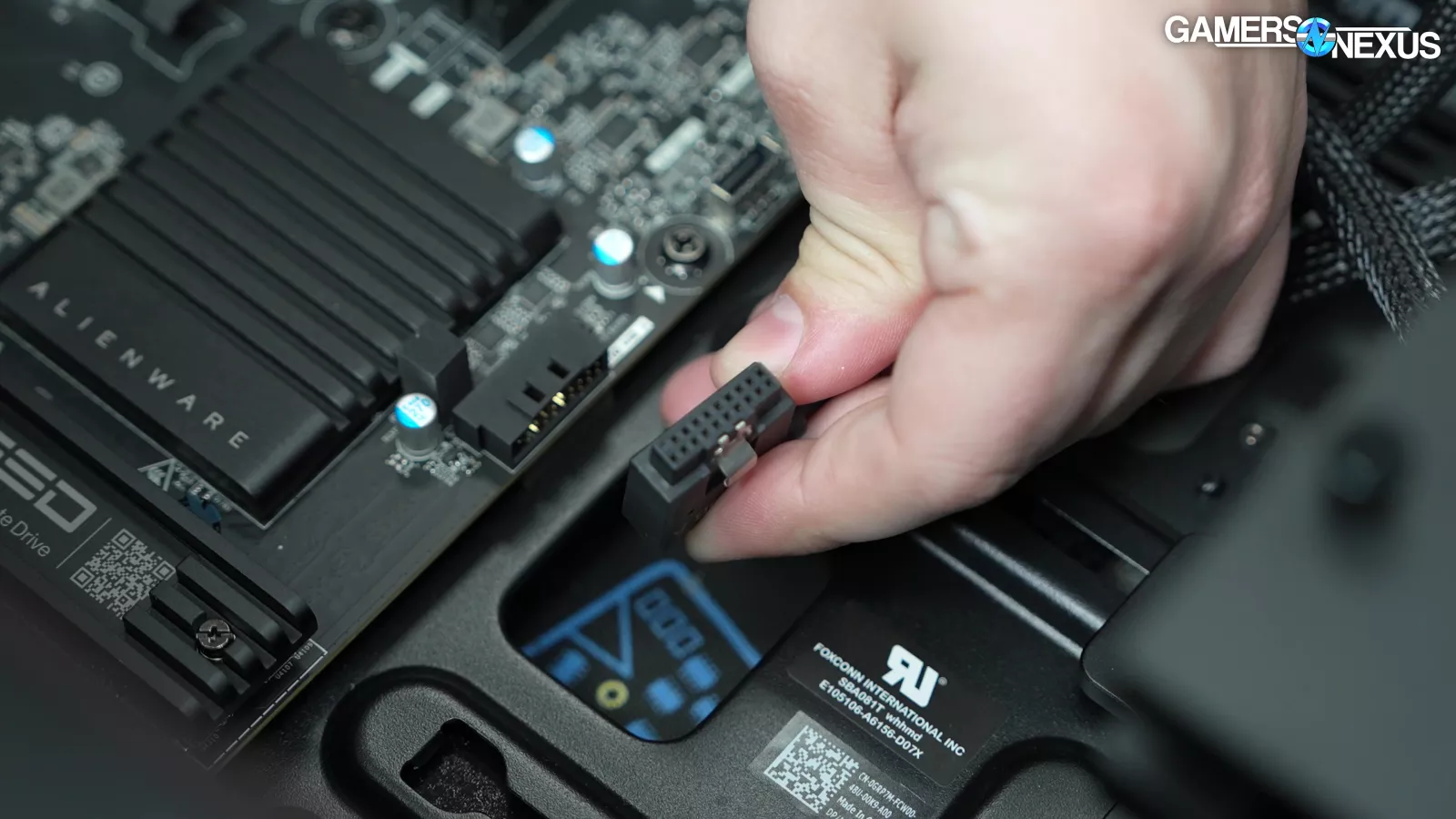
Contained in the PC, we observed a totally customized USB 3.0 connector, which fits into the motherboard at a 90-degree angle.
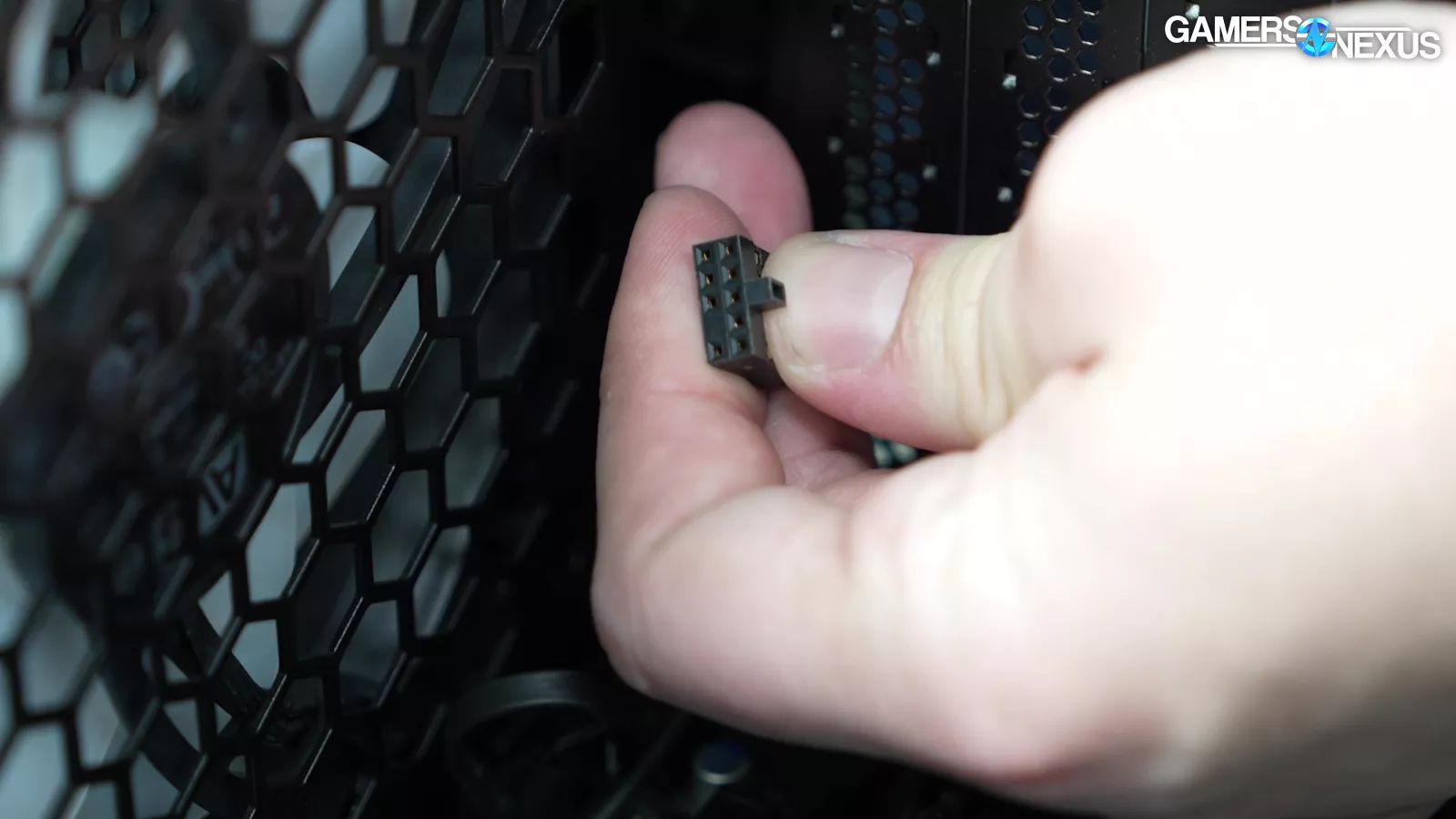
Their HD-audio connector additionally has an additional protrusion on it to latch it in.
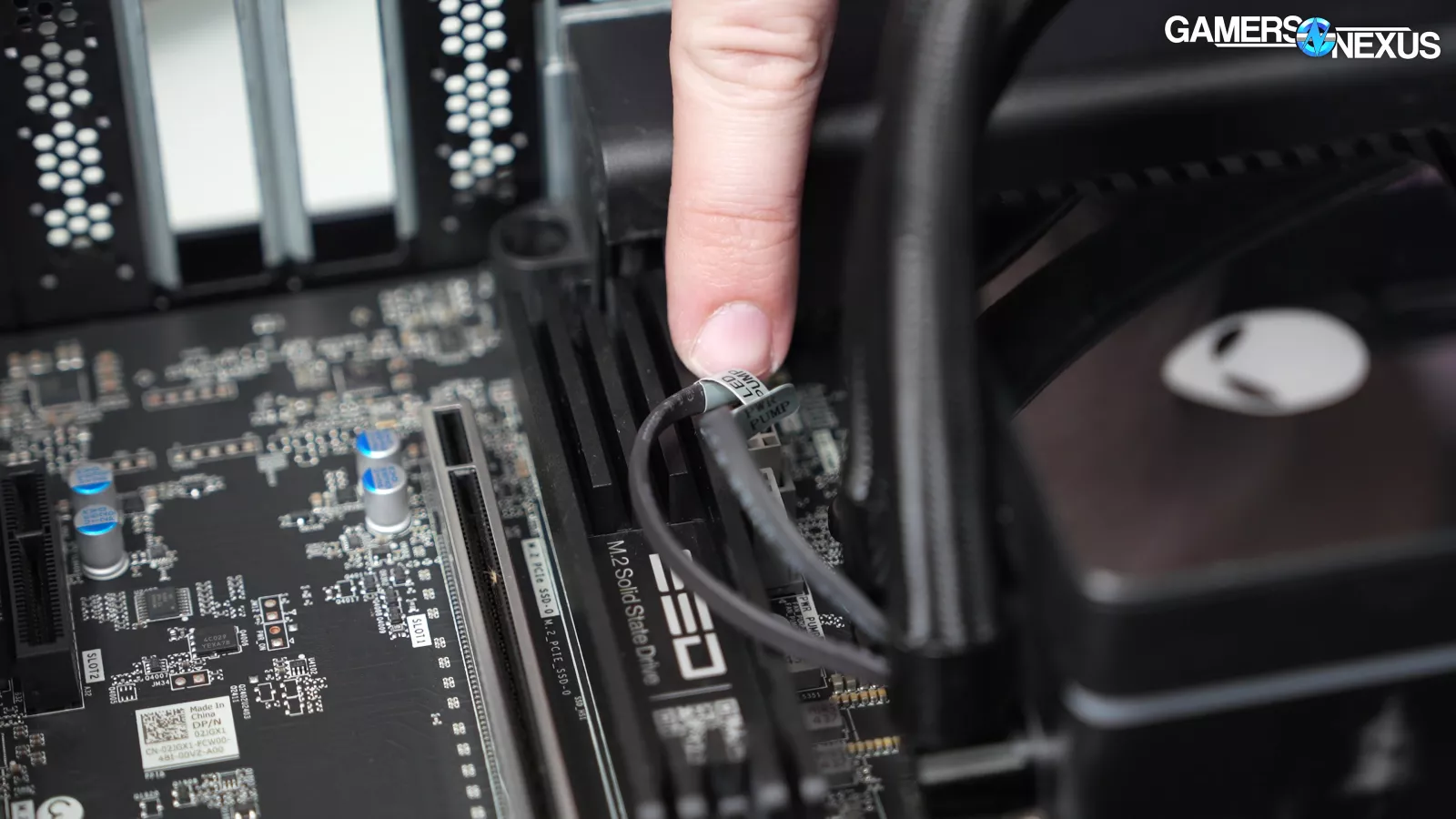
We like how Alienware labeled nearly each single cable.
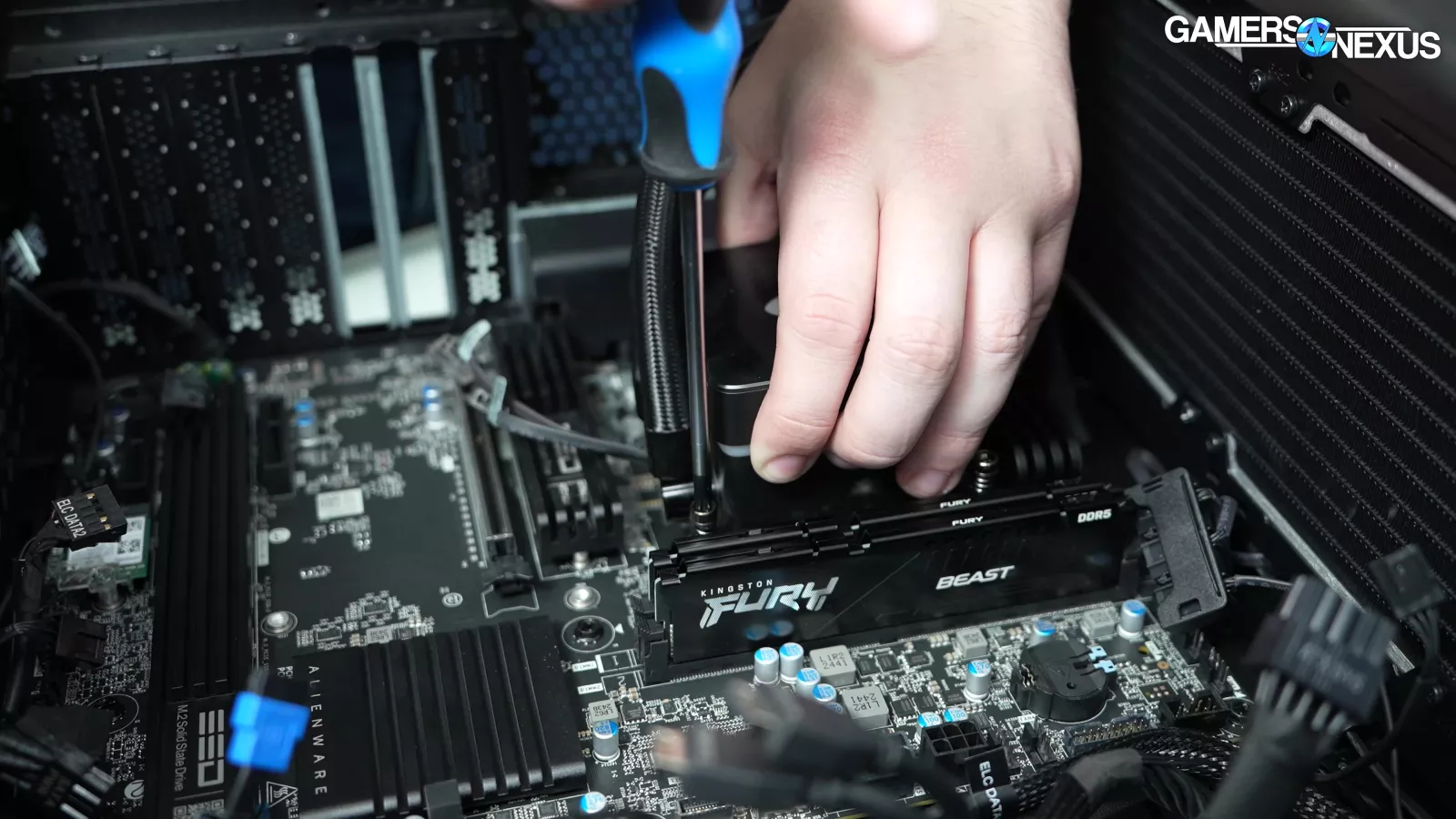
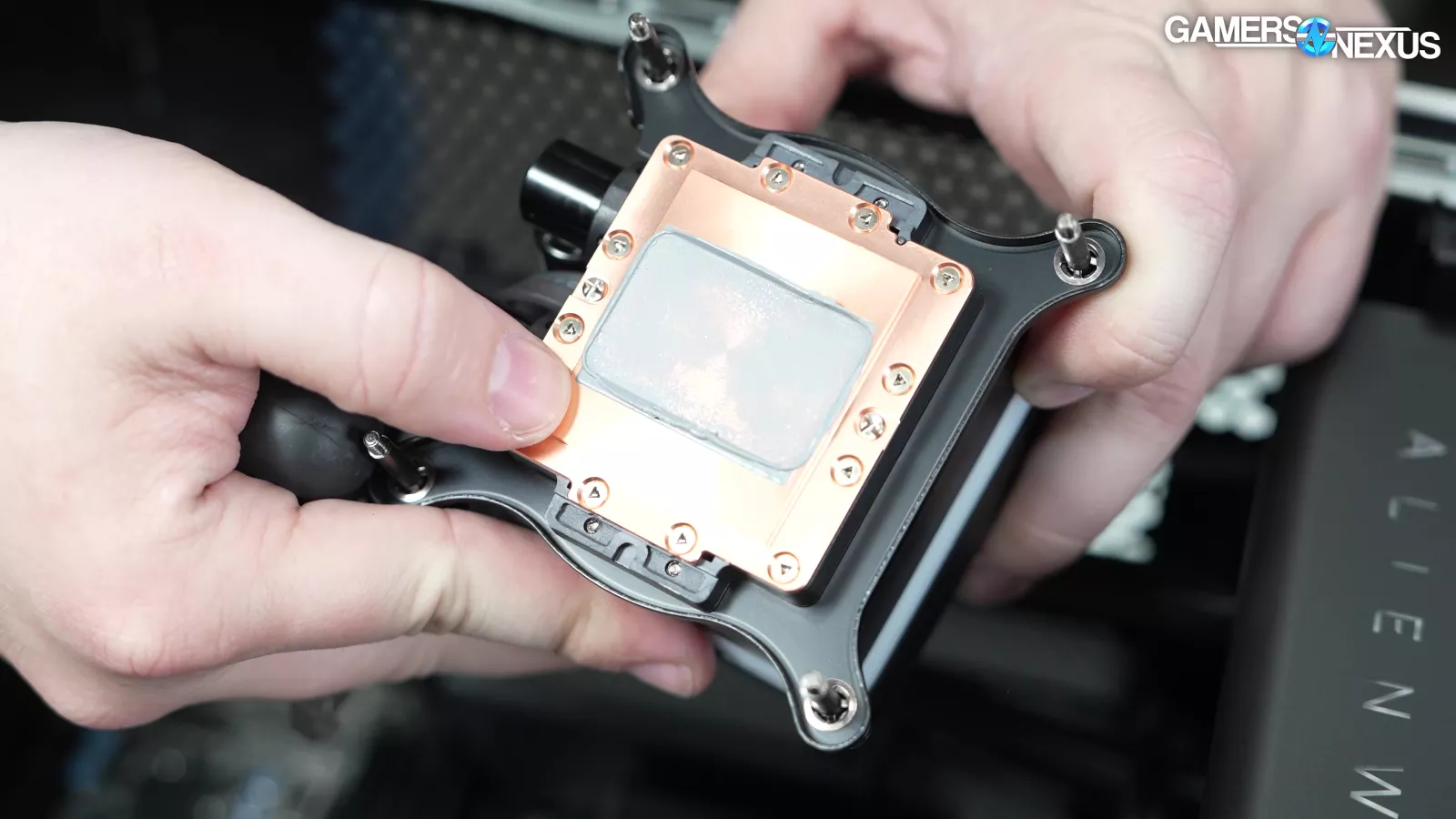
Eradicating the pump block, we will see a thermal pad was utilized beneath. The paste sample is a bit missing in spots.
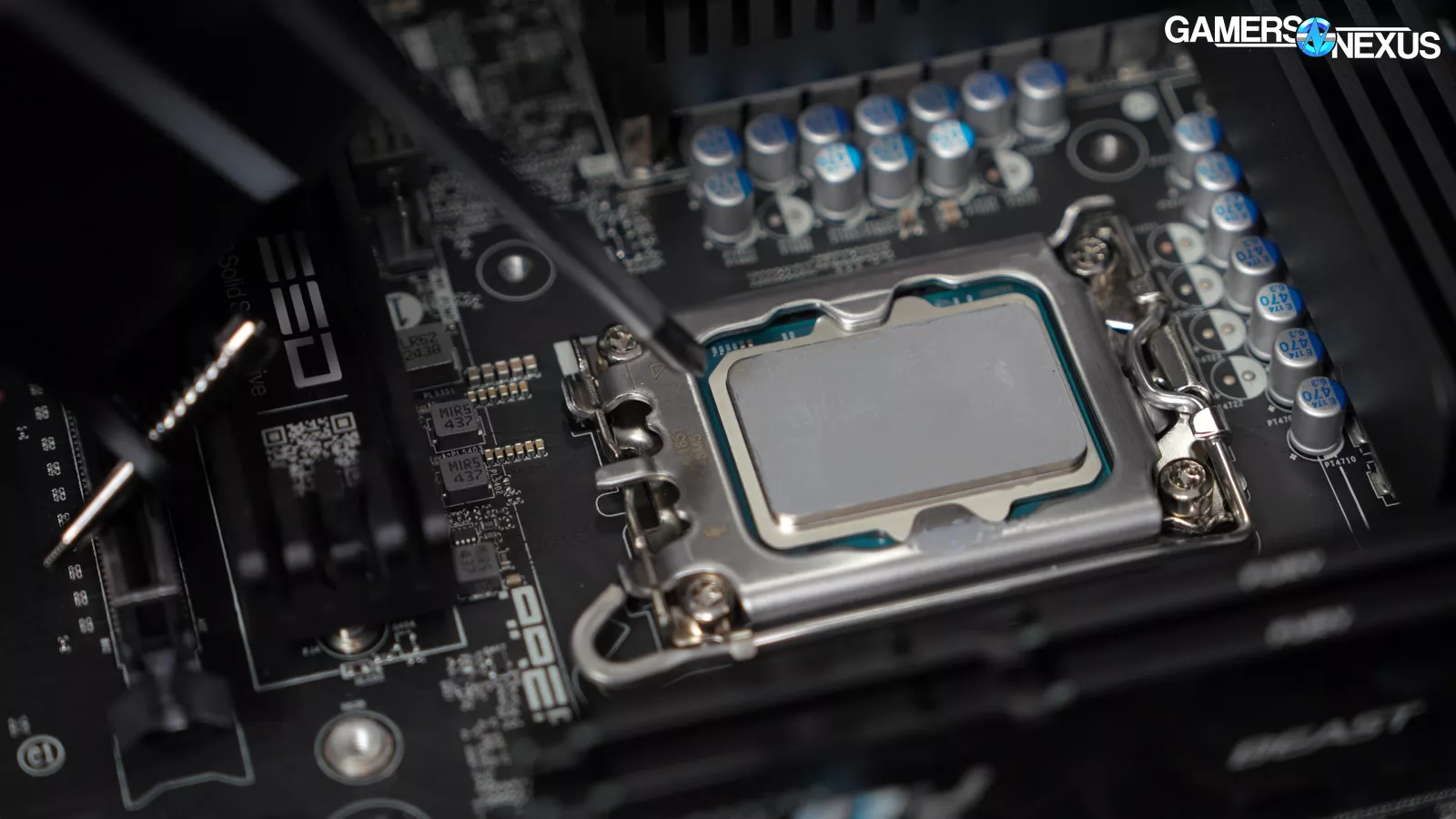
On the CPU facet, we observed a slight hole in protection on one of many corners, however that’s an okay spot. Total, it appears to be like good.
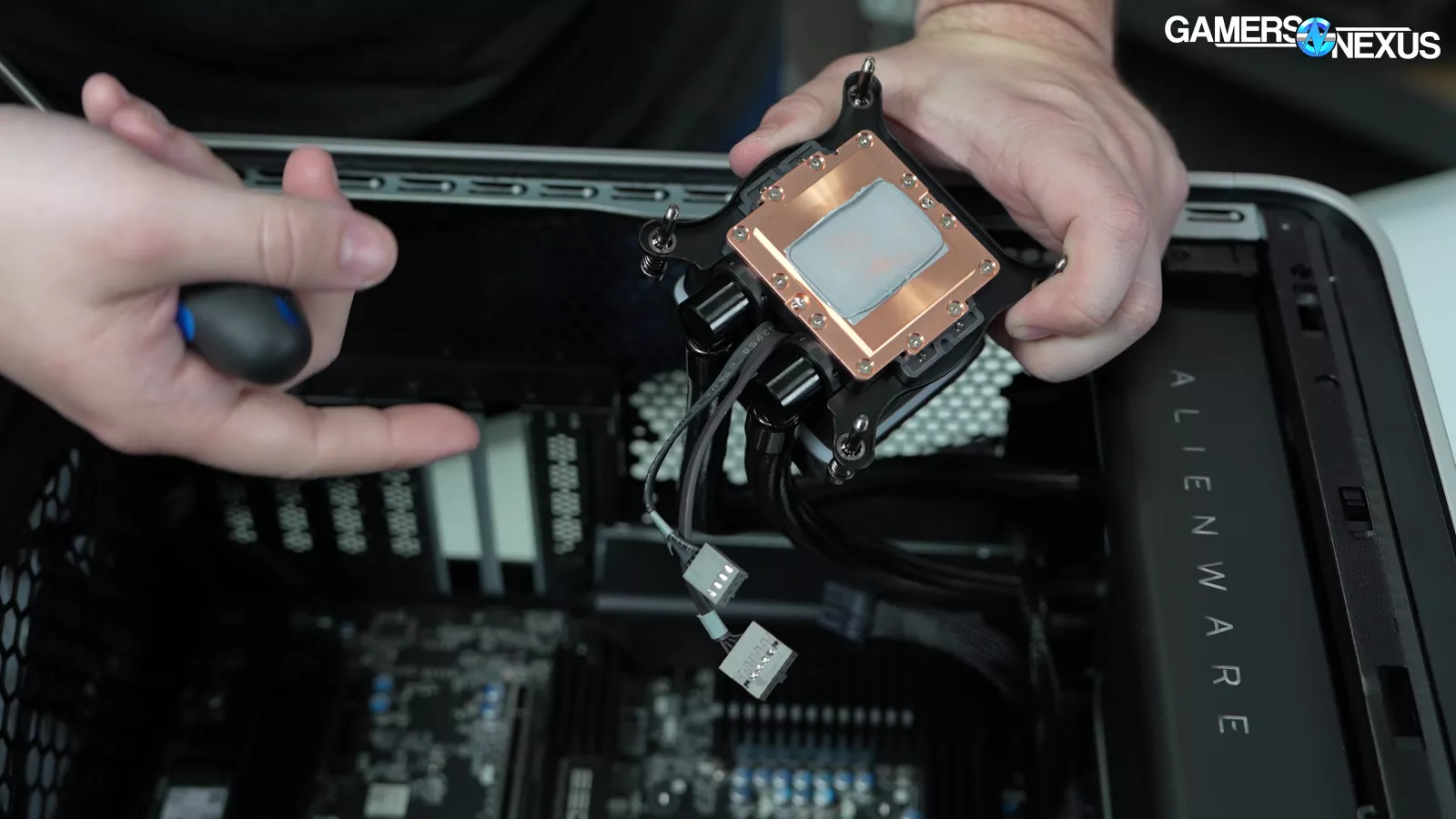
We additionally like how water block’s cables have been stored brief and run straight into the board, which is a bonus that Dell has.
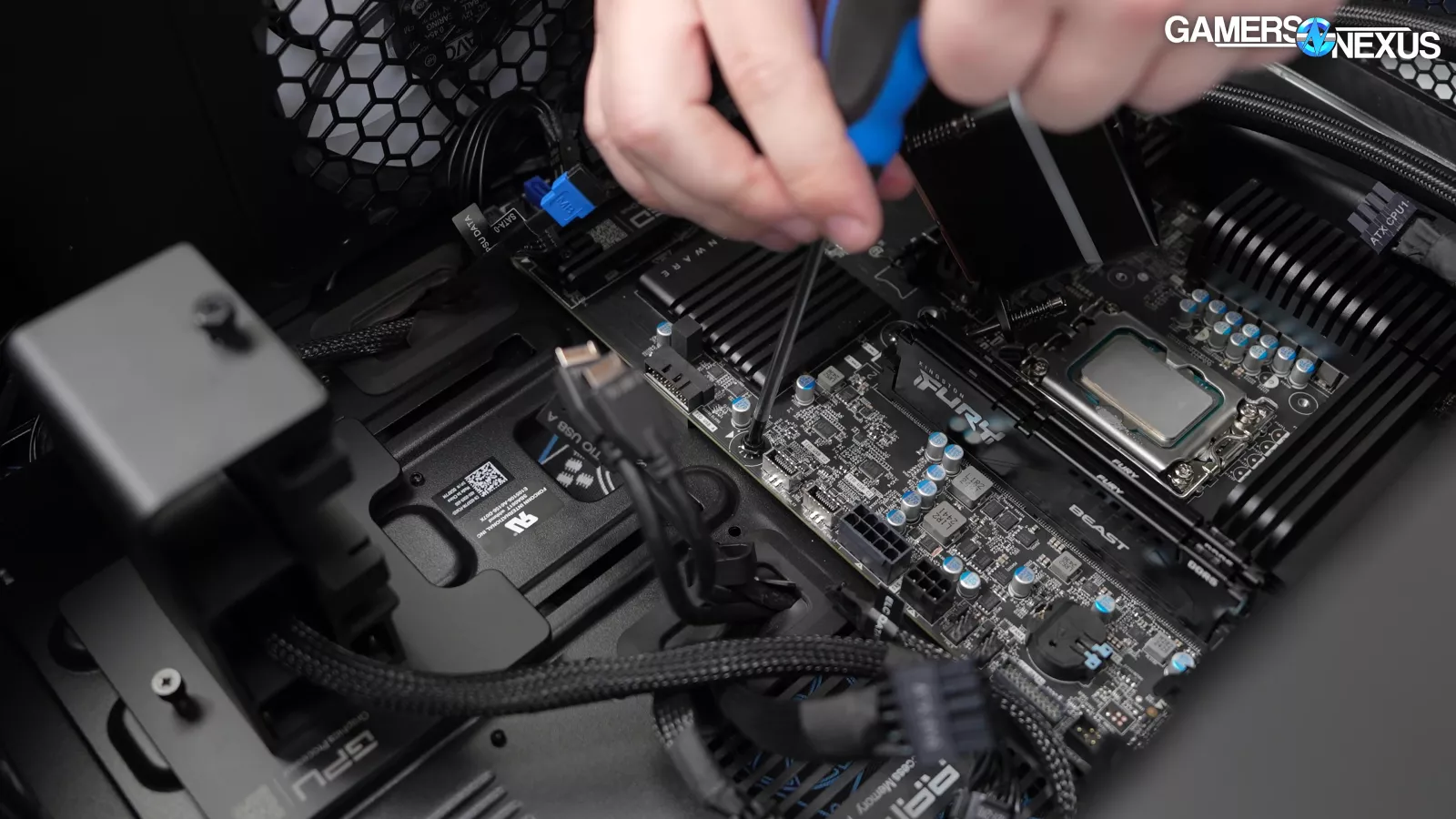
Eradicating the screws from the motherboard, we found one which wasn’t all the way in which in.
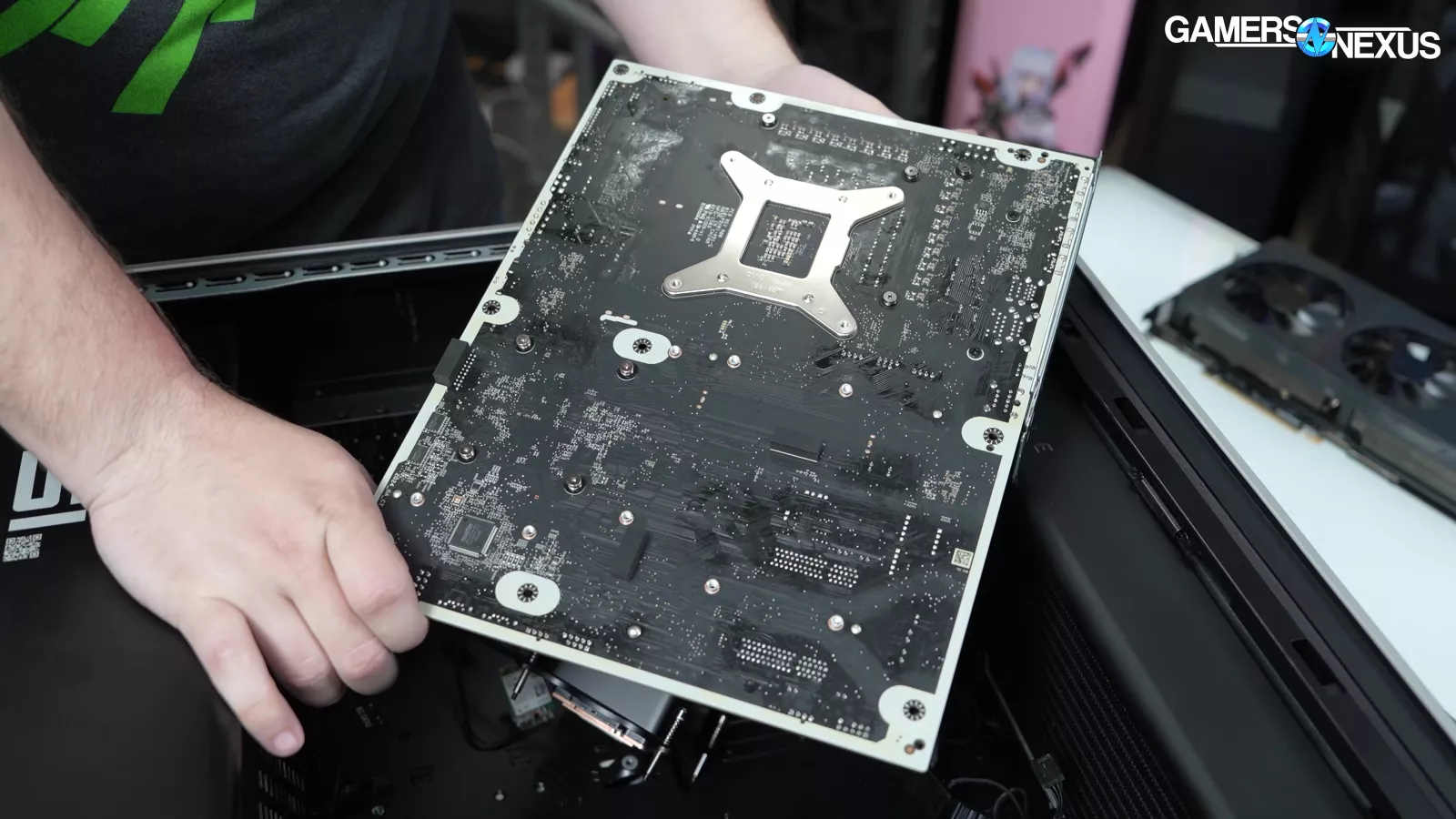
Lifitng the motherboard out of the case, we observed that it was sticky on the again, which signifies that it wasn’t totally cleaned. It shouldn’t harm something, however it’s sort of ugly.
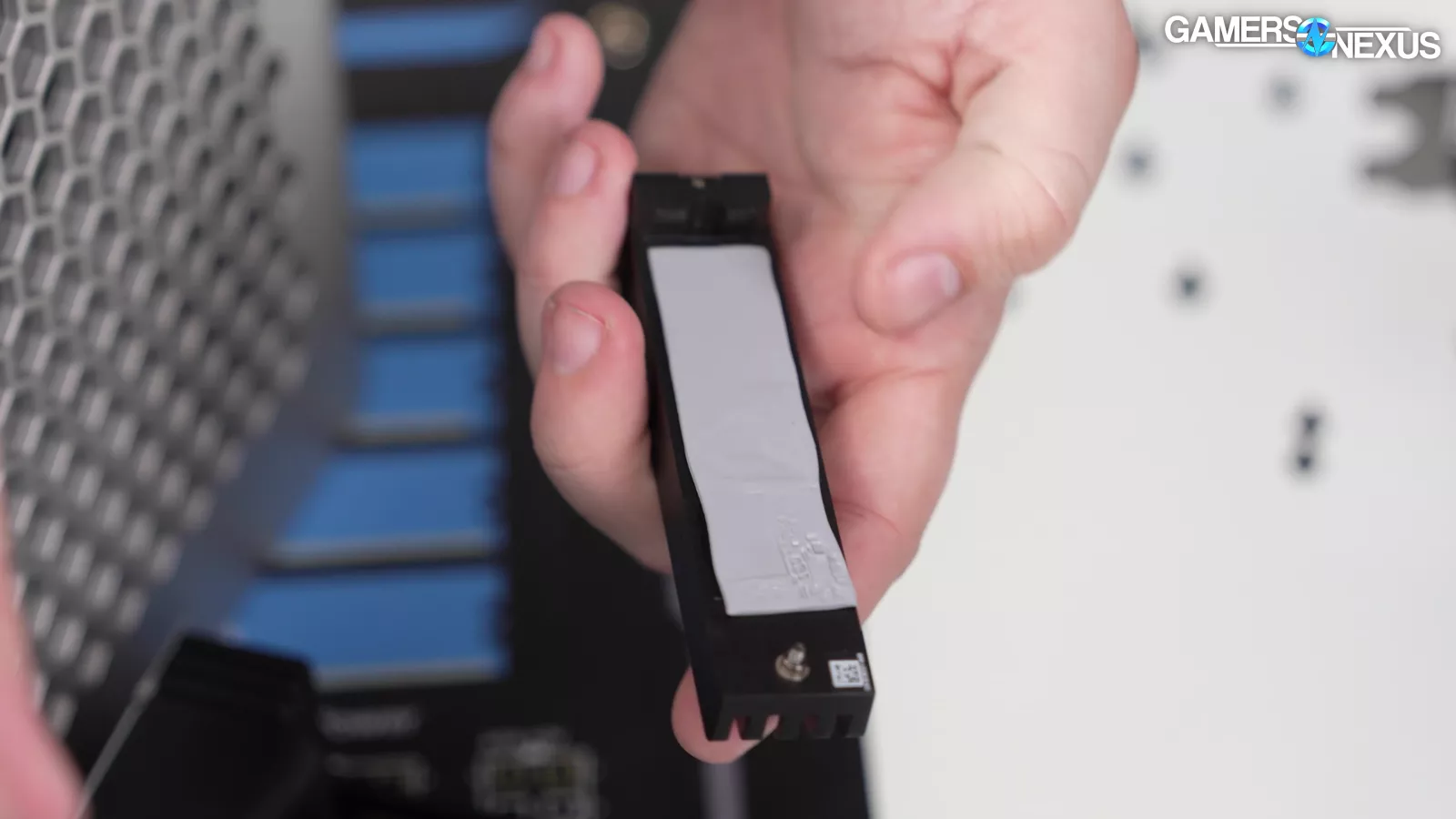
Eradicating the warmth sink off of the SSD and having a look at its thermal pad seemed good as there was no tape on it.
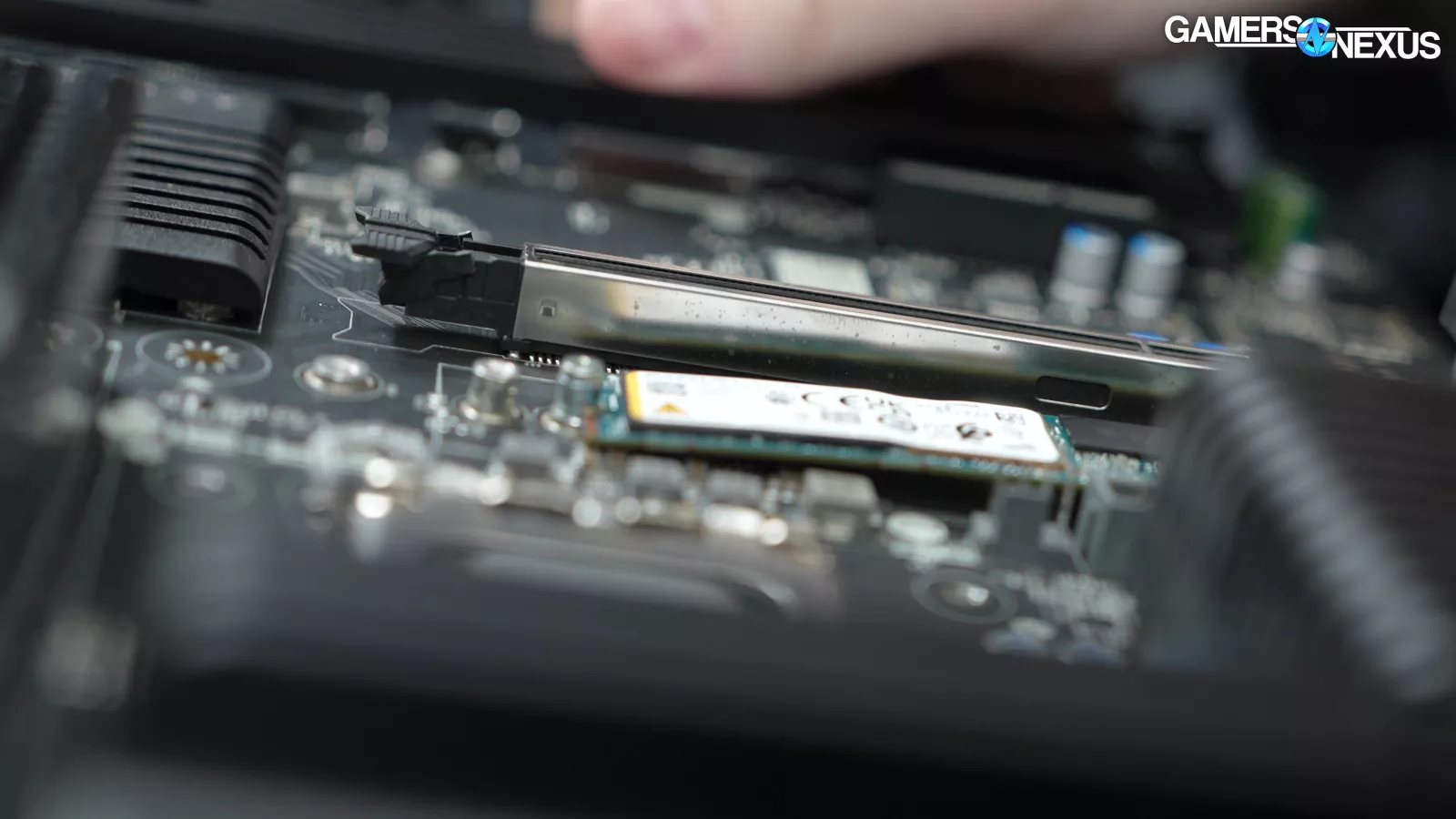
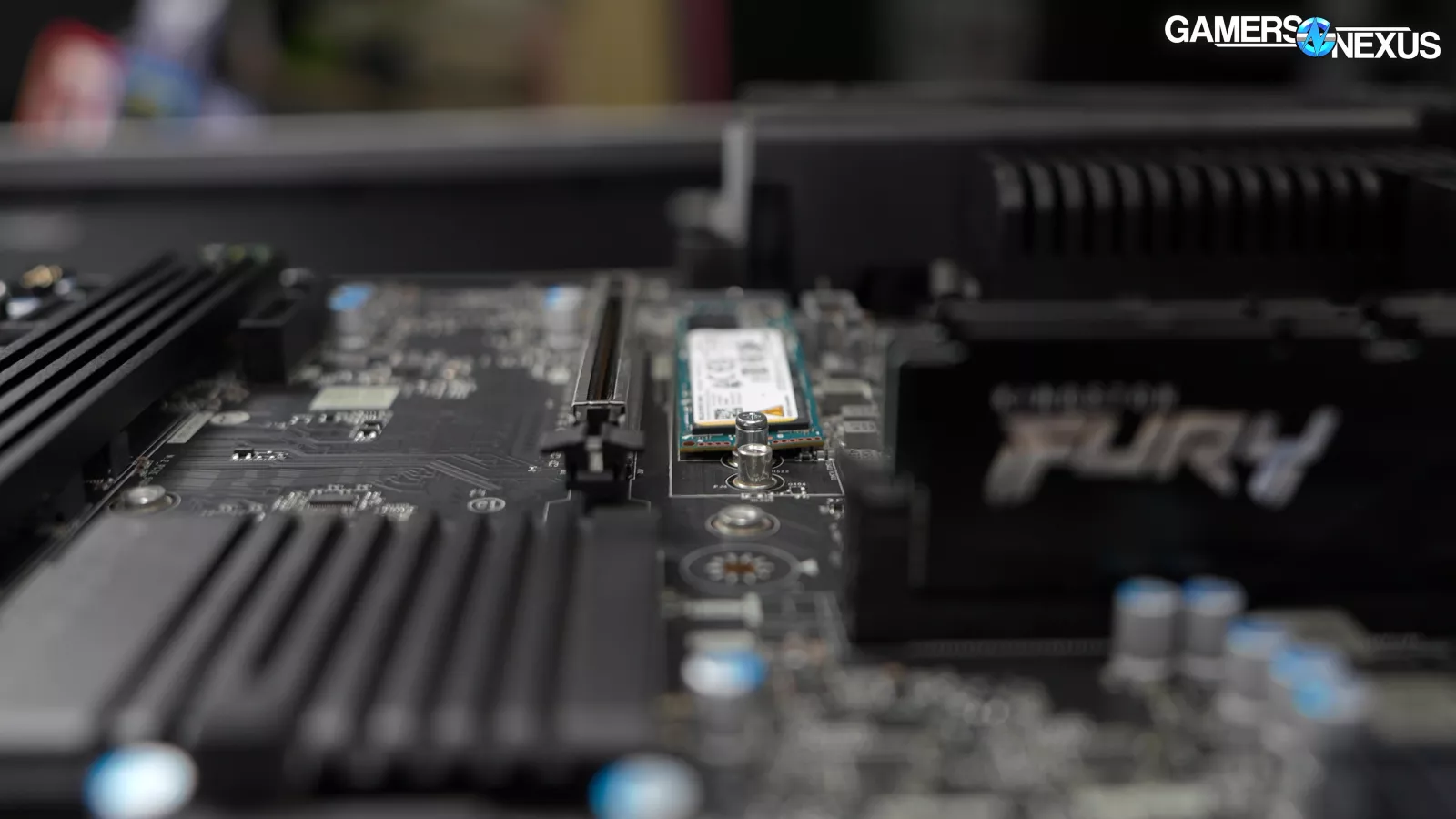
Looking on the SSD itself, that didn’t look nice because it was bent. Alienware is fortunate it didn’t snap the SSD. That is disappointing as a result of the corporate was doing comparatively effectively up till this level. Taking the drive out, it maintains its very slight arc in consequence.
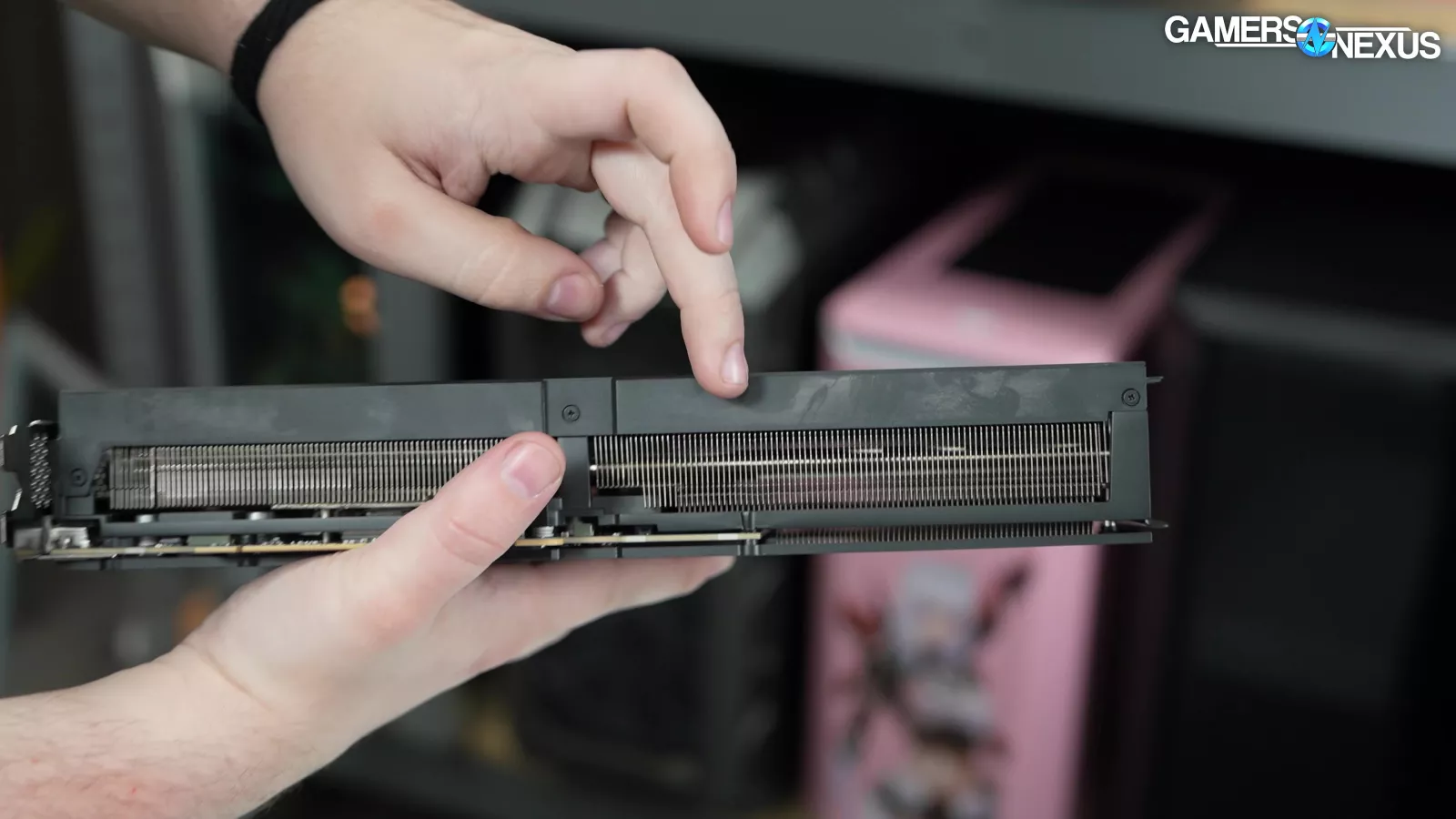
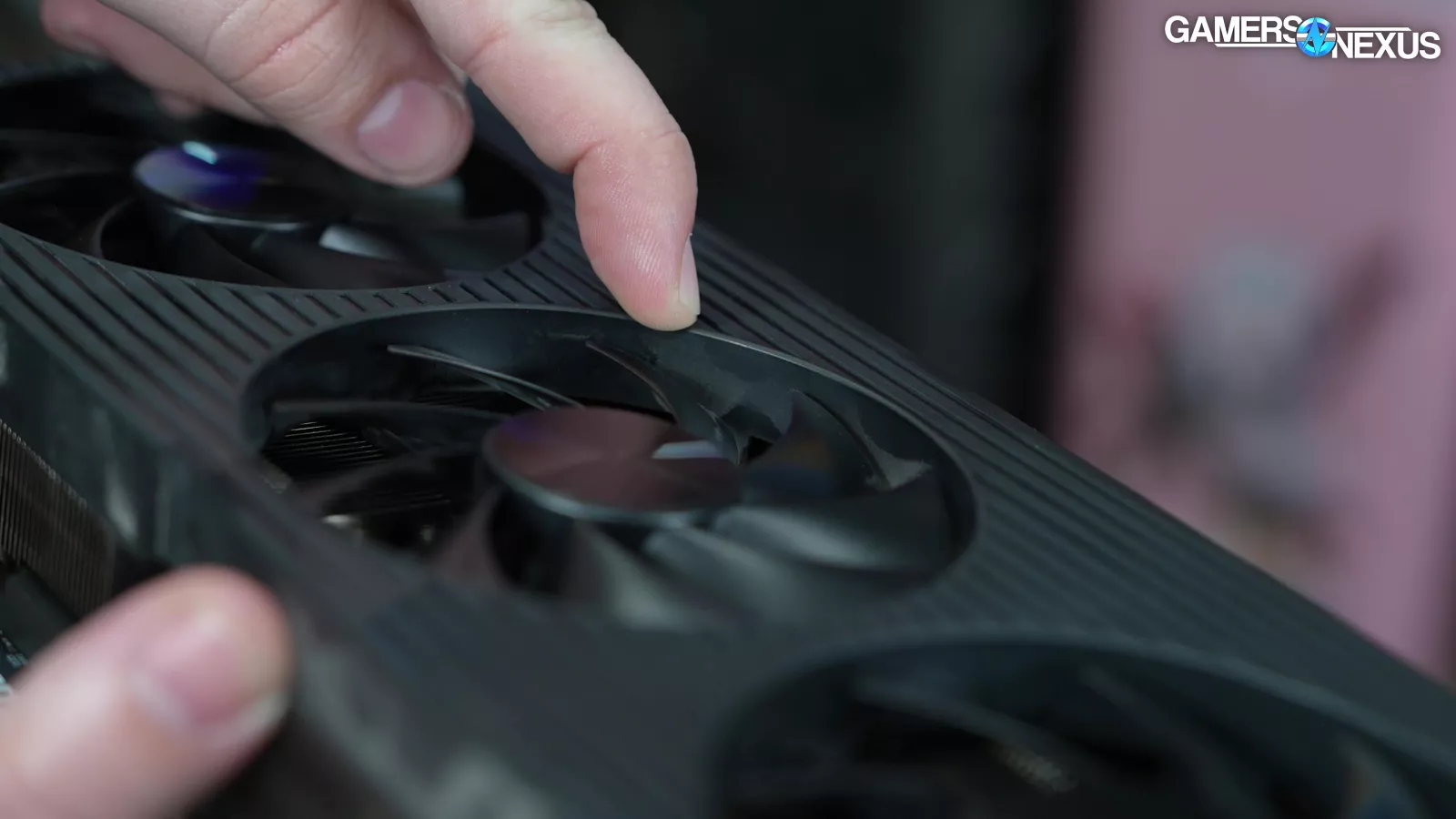
Taking one other take a look at among the elements, there was quite a lot of manufacturing facility mud contained in the system.
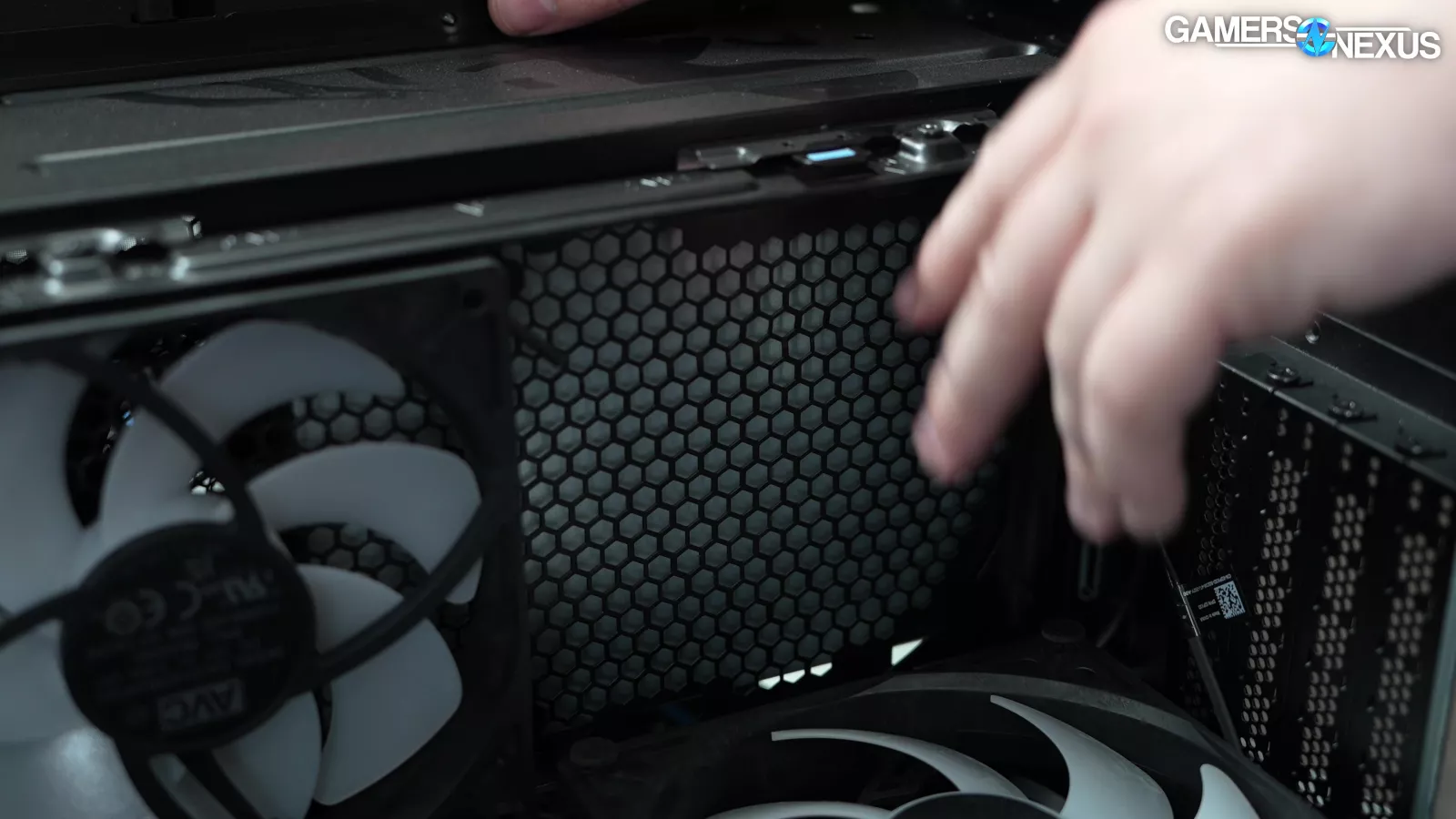
Opening up the PSU shroud enclosure, and eradicating the back-most fan, we will see it doing functionally nothing because it’s proper up in opposition to the facility provide. The case’s 2 grills additionally add impedance as effectively. Wanting on the backside of the system, there isn’t quite a lot of room for air to return up by way of.
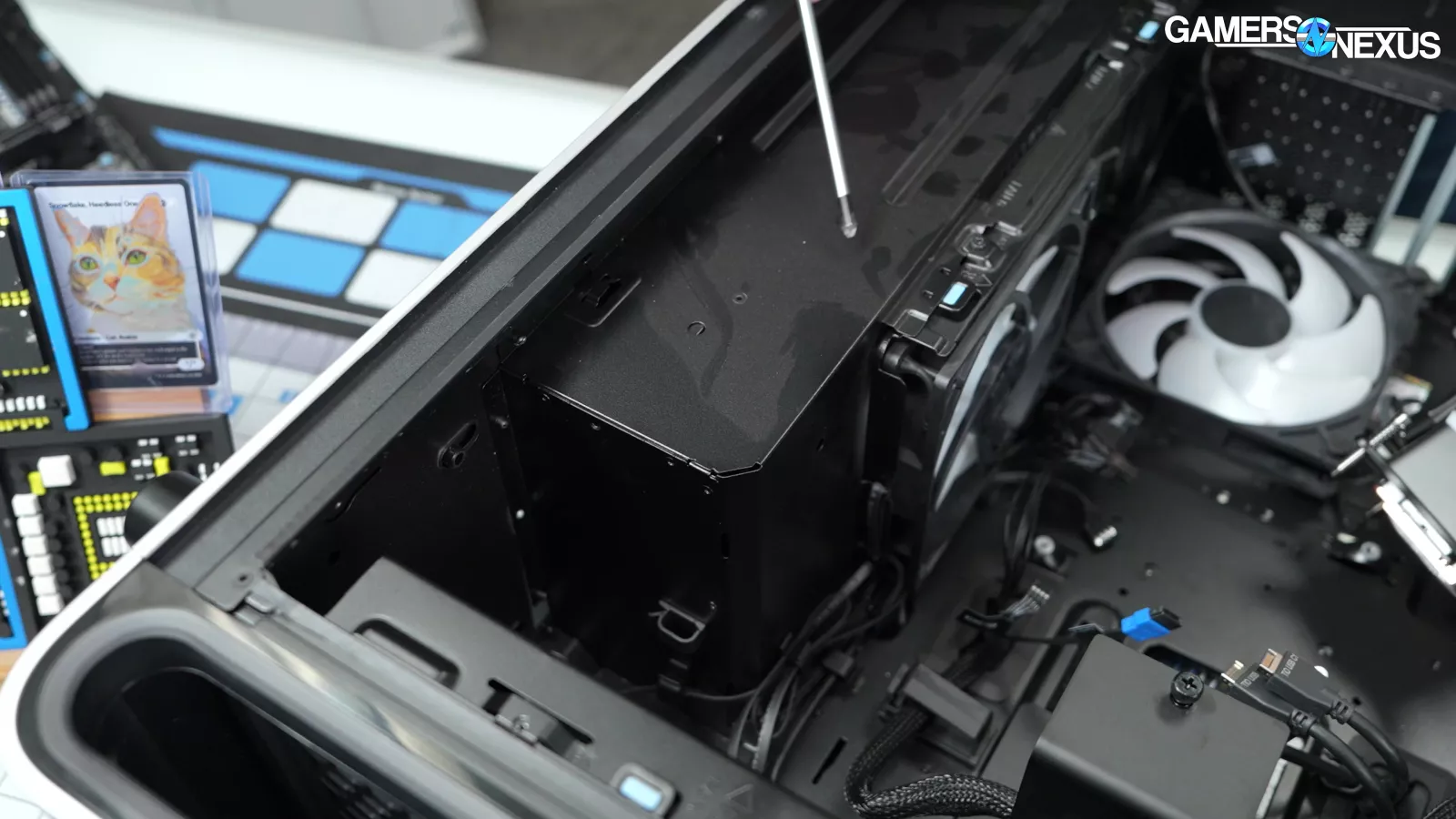
We additionally observed much more manufacturing facility mud.
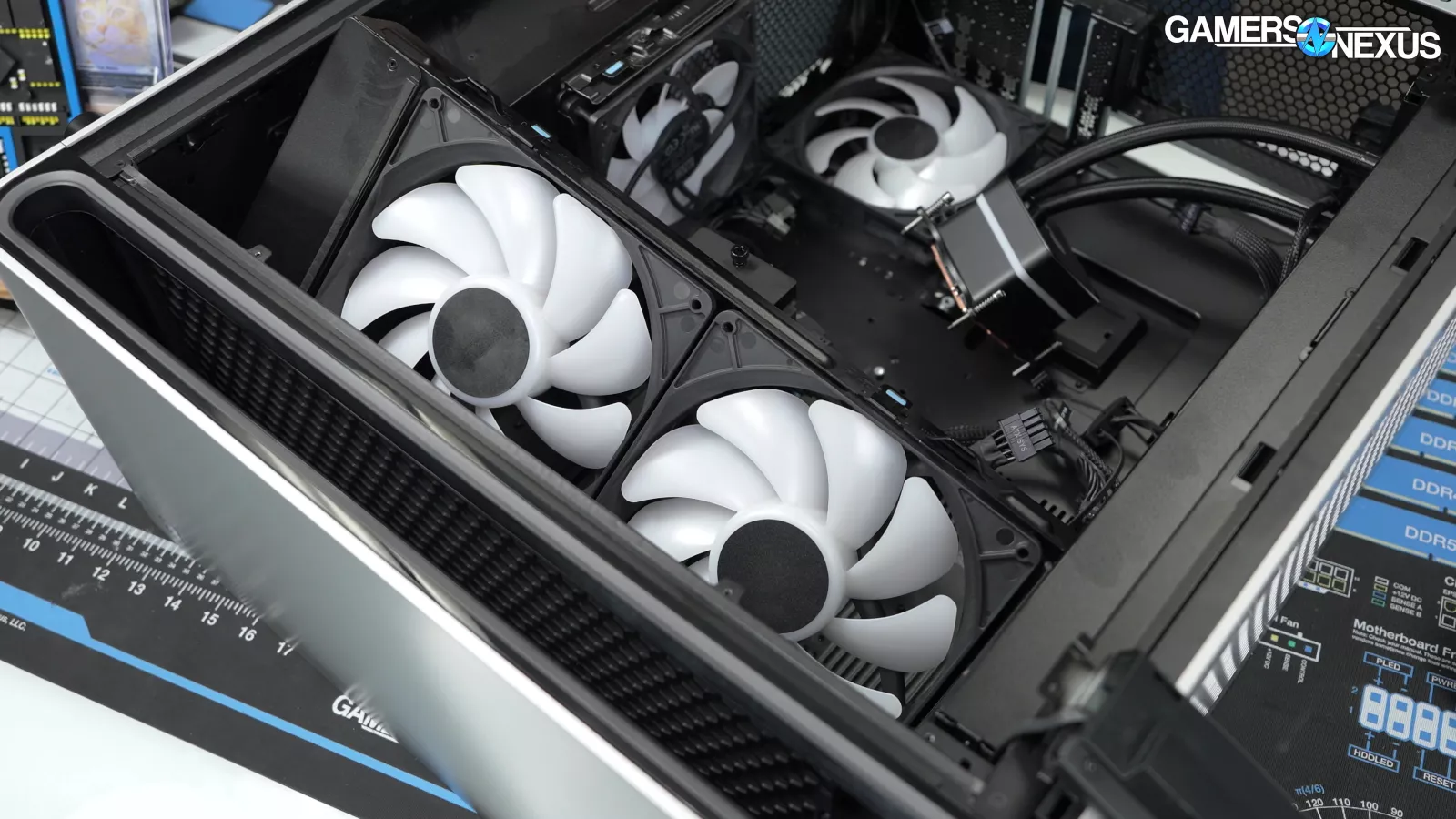
We took the highest radiator followers out and measured them at 38mm, that are fairly thick.
Alienware Space-51 Upgradeability
Again to the remainder of the assessment:
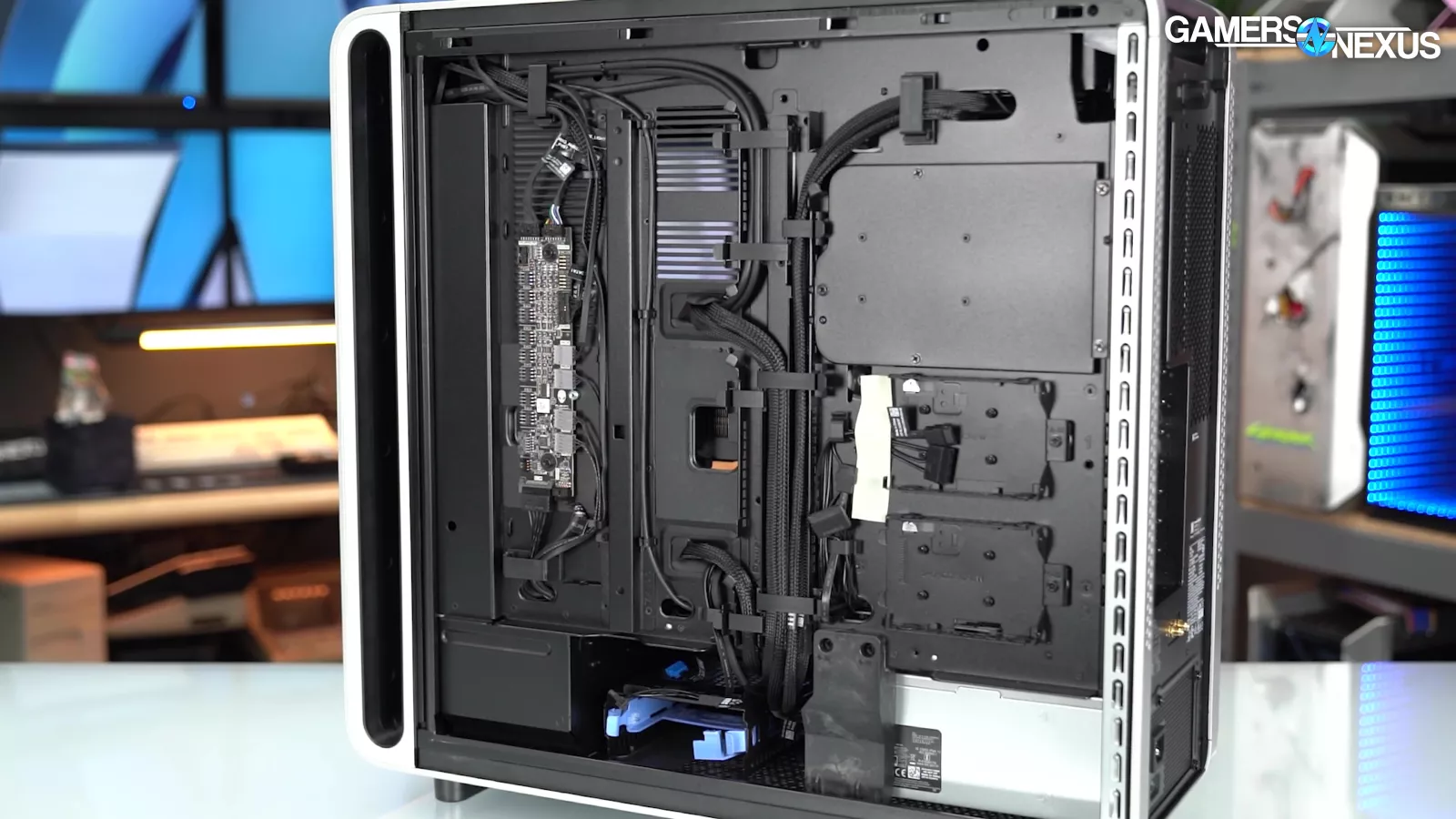
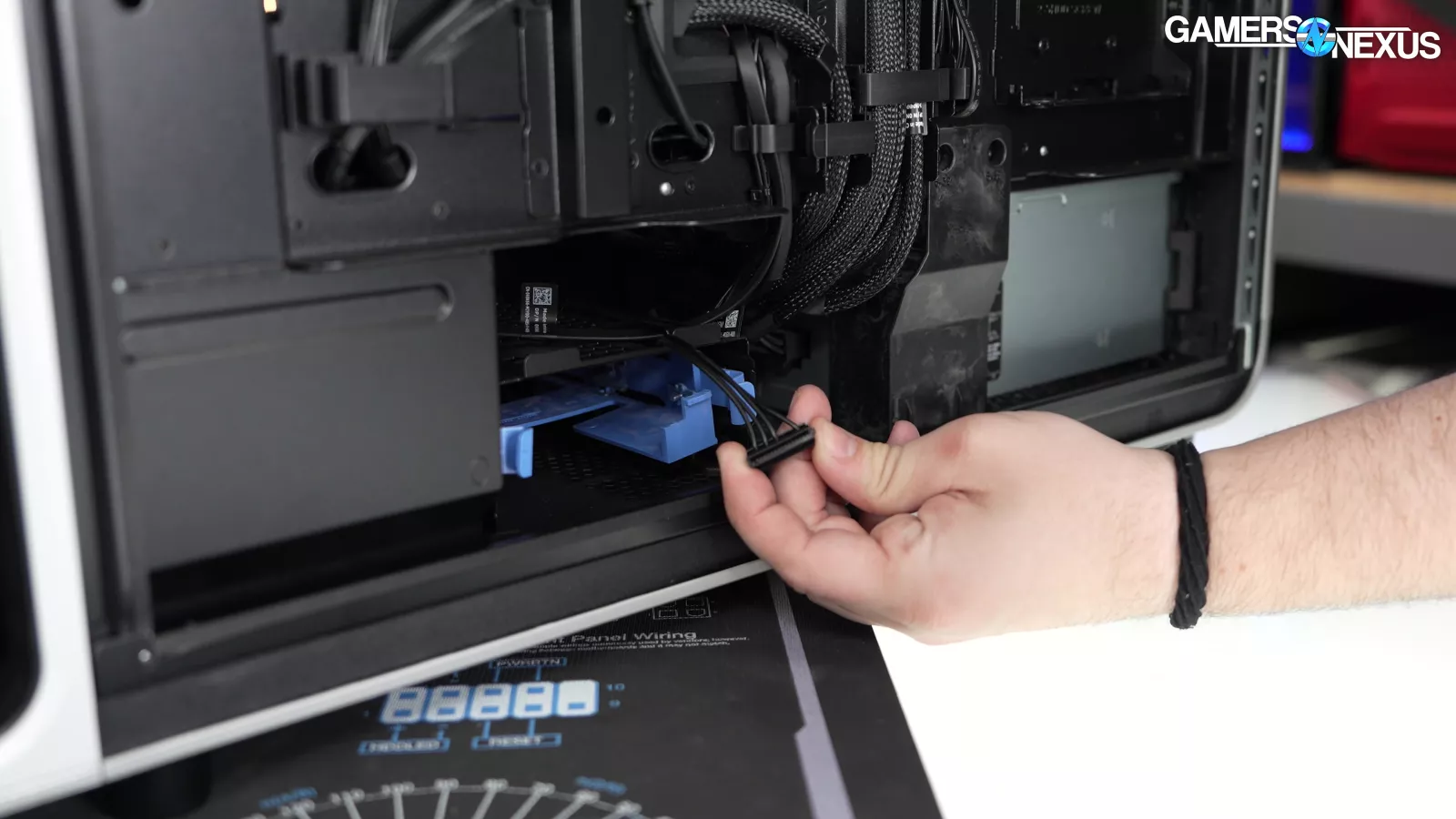
Alienware intends for this era of Space-51 to be expandable and upgradable into the long run. That’s obvious in fast methods just like the empty drive trays below the precise facet panel with pre-routed cables, which is one thing we like.
Sadly, rumors point to LGA1851 being a dead-end platform. If that’s true, there gained’t be any CPU upgrades.
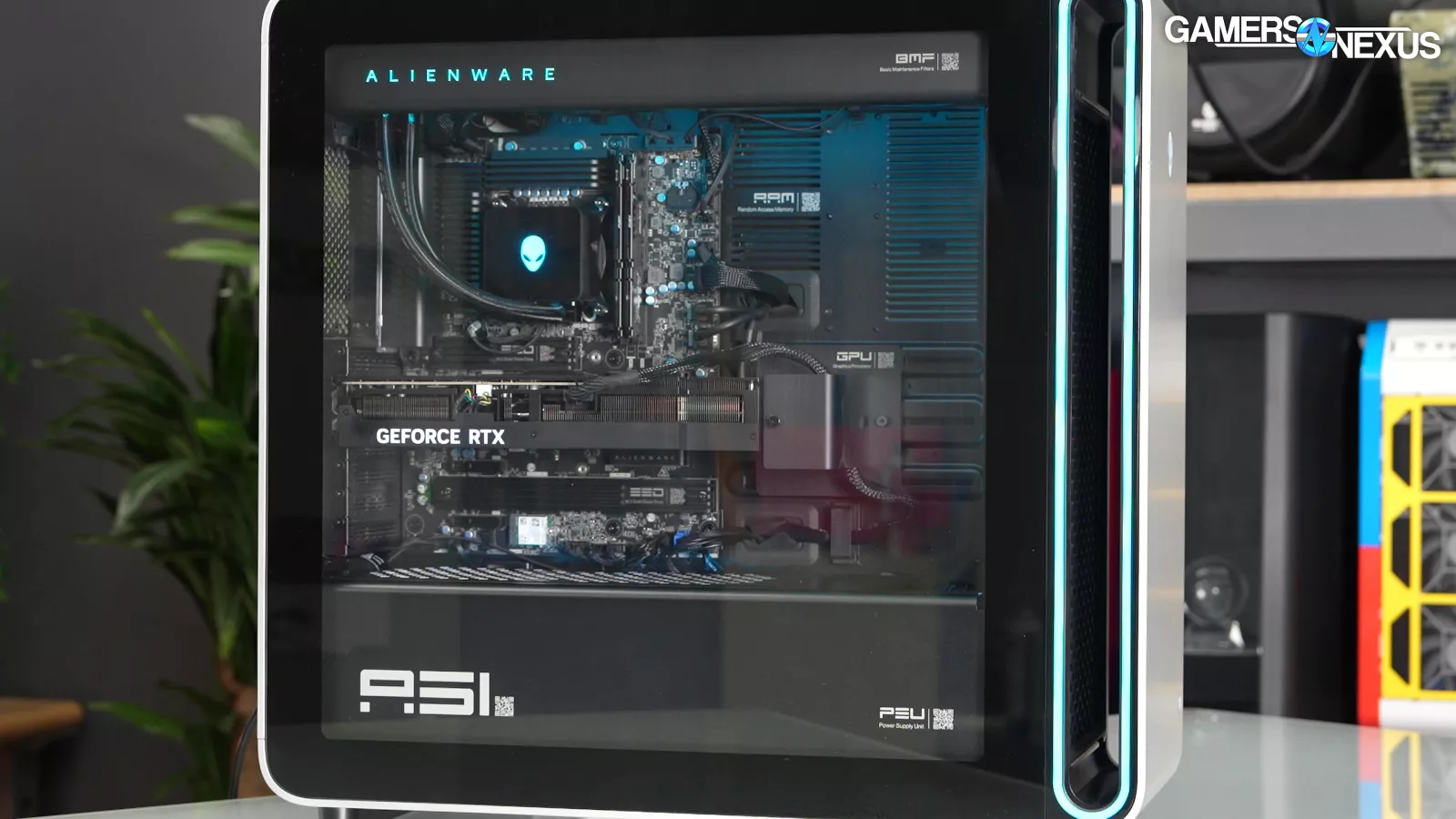
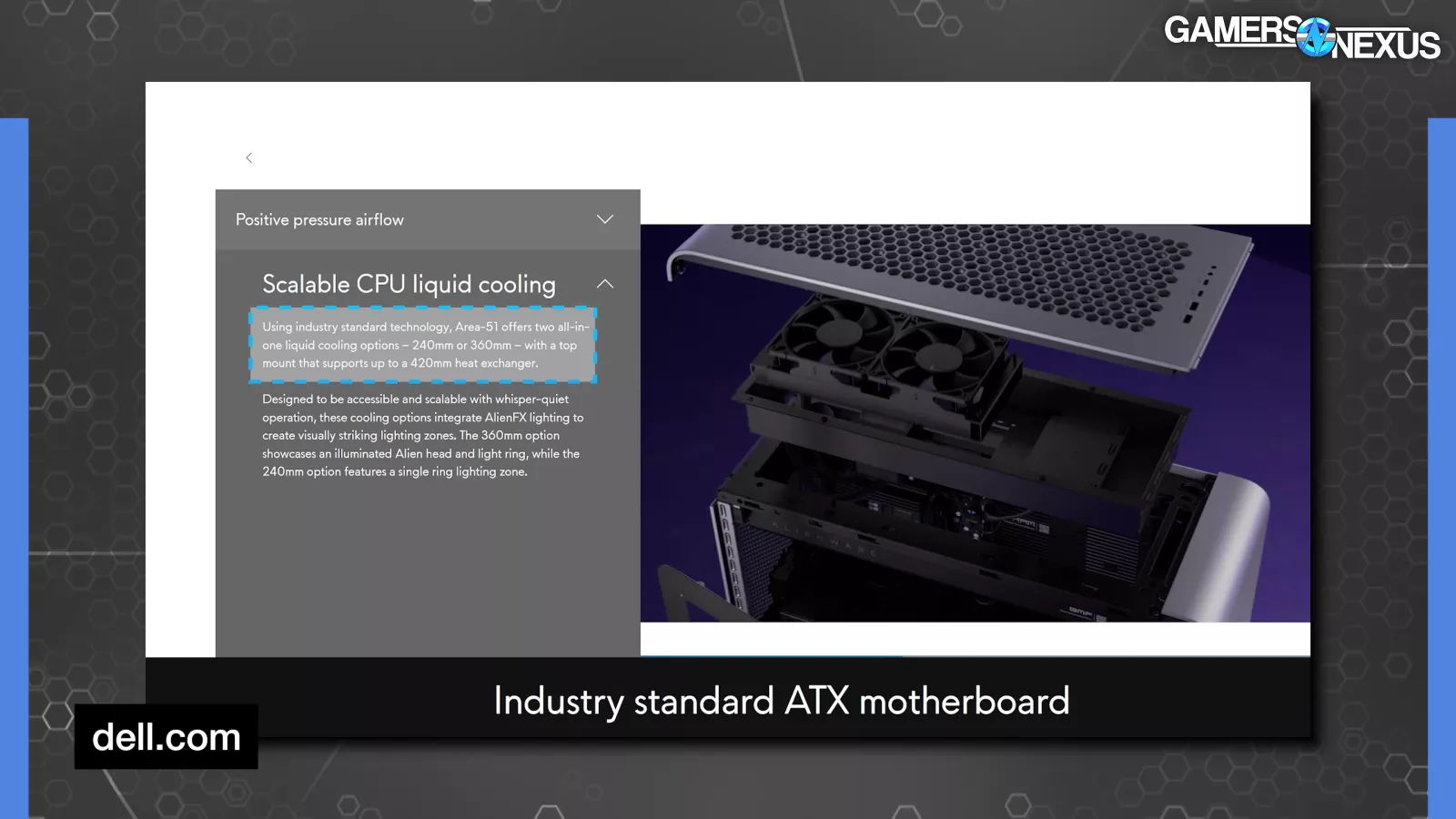
The GPU could be as simple to swap as in any regular PC, and area is plentiful. Alienware additionally claims as much as a 420mm radiator can match within the high of the case.
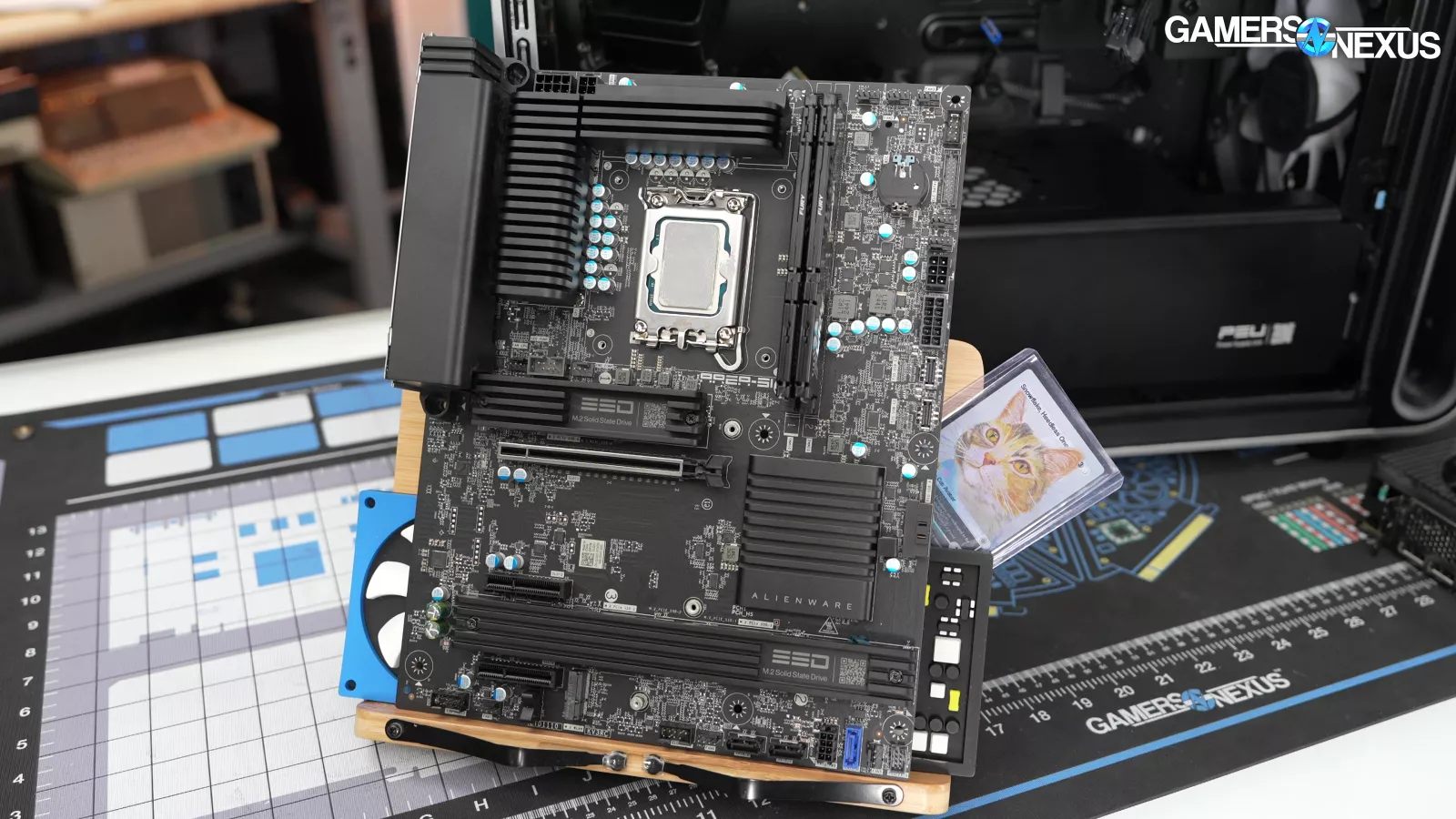
It will get bizarre when contemplating a motherboard swap. Since that is an ATX12VO system, meaning it could both have to be one other ATX12VO motherboard otherwise you’d must additionally swap the PSU, which might be a disgrace. This can be a hen or the egg downside. There aren’t many ATX12VO motherboards within the DIY market, however Alienware additionally isn’t utilizing one thing proprietary. It’s a actual customary. It’s simply not one which’s closely adopted by DIY motherboards.
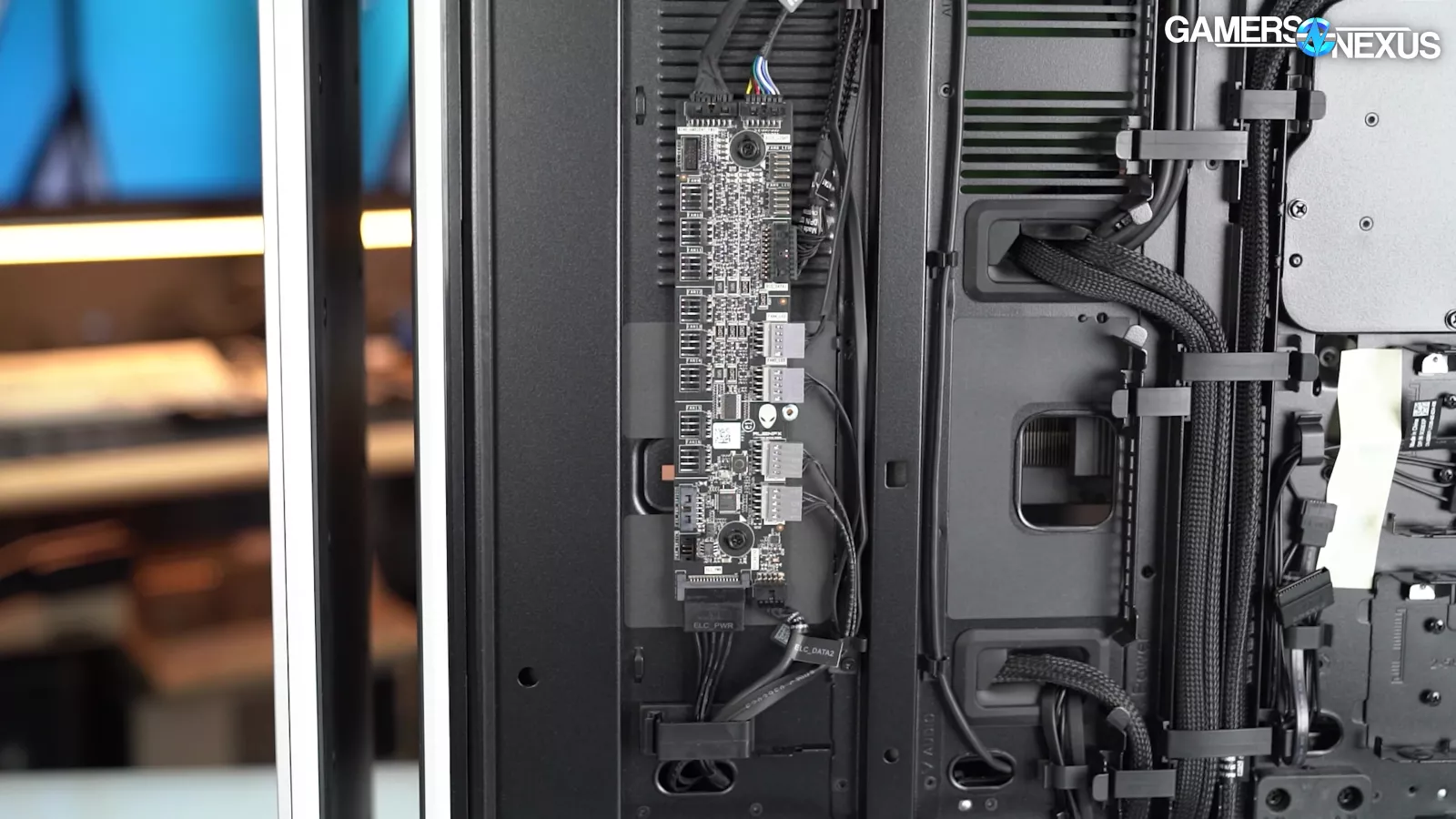
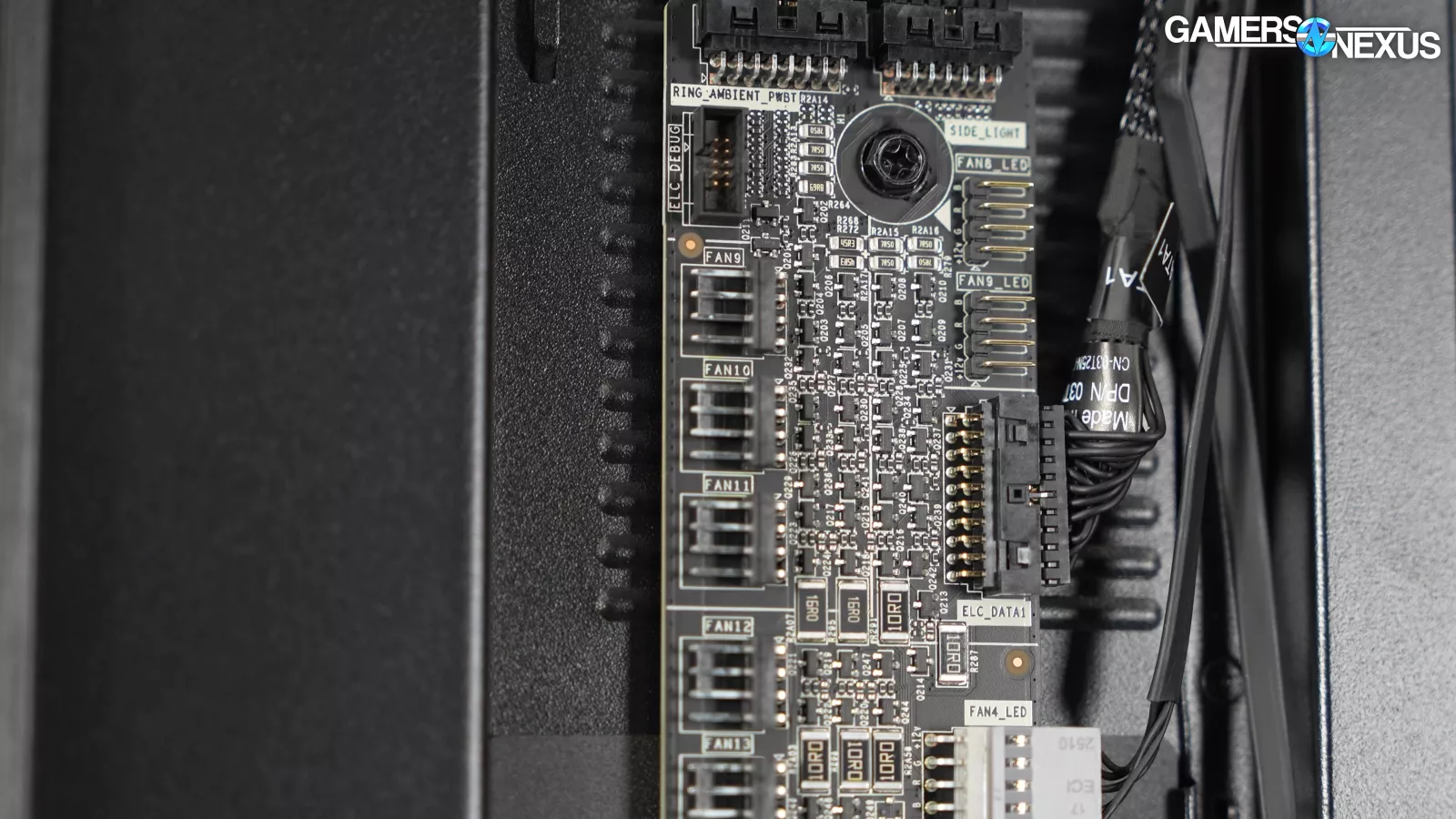
The actually bizarre factor is the so-called “AlienFX board” behind the precise facet panel. It’s a combo platter of fan and light-weight management, together with offering entrance panel connectivity. Nonetheless, it doesn’t even have any followers related to it – they’re all straight related to the motherboard as regular. Alienware’s concept right here, we predict, is that in the event you ever do swap the motherboard, you should buy a conversion kit. That package hooks the AlienFX board to the brand new motherboard, and would then present each mild and fan management through the Alienware software program.
Frankly it appears back-asswards to how we’d assume this is able to go. It might make extra sense to us if the inventory configuration had all of the followers related to the AlienFX board, then a future motherboard swap would simply use the common headers.
So general, the Space-51 is technically upgradeable, it’s simply in a distinct segment tech-tree with a doubtful future.
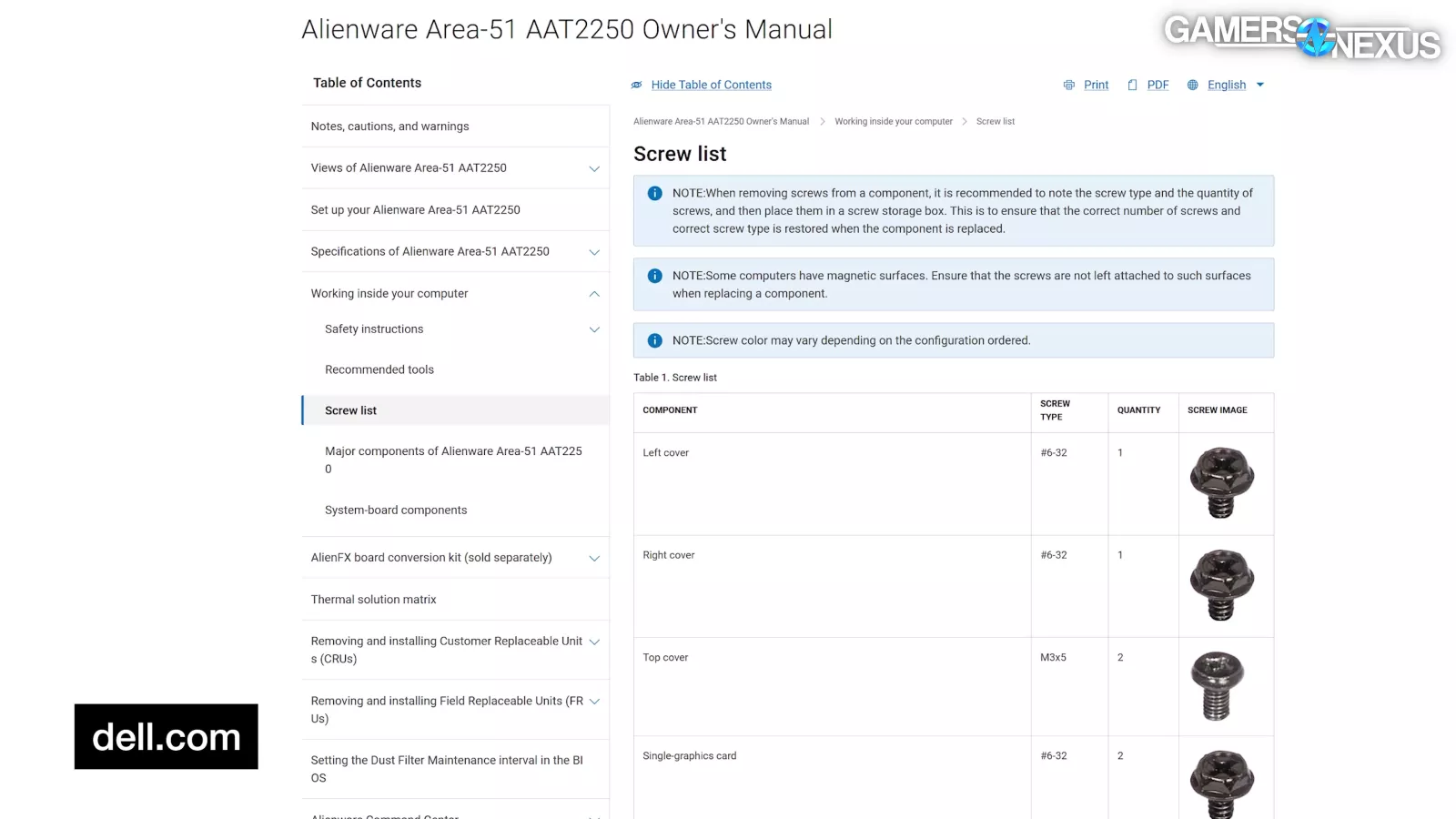
The case can also be coated in a minimum of 7 QR codes that hyperlink to varied sections of the manual. It’s detailed, together with this cool exploded diagram of the system and a dedicated screw list. Alienware is definitely making progress right here. Utilizing ATX12VO and LGA1851 is a limiter, however the elements are customary, and that’s a giant enchancment over the proprietary crap they’ve used prior to now.
Intro to Charts
Let’s get into the benchmarks.
CPU Thermals – Regular State – Alienware Management
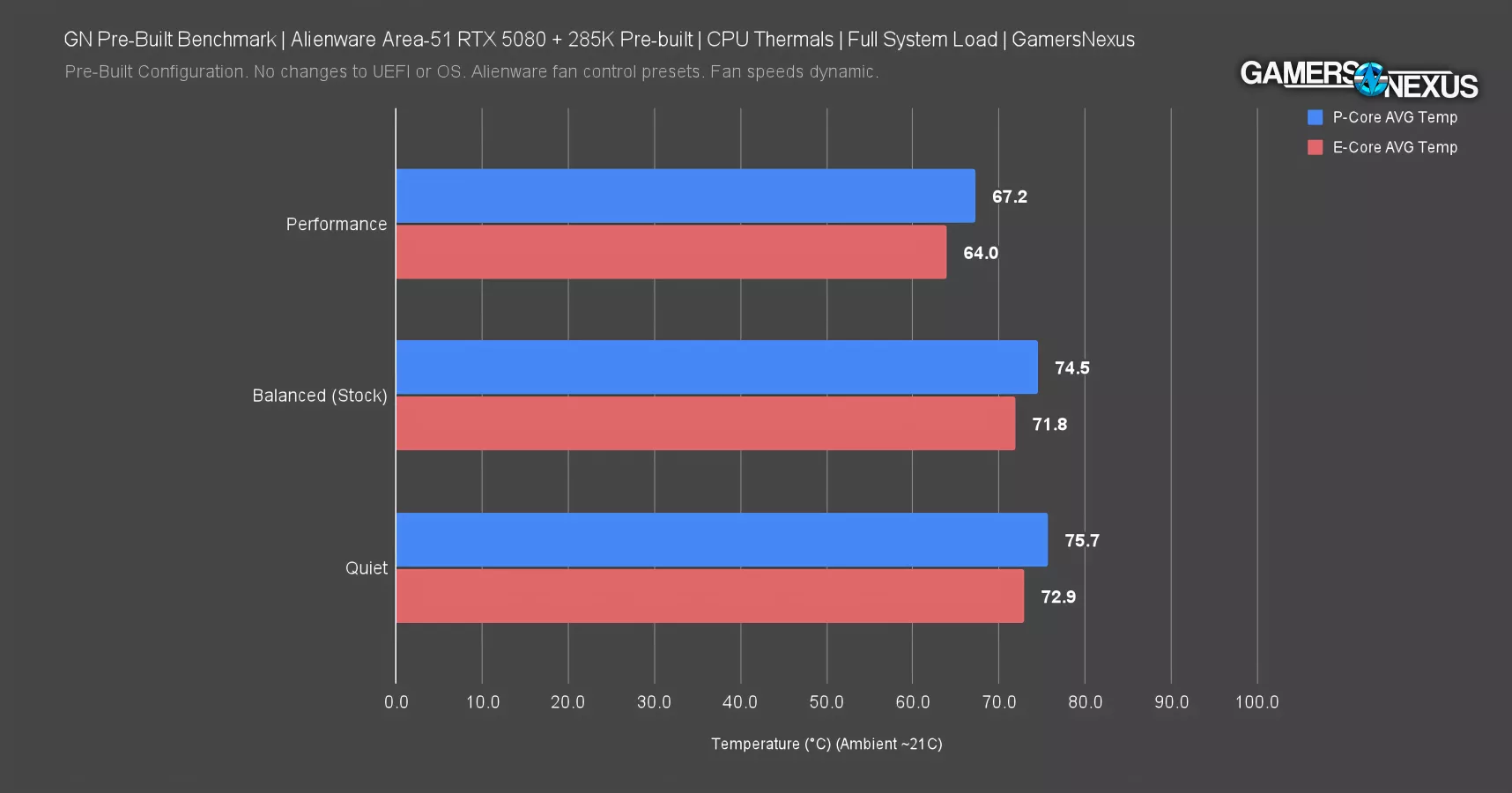
We’re beginning with CPU thermals at regular state. The Efficiency fan preset resulted in an enormous temperature discount versus the opposite choices of seven.3 levels Celsius on the P-cores versus the inventory Balanced preset at 74.5C. The Quiet preset didn’t change a lot and was roughly 1 diploma hotter than Balanced.
E-cores common and observe the identical sample.
GPU Thermals – Regular State – Alienware Management
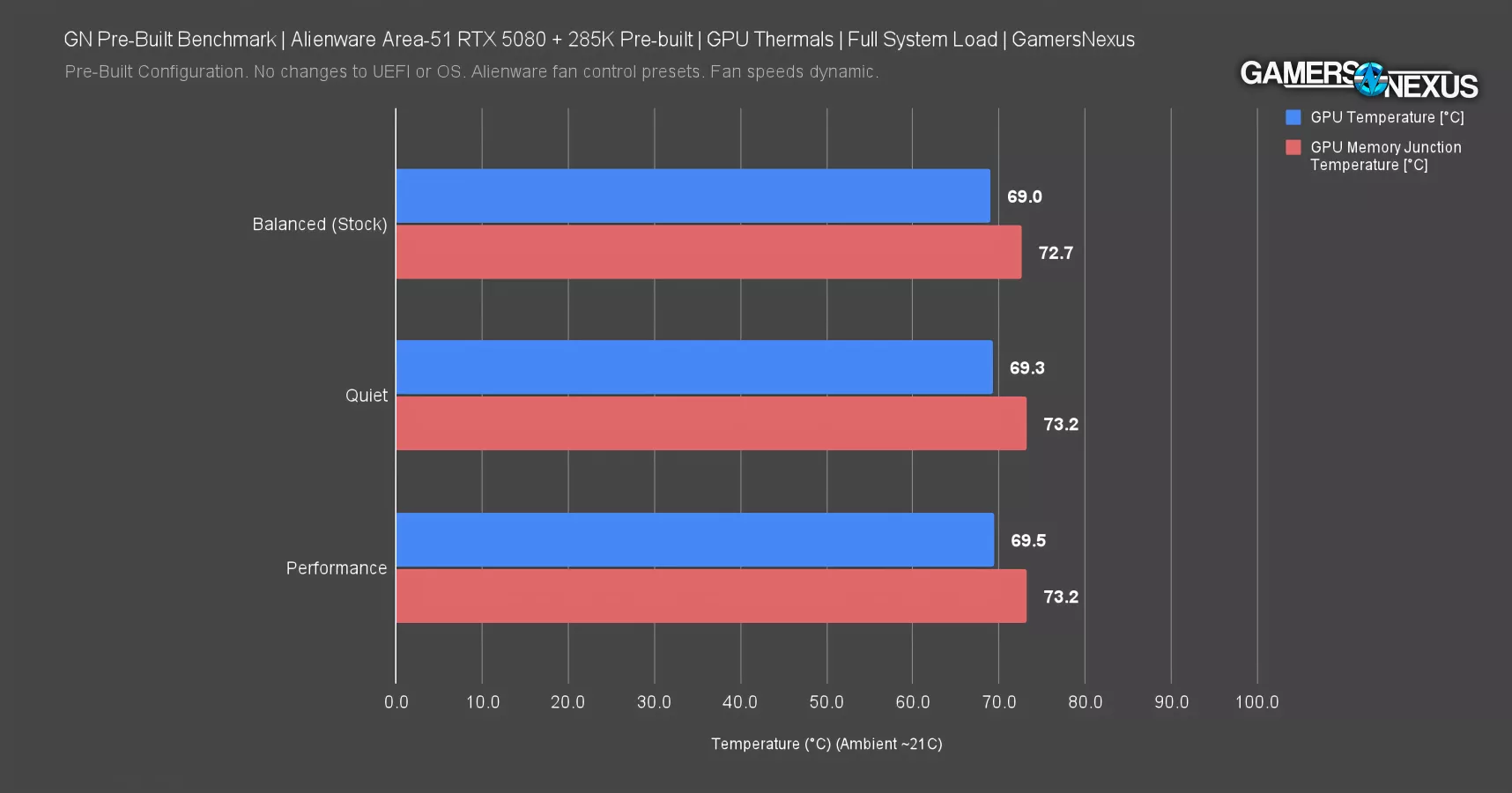
GPU thermals below computerized fan management are just about a wash and illustrate NVIDIA’s upkeep of a goal temperature from VBIOS.
GPU Thermals vs. Fan Velocity – Over Time – Alienware Management
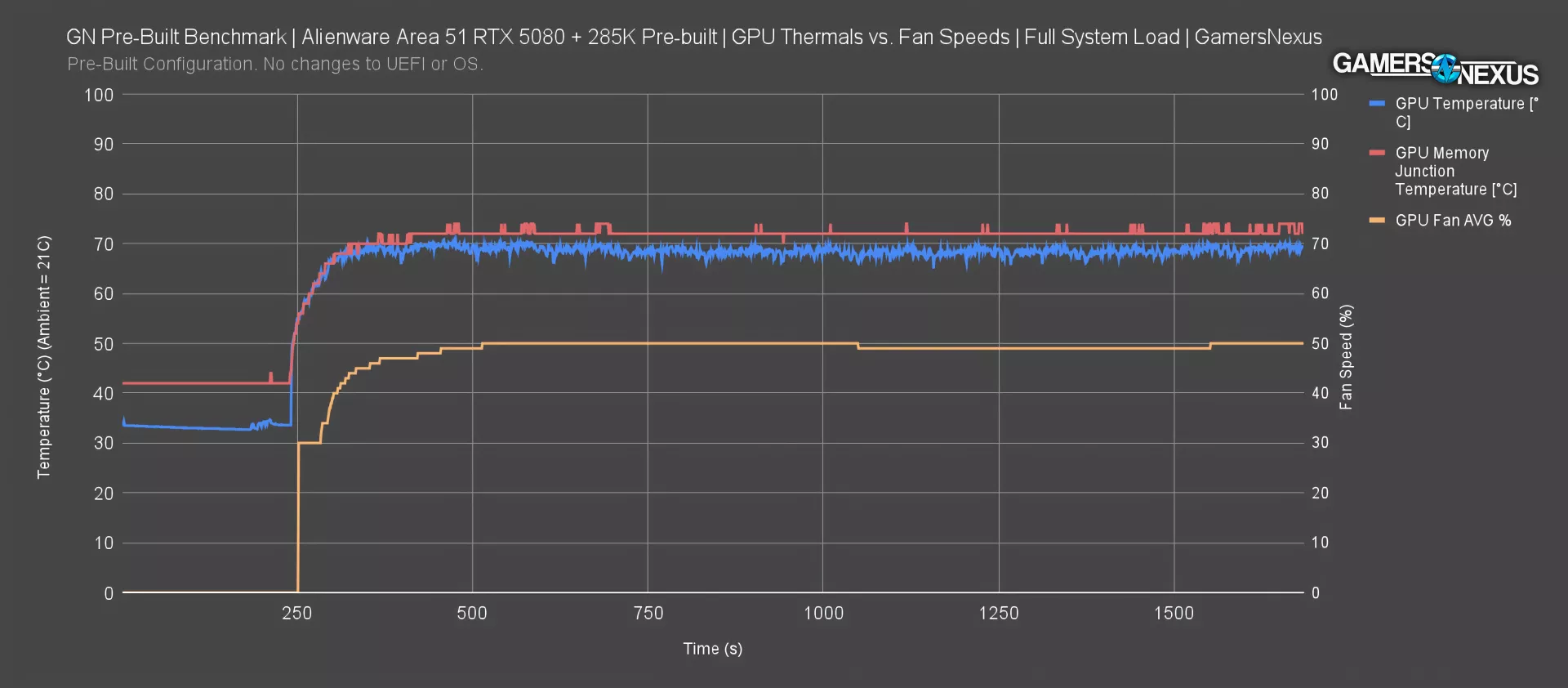
Right here’s a fast take a look at GPU temperature and its fan pace over time. The outcomes are unremarkable besides as a mannequin for what this could seem like. GPU temperature rapidly climbed to the excessive 60s and the followers locked in at 50% after a couple of minutes. That’s undoubtedly quite a bit higher than what we noticed with Origin, where it took 8 minutes for the fans to do anything.
I/O Thermals – Regular State – Alienware Management
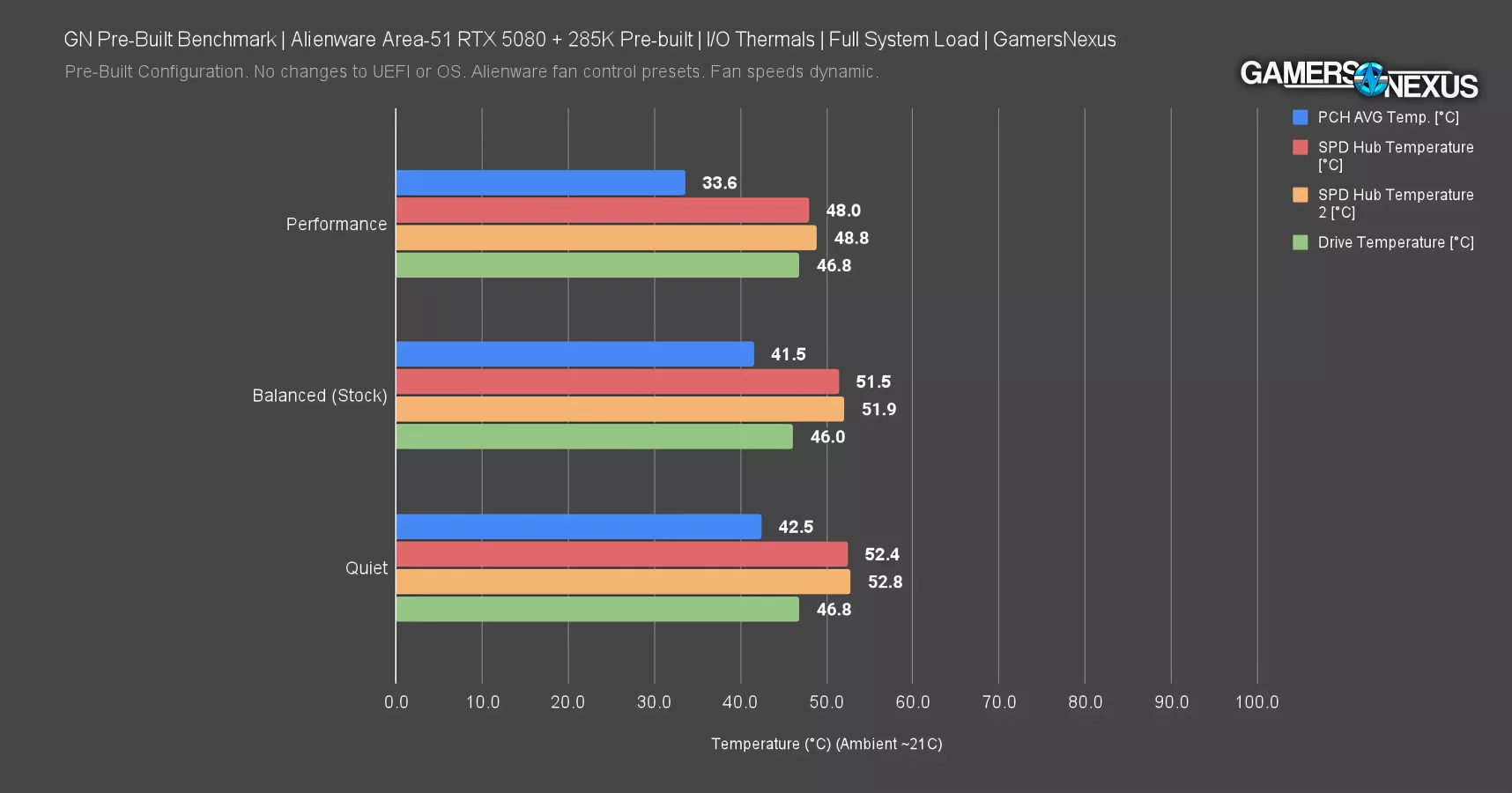
Different temperatures have been largely unremarkable, except the PCH temperature getting considerably extra cooling with Efficiency mode. Any of those outcomes are acceptable for the chipset temperature, although, so this largely tells us the place the air goes.
Intro to Handbook Fan Management Thermals
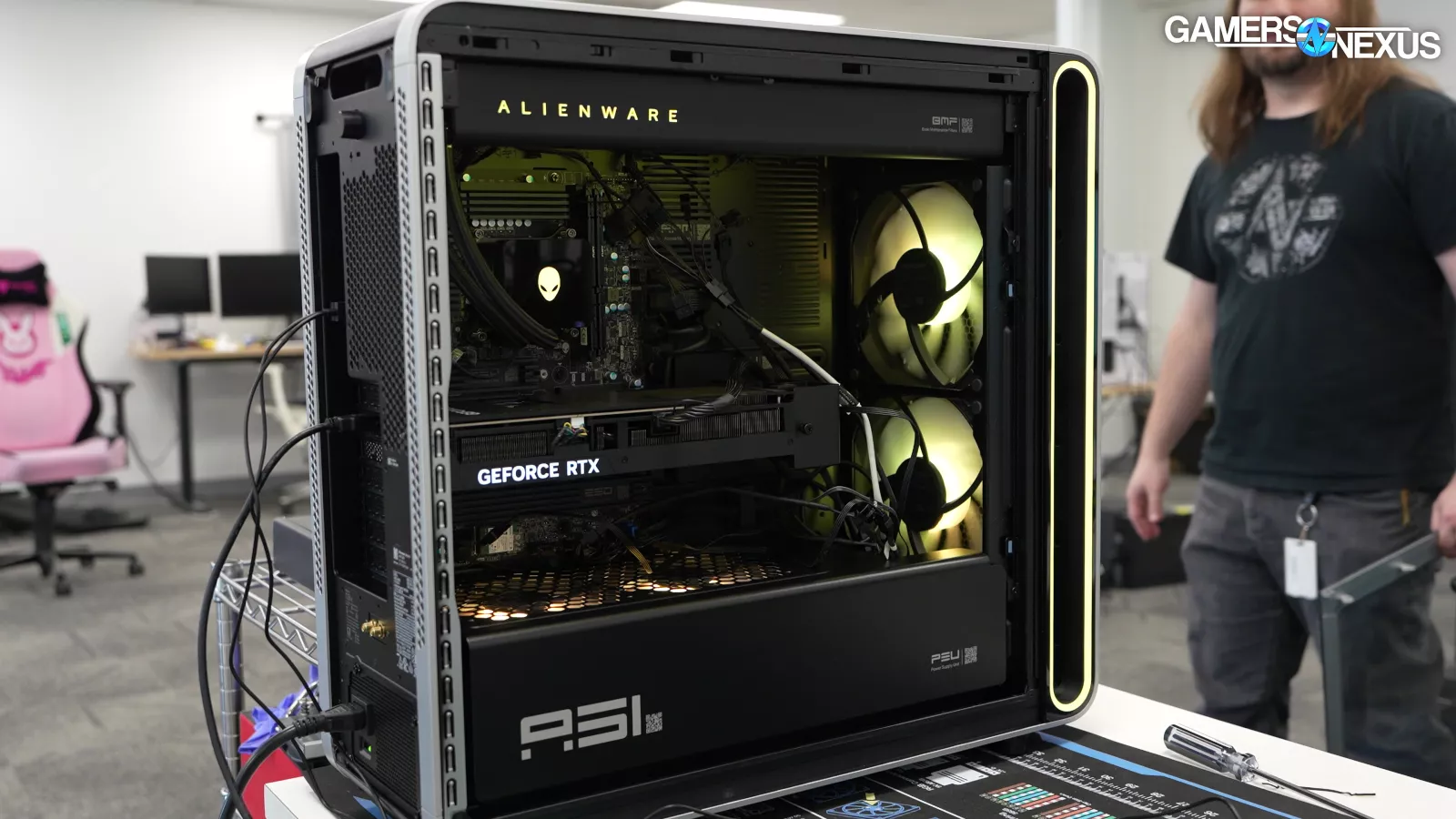
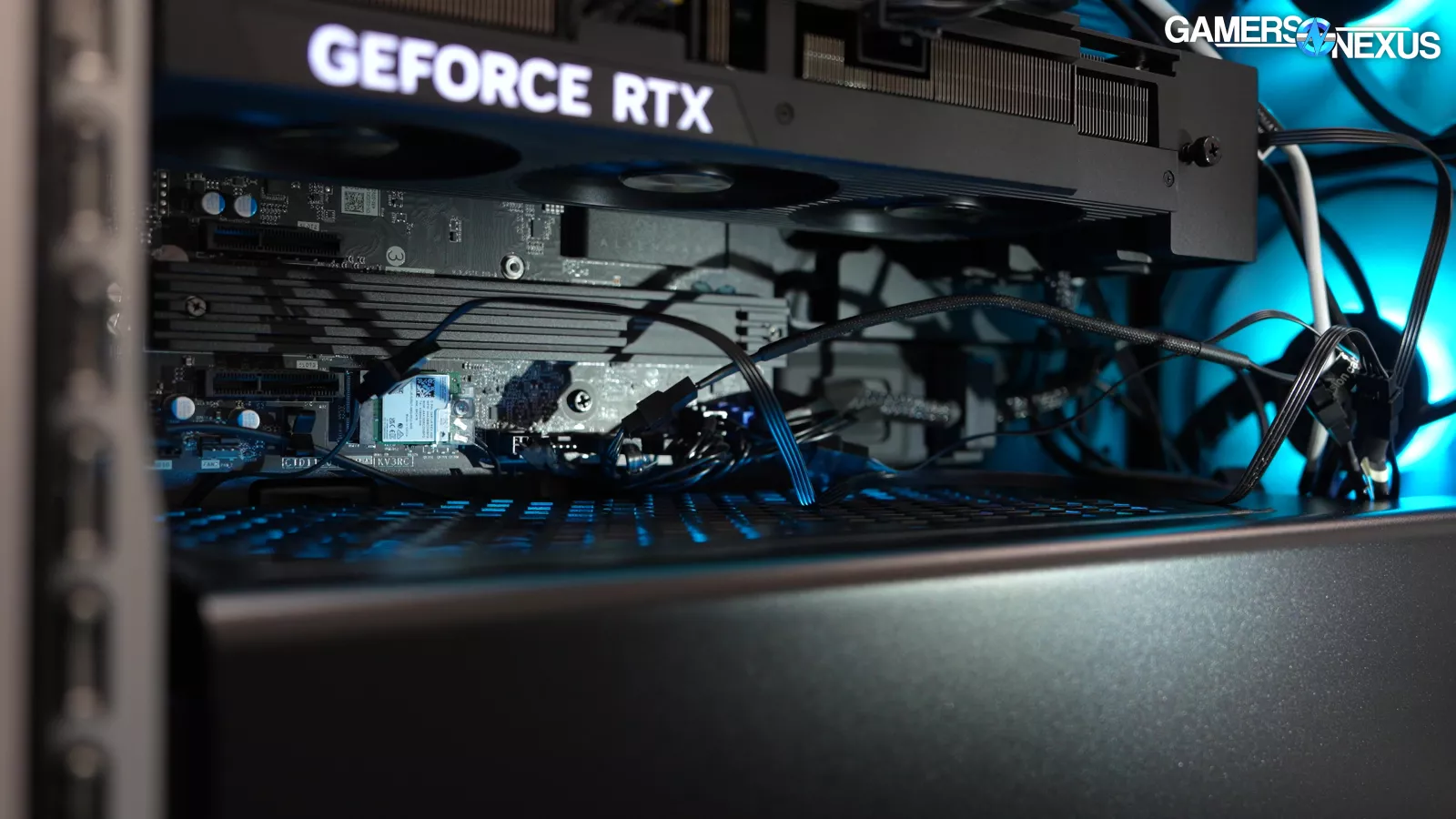
Subsequent, we’re manually controlling the fan speeds to do some A/B testing to guage Alienware’s design selections. We related all of the followers to a Corsair fan controller preloaded with PWM values that roughly correspond to the values at steady-state below Alienware’s management. The GPU followers have been fastened at 50%.
We did testing inventory, with the entrance panel eliminated, and with the highest followers flipped to exhaust.
Regular State – Handbook Management
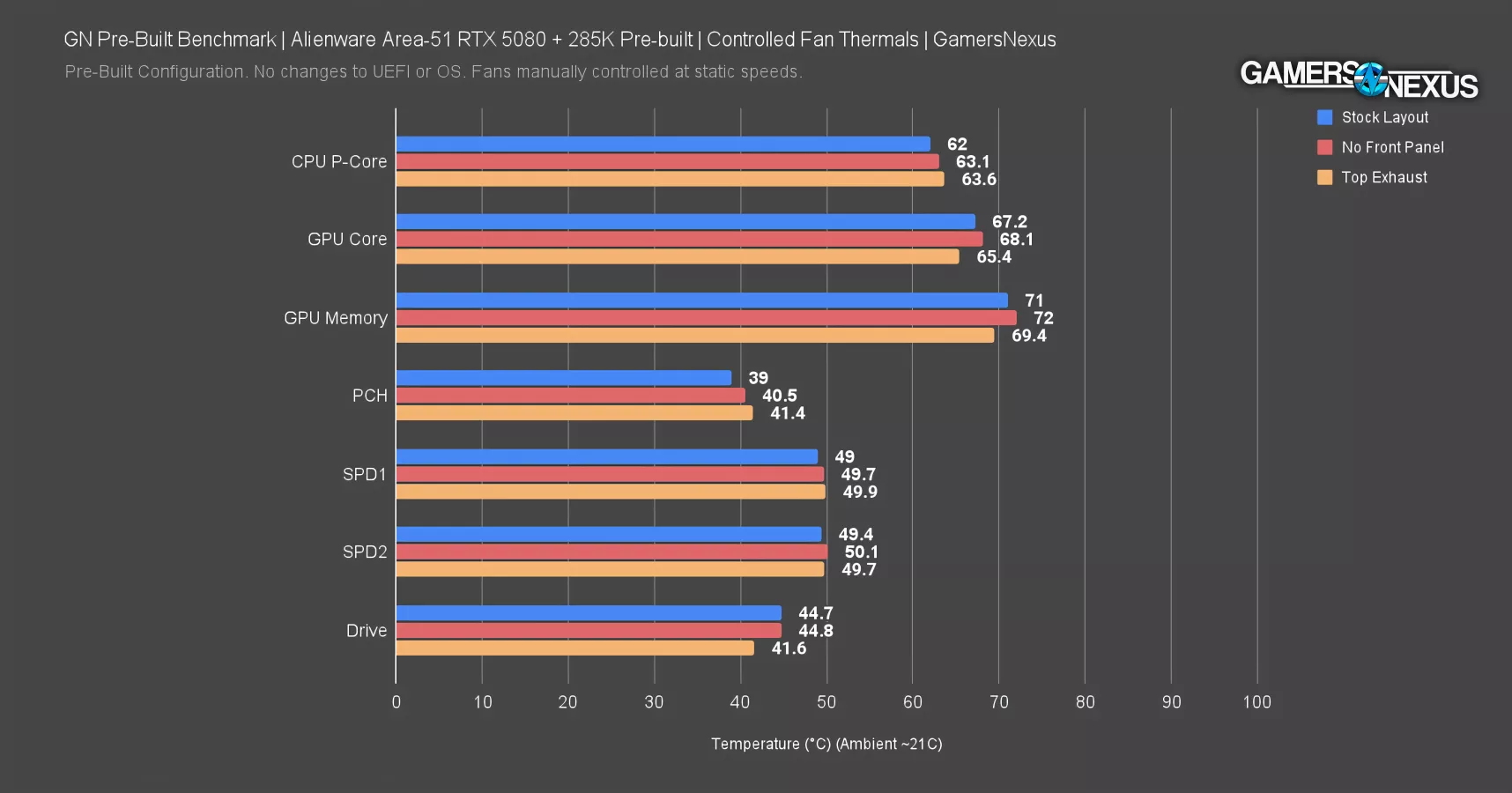
Broadly talking: Eradicating the entrance panel had no significant affect on outcomes and was inside error. Prime exhaust considerably improved drive temperature, GPU reminiscence temperature, and GPU temperature for the core, with reductions of about 3 levels in every. The GPU temperature specifically improves due to the higher skill to make the most of flow-through cooling, evicting warmed air out the highest of the case in a straight path for the GPU. This naturally heats up the CPU radiator extra, which implies CPU temperature barely will increase. The CPU can take it although, and the GPU will really increase barely increased because of this. Likewise, the CPU temperature improve is lower than the GPU temperature lower.
Frequency – CPU
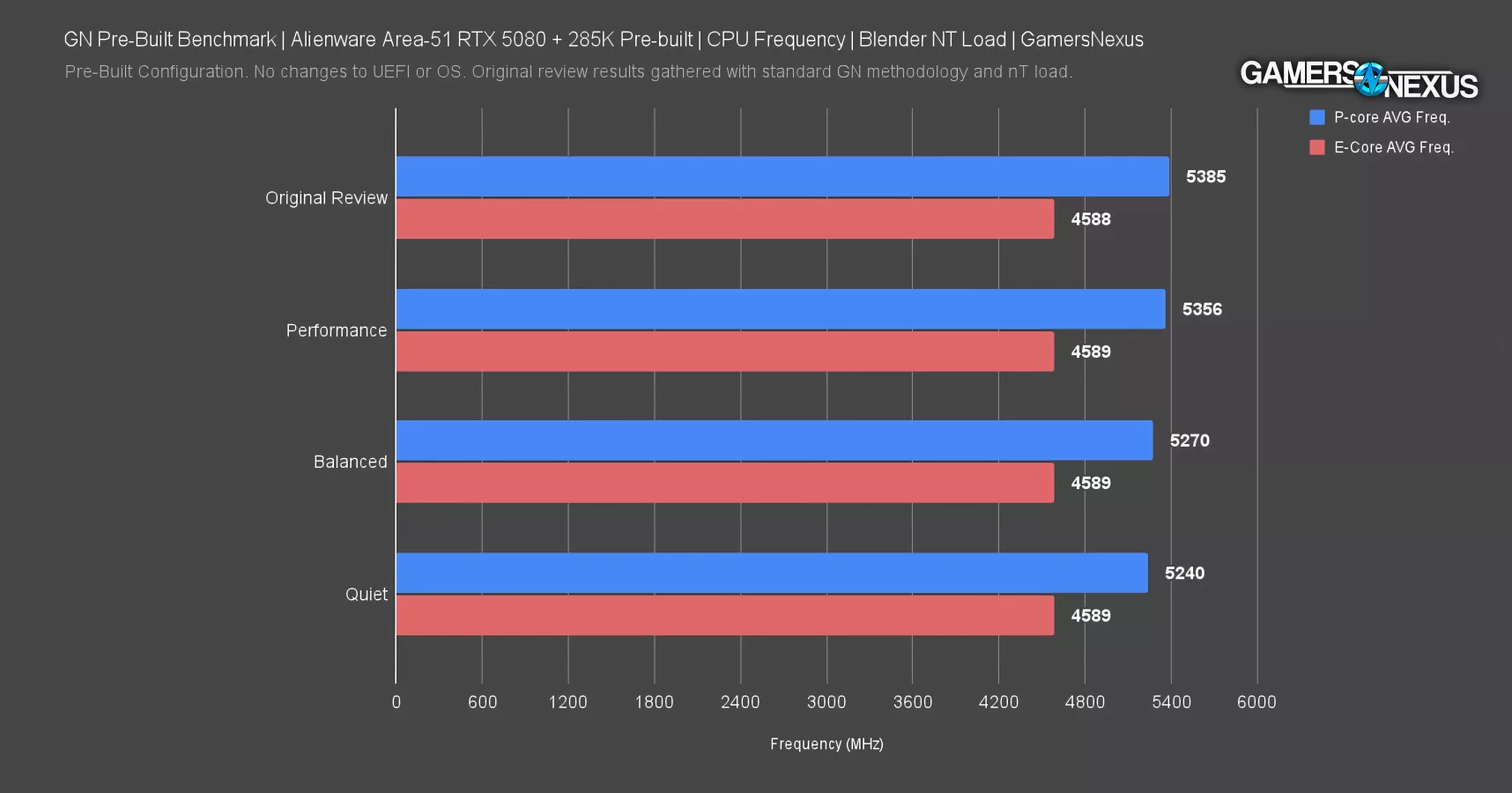
CPU frequency has steadily been a key space of failure for a number of of the pre-builts that we’ve reviewed – often as a consequence of poor thermals or energy administration.
To Alienware’s credit score, that’s not the case right here. The Intel 285K with the 360mm liquid cooler and the followers on the Efficiency preset solely loses a median of 29MHz throughout the P-cores versus our original review of the 285K. The inventory Balanced preset provides up 115MHz on common, and Quiet falls behind by 145MHz versus inventory. A 145MHz loss is giant throughout all cores averaged and could be noticeable the place efficiency is time-based, however as a result of it’s an non-compulsory fan preset, we’re OK with it so long as customers learn about it. It’s buying and selling clocks for decrease noise.
Acoustics – dBA Over Time
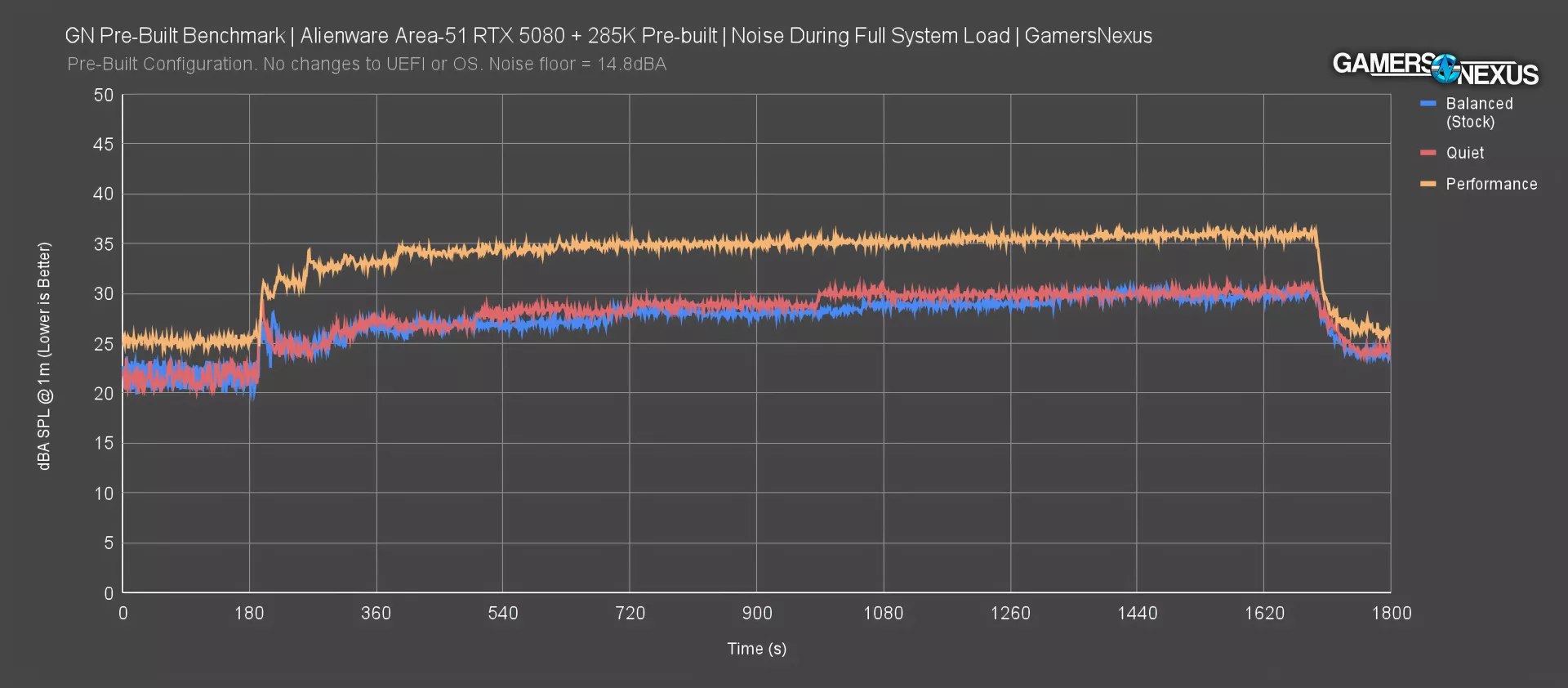
Subsequent up is testing in our hemi-anechoic chamber, which we’ll use to guage noise ranges of the completely different preset fan profiles (now that we all know the trade-off for efficiency and thermals).
The inventory Balanced profile idles round 21-22dBA earlier than spiking in response to the preliminary CPU load. There’s a faint prolonged stair-step sample all through the check length earlier than settling in at 29.7dBA common at steady-state.
The Quiet profile follows a lot the identical sample – really measuring barely louder than Balanced throughout elements of the check. This displays the extraordinarily related thermal conduct we noticed between Balanced and Quiet.
Efficiency idle was round 24-25dBA, ramping past 30dBA rapidly, then settling in at 35.9dBA at steady-state. It’s not objectively that loud, however is by comparability to the reserved nature of the default curve.
Energy on the Wall
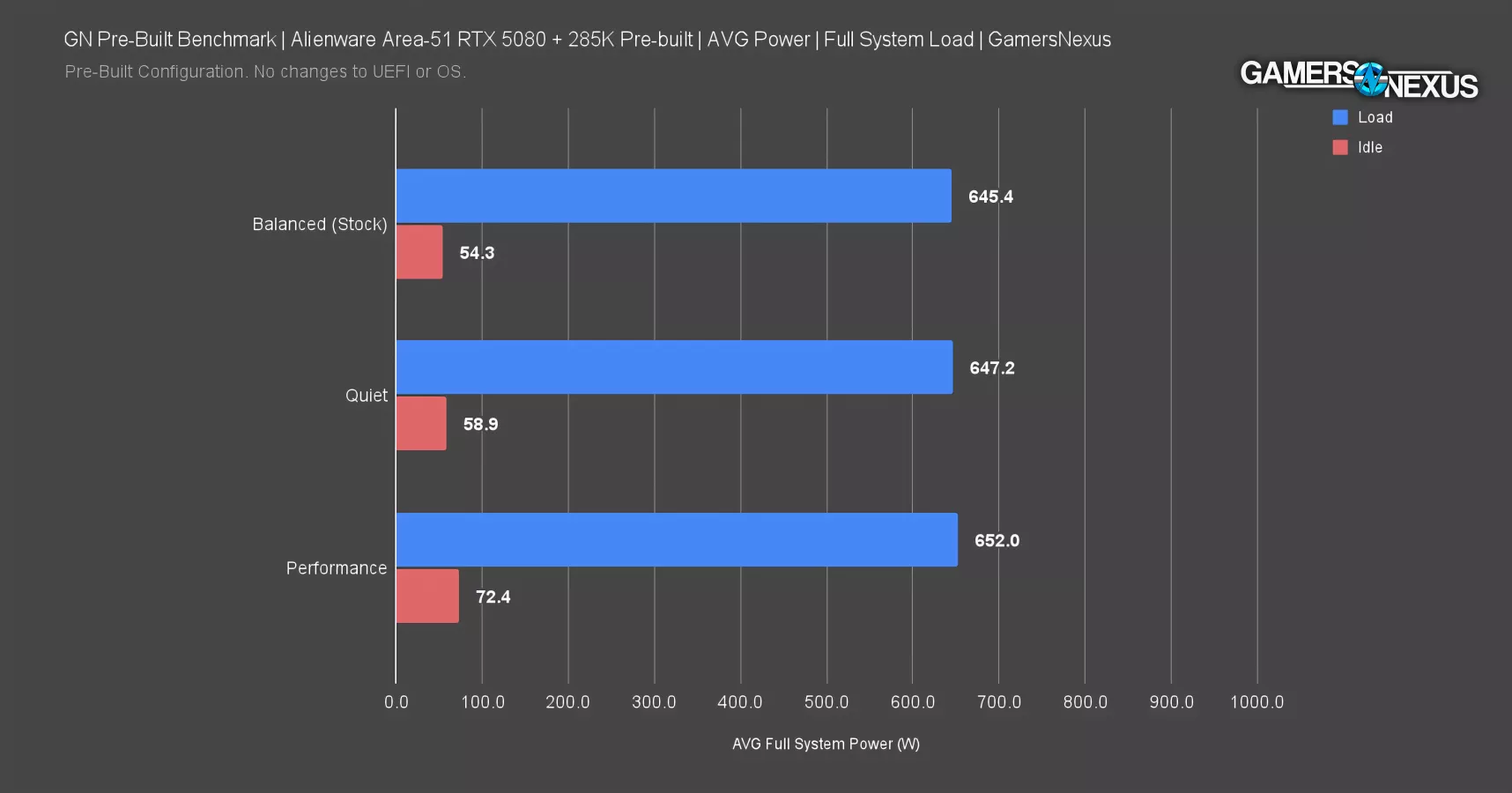
Measuring energy on the wall throughout the full system torture load reveals solely marginal variations between the three profiles, all sitting round 650W common at load. Probably the most important distinction is elevated energy consumption at idle when utilizing the Efficiency profile. That is because of the raised fan and pump speeds.
Setup and Software program
Software program and setup is subsequent.
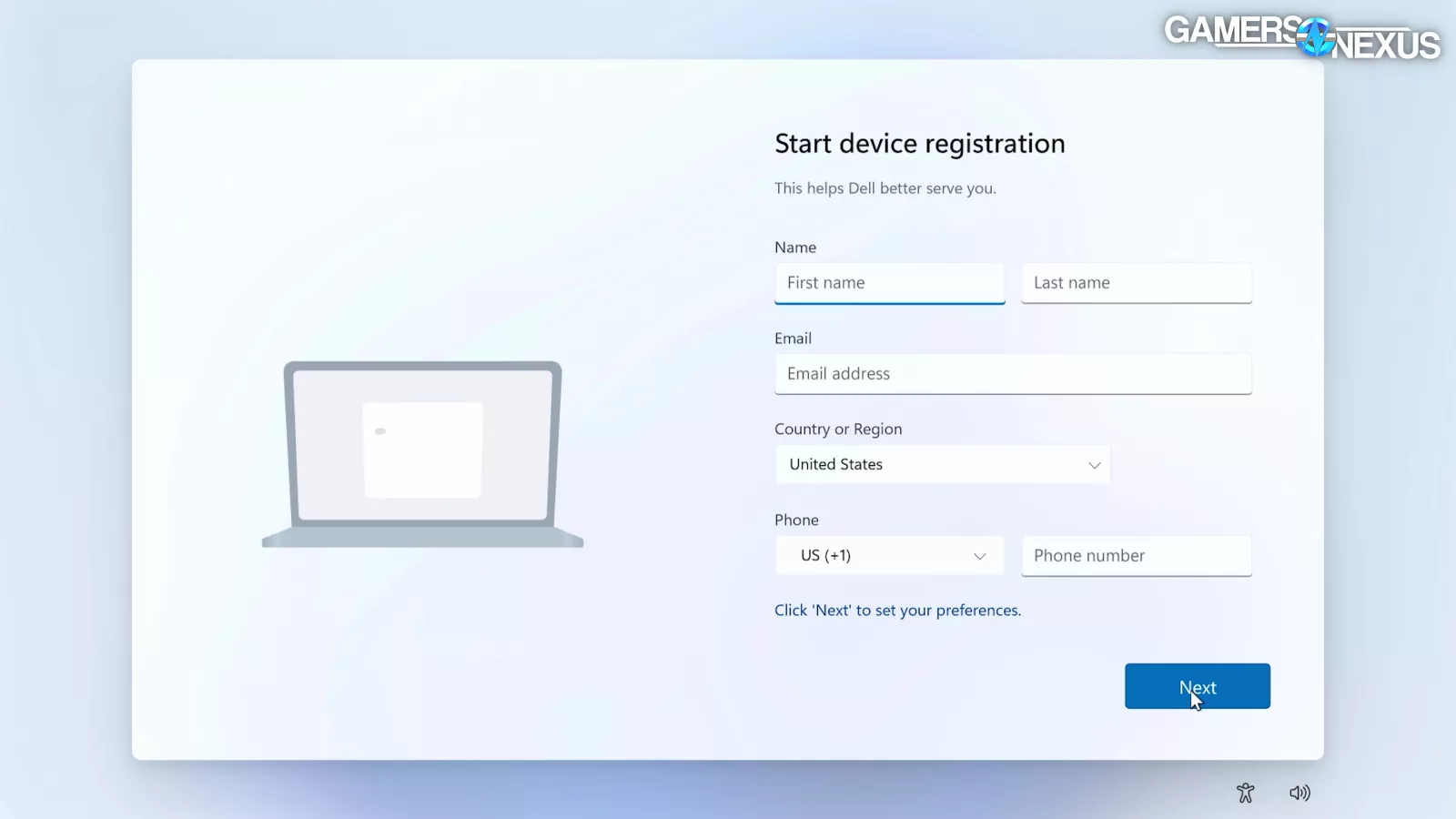
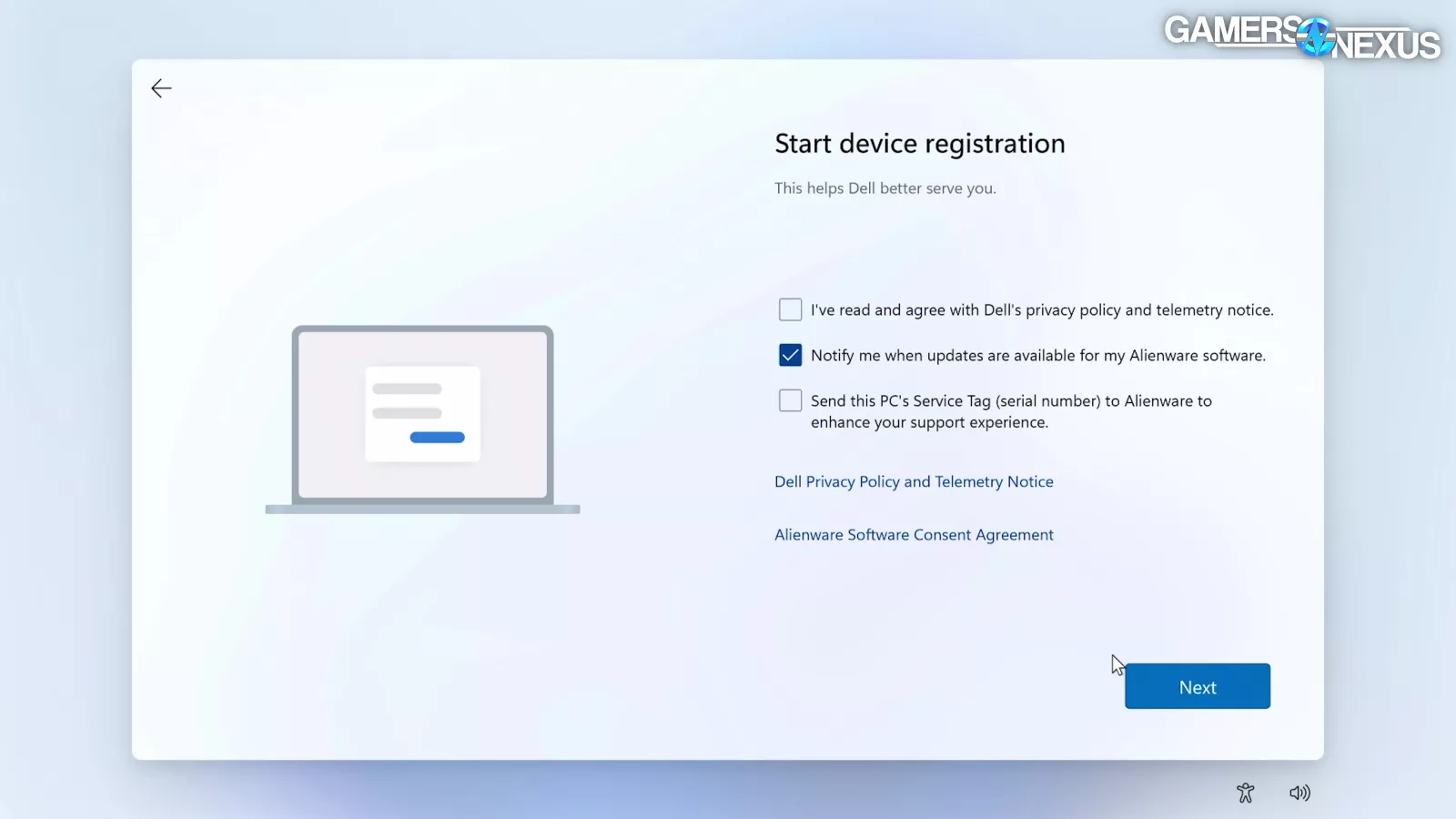
The Home windows set up course of was modified to incorporate a registration kind and agreements to Alienware’s phrases. We are able to by no means simply get a clear Home windows set up from Dell. The excellent news is that you simply don’t must fill them out or comply with them, you may simply press subsequent. The unhealthy information is that it doesn’t inform you that’s even an possibility.
After hitting the desktop, we noticed that each one drivers have been current, however the NVIDIA driver model was 572.16 from the 50 collection launch on January thirtieth, regardless of newer variations being obtainable on the time of construct. Additionally, one of many Intel drivers was even older, relationship again to October 2024, though a lot newer variations can be found.
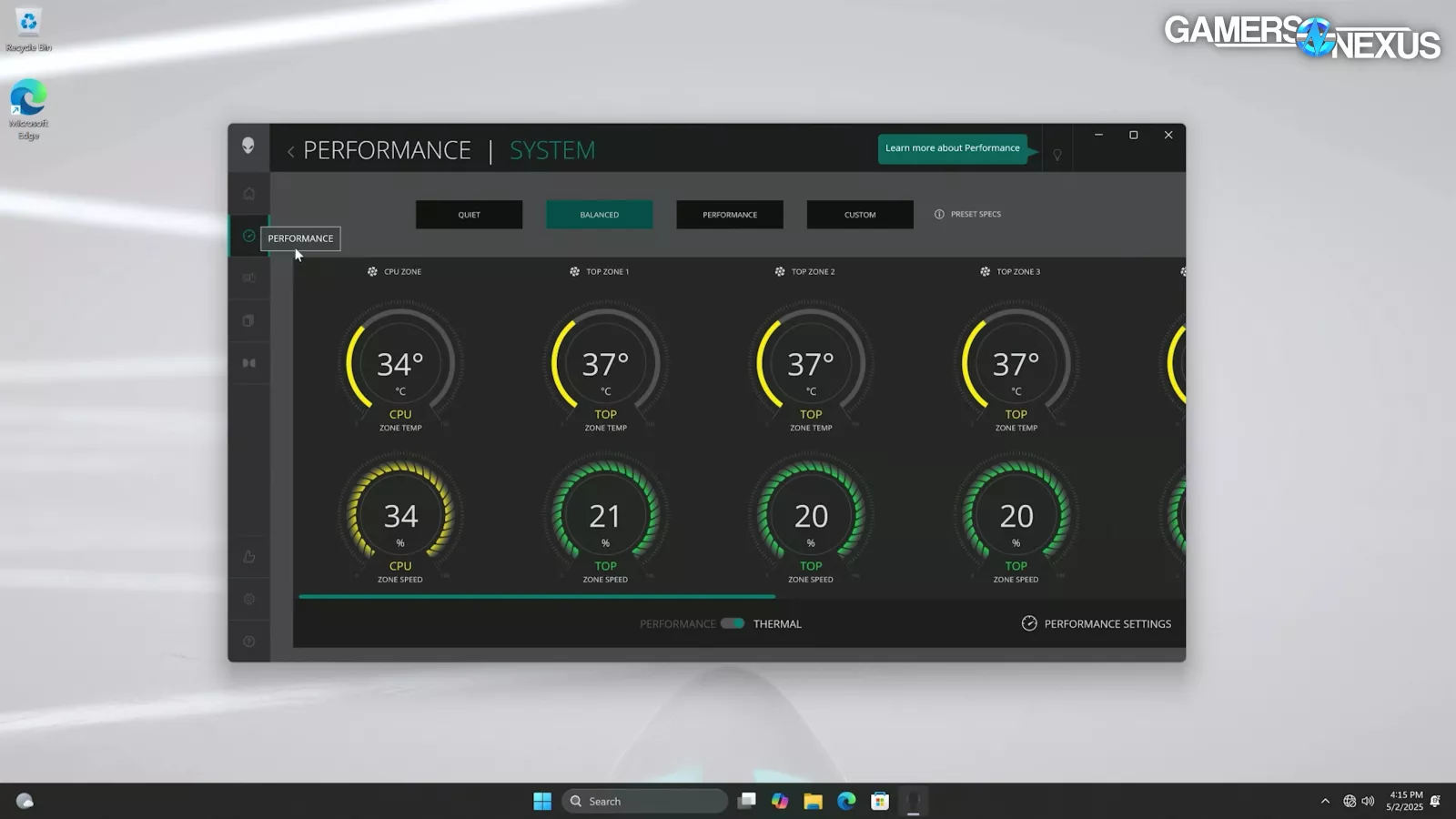
Bloatware consists of the Alienware Command Heart (which is definitely wanted for fan and light-weight management), Alienware Digital Supply, Dolby Entry, Killer Intelligence Heart networking, Microsoft Workplace, together with “Outlook (new),” and SupportAssist.
This can be a lot of crap for a clear set up. It’s not the worst we’ve seen: There weren’t any anti-virus options put in from McAfee or Norton, which is a serious constructive, however it’s nonetheless slightly bit bloated.

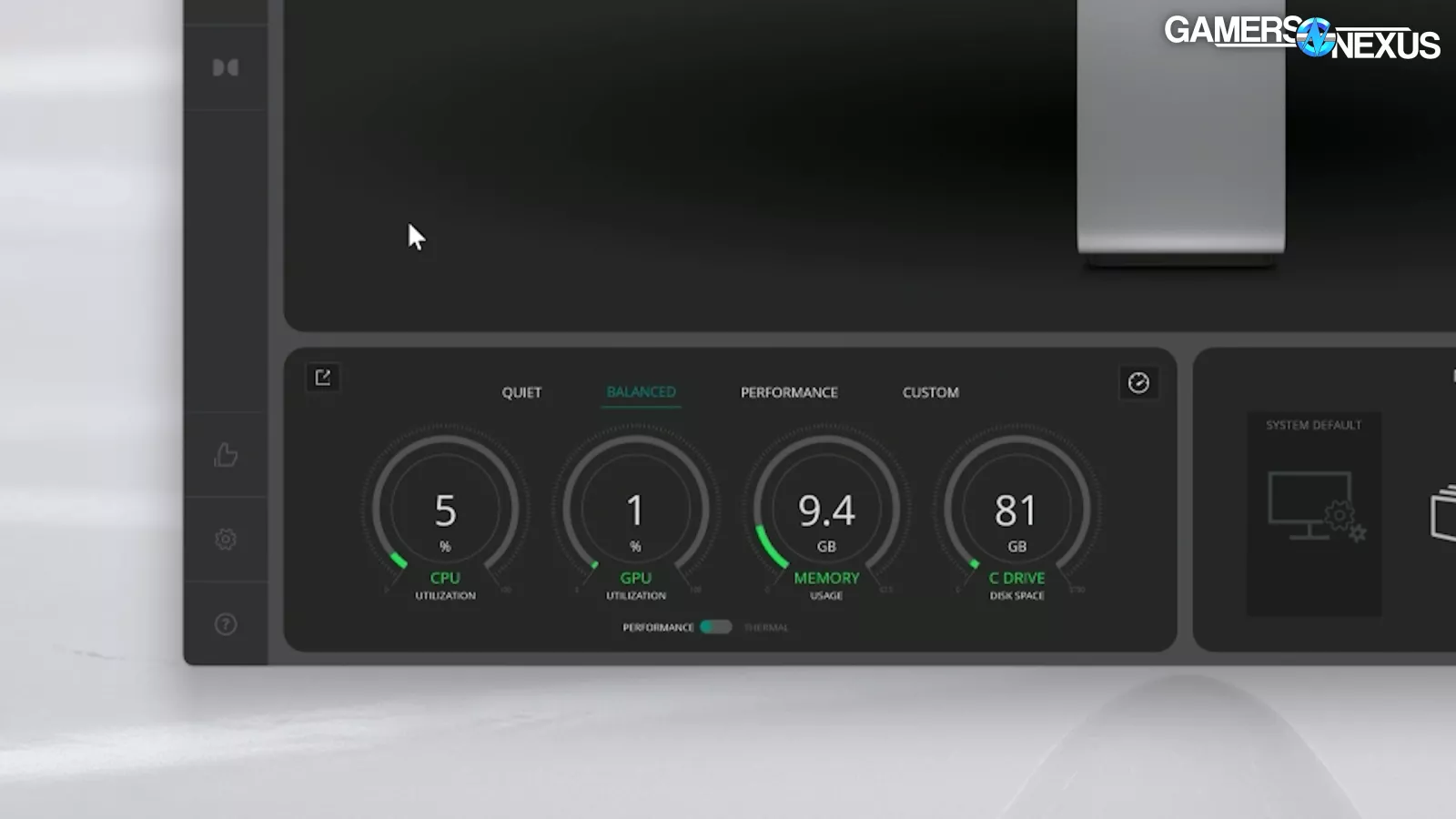
Upon opening the Alienware Command Heart, you get hit with textual content studying “Welcome, Gamer!” The principle web page reveals a number of fundamental metrics like CPU, GPU, and RAM utilization, and likewise fundamental thermals. From right here you may select efficiency profiles, which management the fan curves.
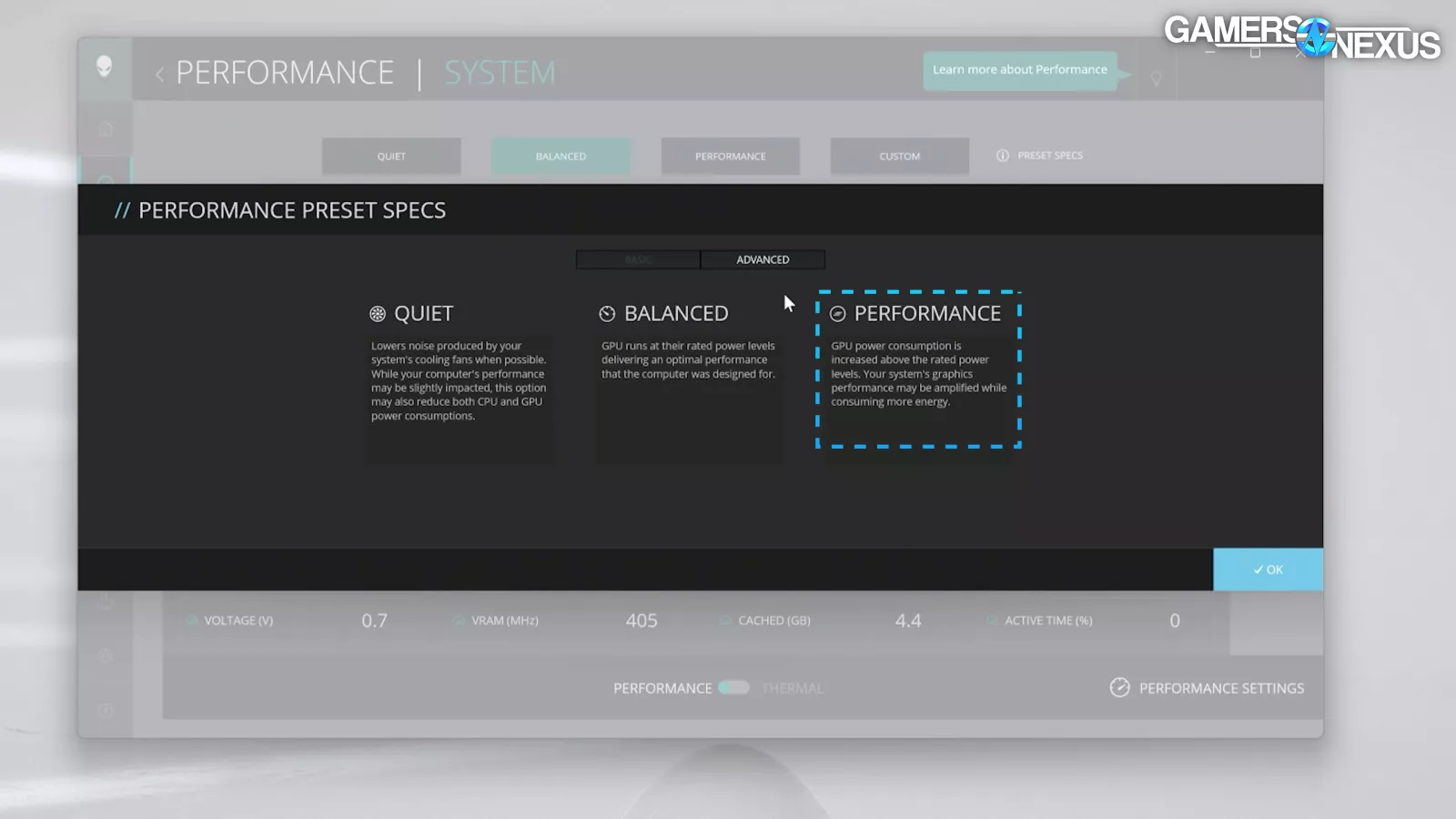
Weirdly, the efficiency web page claims that Efficiency mode does this: “GPU energy consumption is elevated above the rated energy ranges. Your system’s graphics efficiency could also be amplified whereas consuming extra power.”
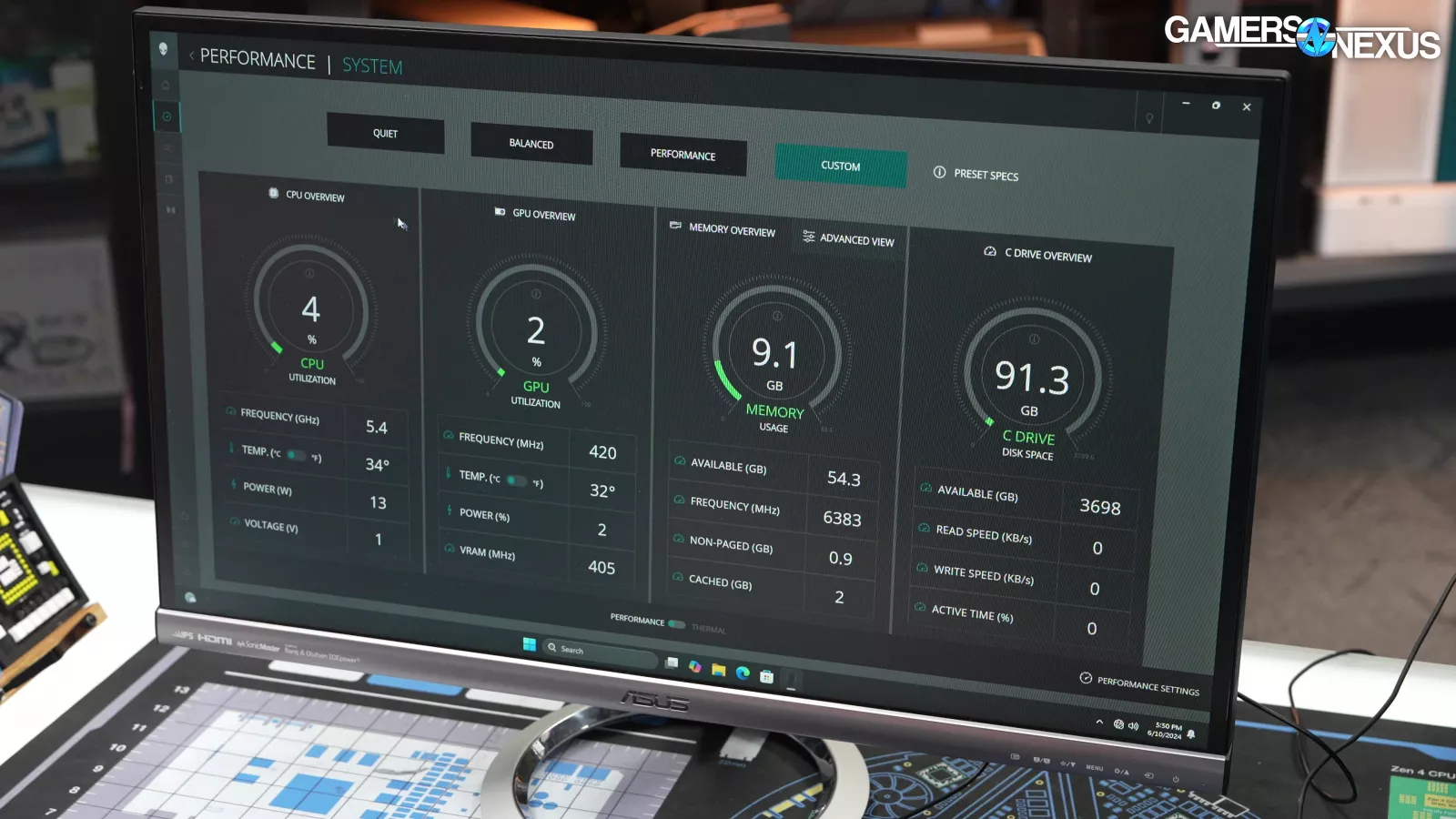
That makes Efficiency sound aggressive, prefer it’s overclocked or one thing, and implies pushing past regular limits, which is only a lie. It runs on the rated energy ranges, not above them, except Alienware means above its personal rated energy ranges reasonably than NVIDIA’s, through which case that’s deceptive. The app claims it controls overclocking settings, however the Customized profile provides neither clock nor energy management.
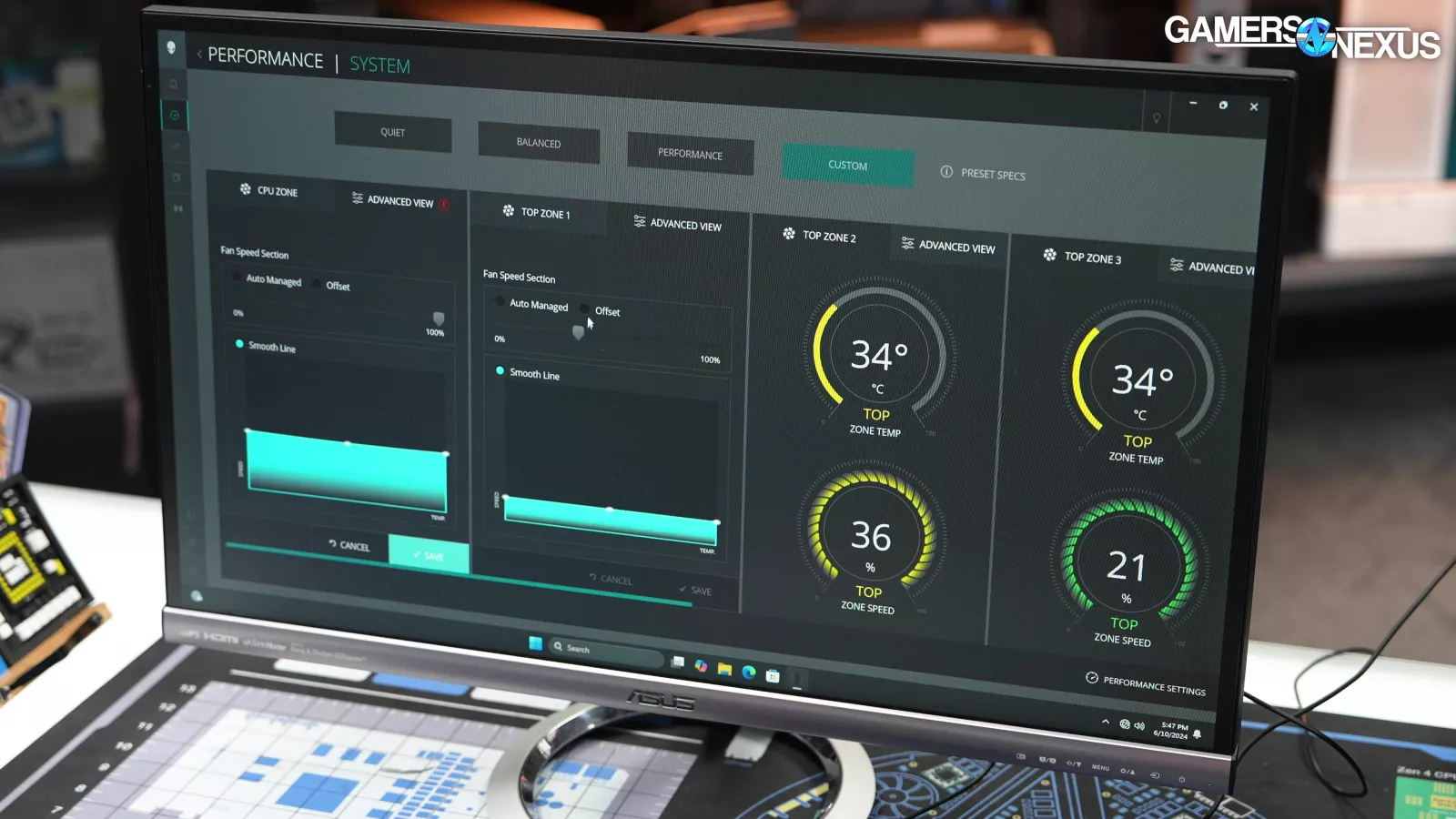
One enormous miss right here is the shortcoming to set really customized fan curves. All you are able to do is add a constructive share offset to the present base fan curve. It technically works, however it’s awkward and deprives the consumer of granular management.
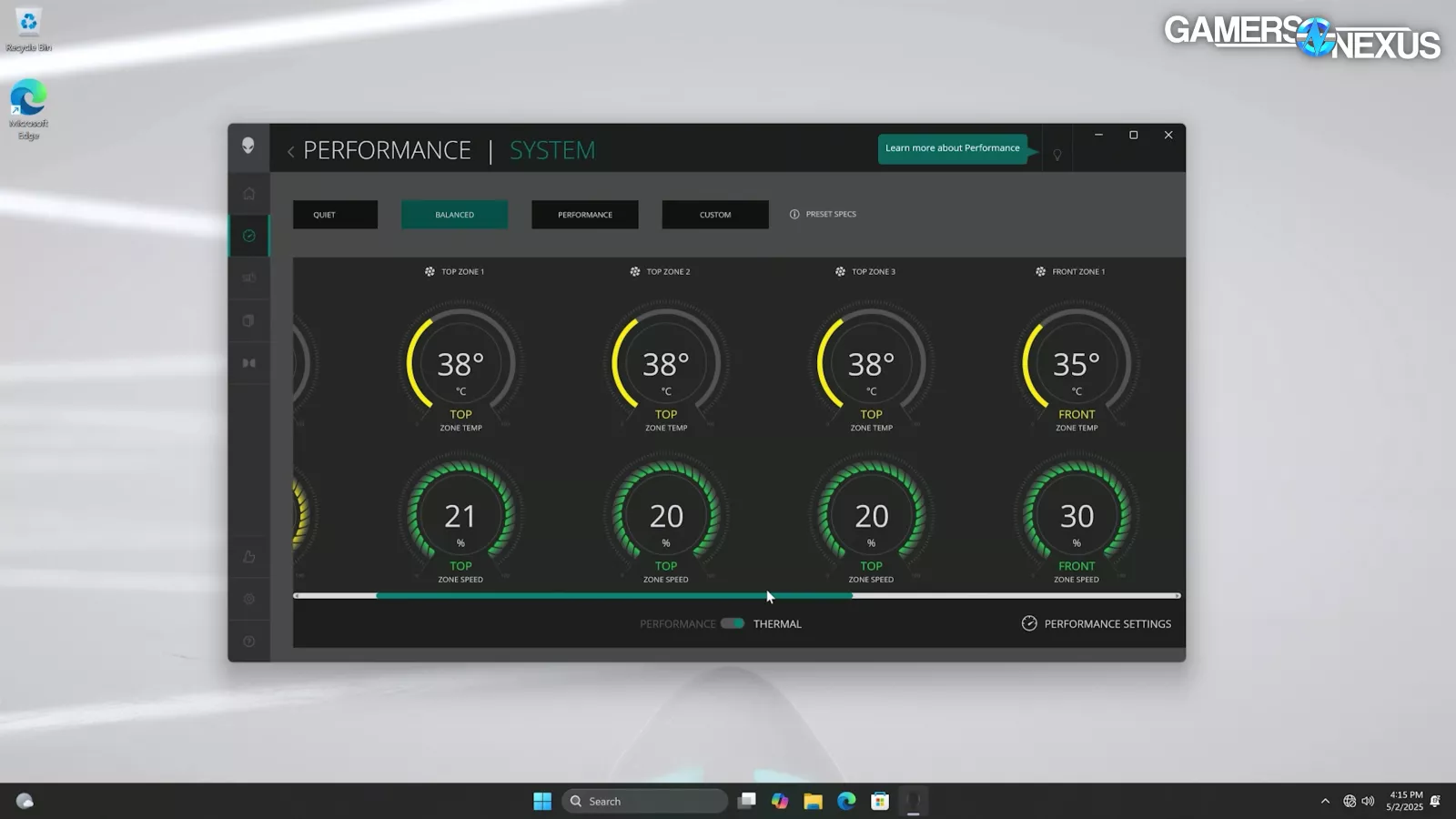
Detailed temperature readouts are break up into 8 “zones.” It might have been fascinating if these have been thermocouples really positioned across the system, however they’re not. CPU, Entrance, and Prime are the CPU temperature, and Backside is the GPU temperature.
Packaging and Equipment
The Space-51 got here in an enormous and heavy field. The outer field pulls off after popping the retaining plugs, revealing the foam-encased PC. There’s even a bit of froth shoved into the entrance panel opening, which is welcomed consideration to element to forestall entrance panel harm.
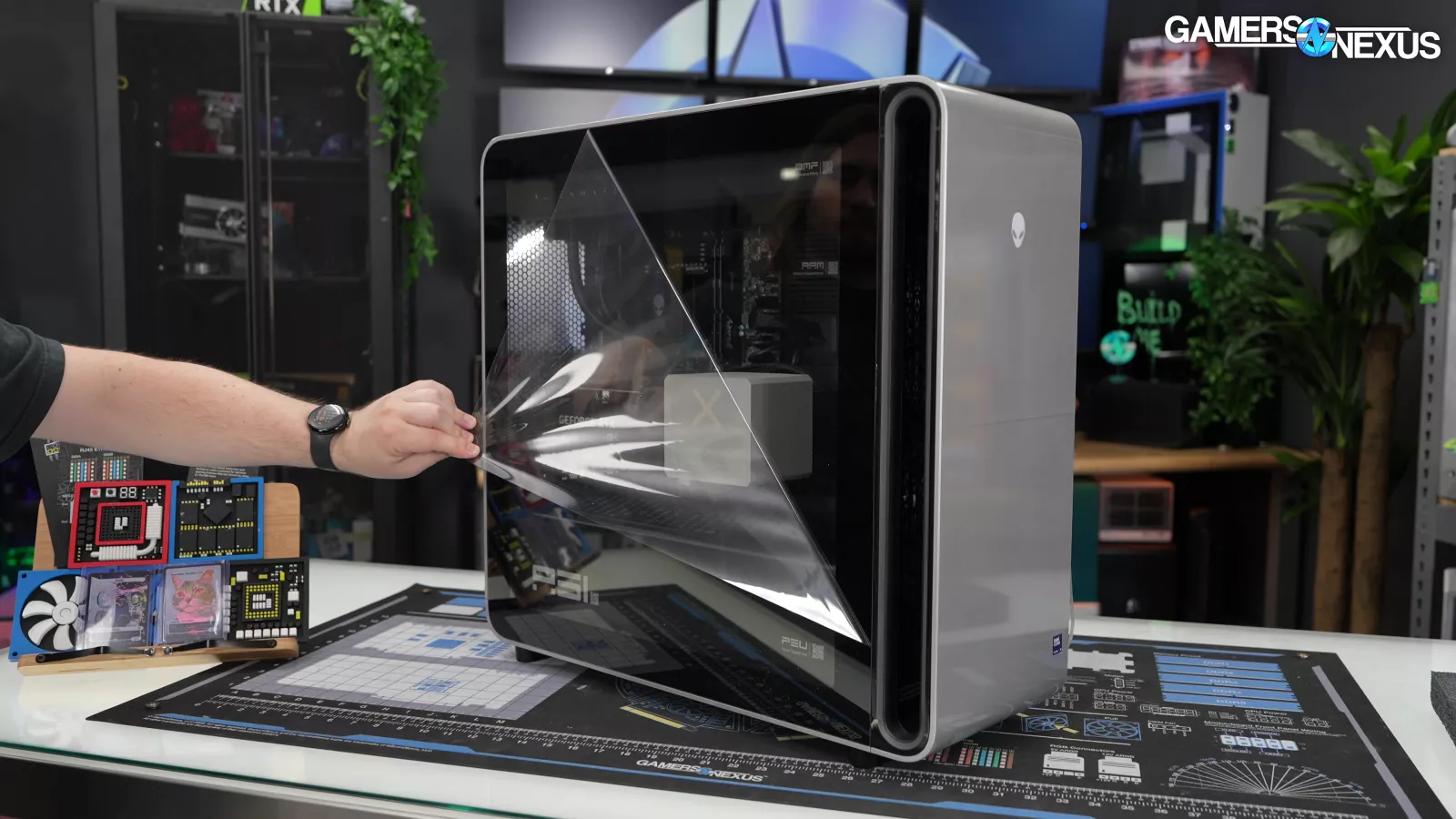
The case itself was completely mummified in a ridiculous quantity of plastic – each panel, edge, and piece of trim was coated. That is annoying to take away and likewise creates pointless waste.
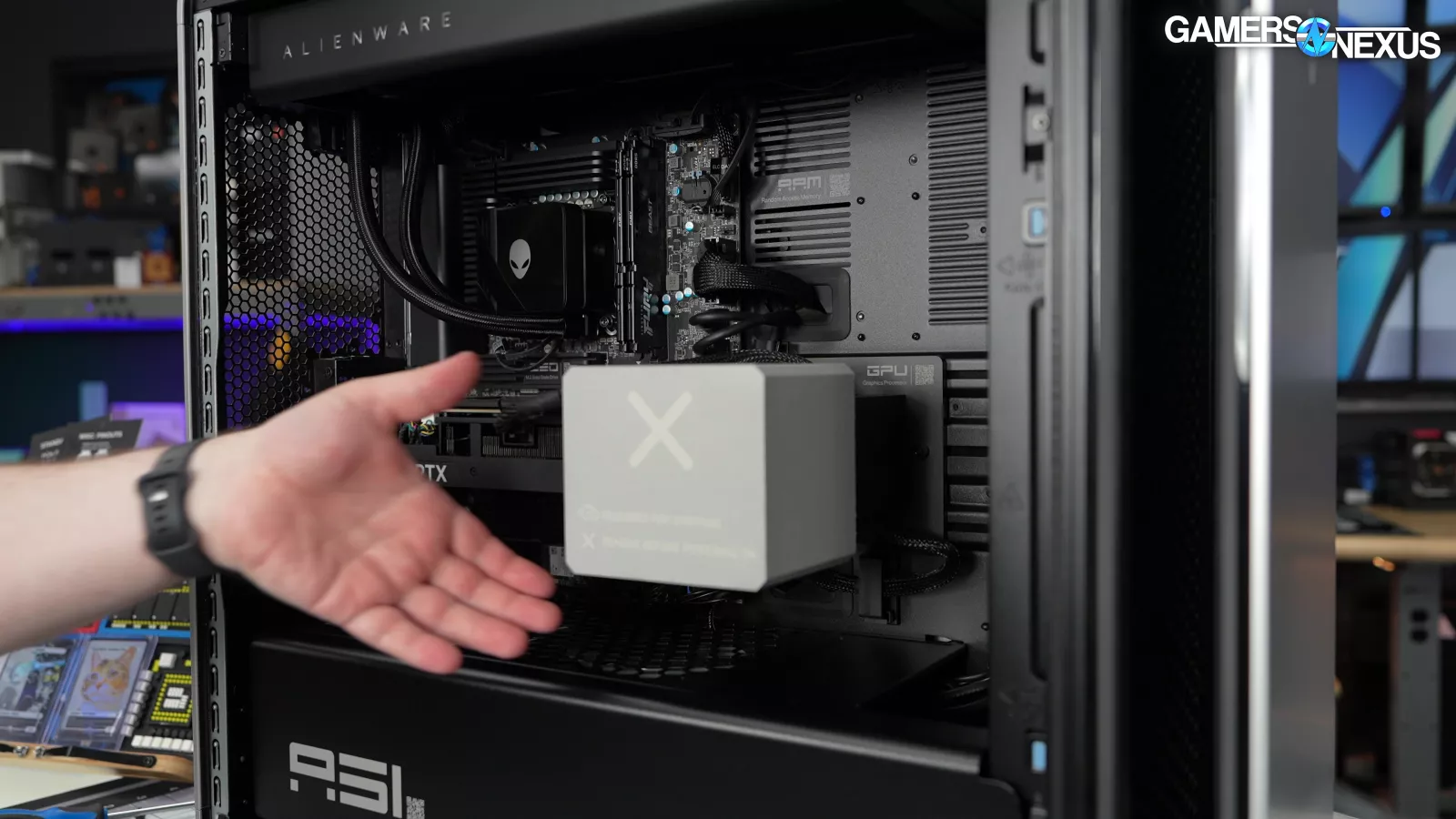
Contained in the case was a block of froth for extra GPU assist. That is nice and permits Alienware to ship with the GPU put in, reasonably than requiring consumer set up.
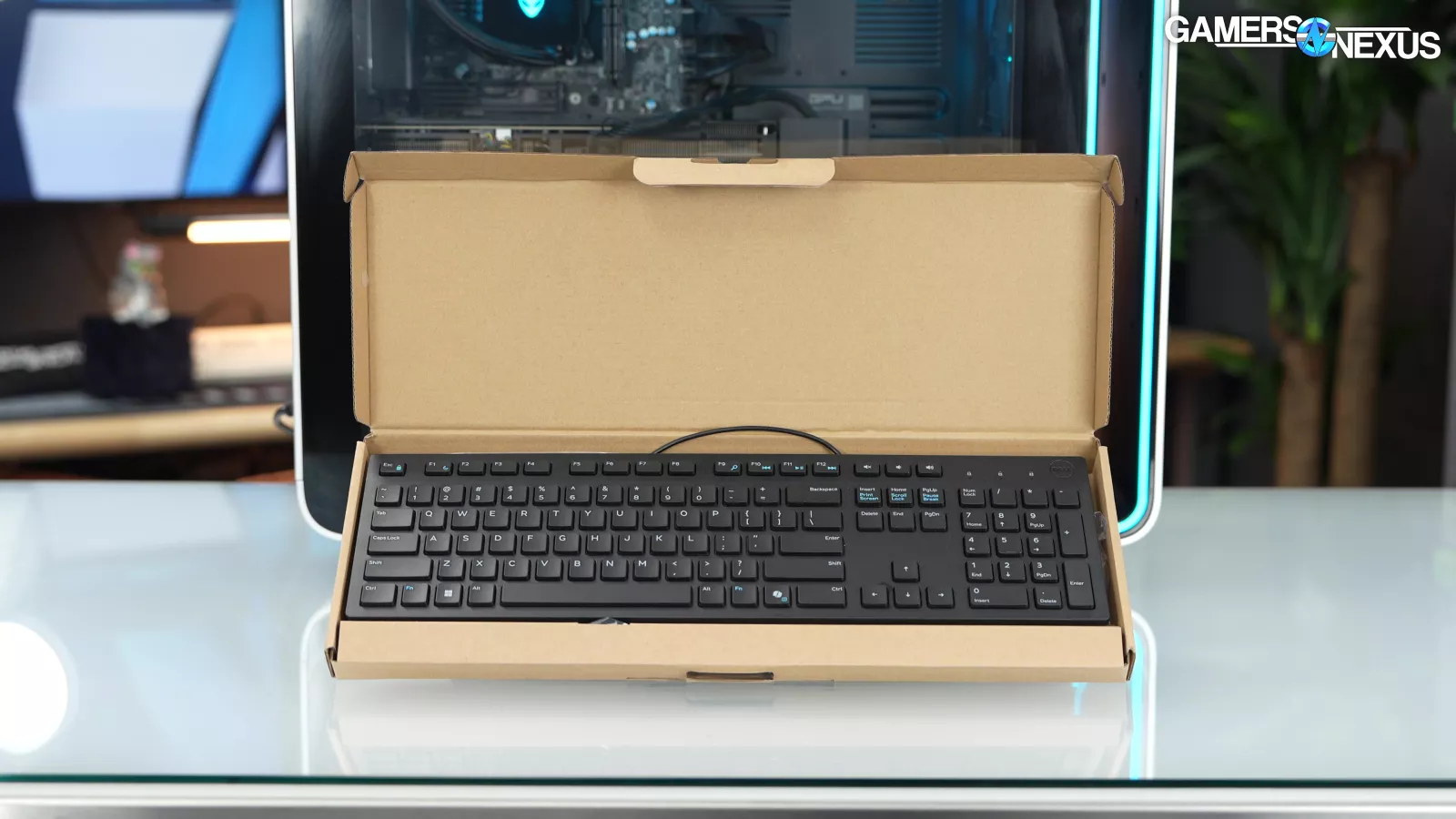
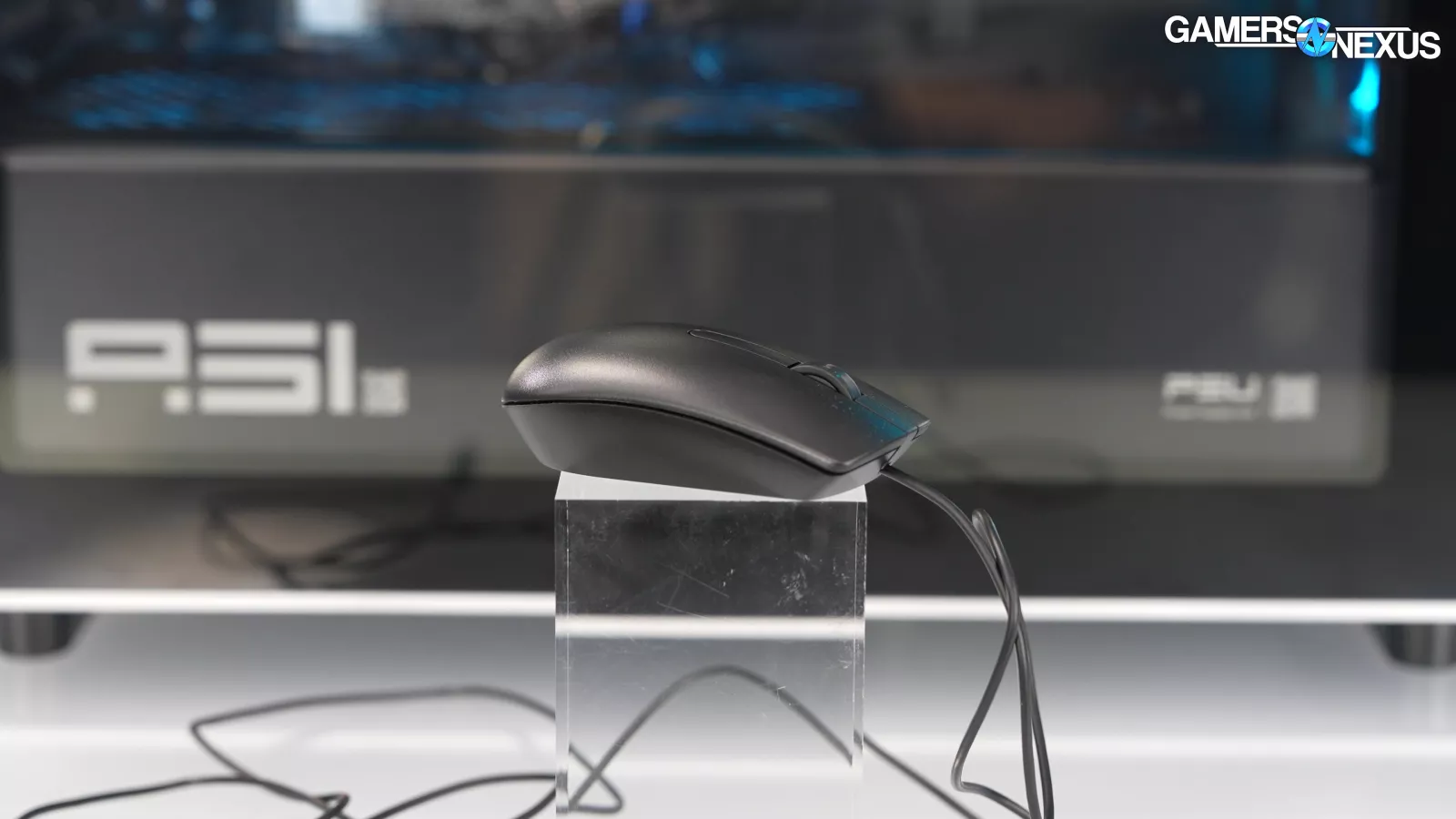
The one included equipment are a fundamental keyboard and mouse, like the type you’d get with any Dell system off the shelf.
BIOS
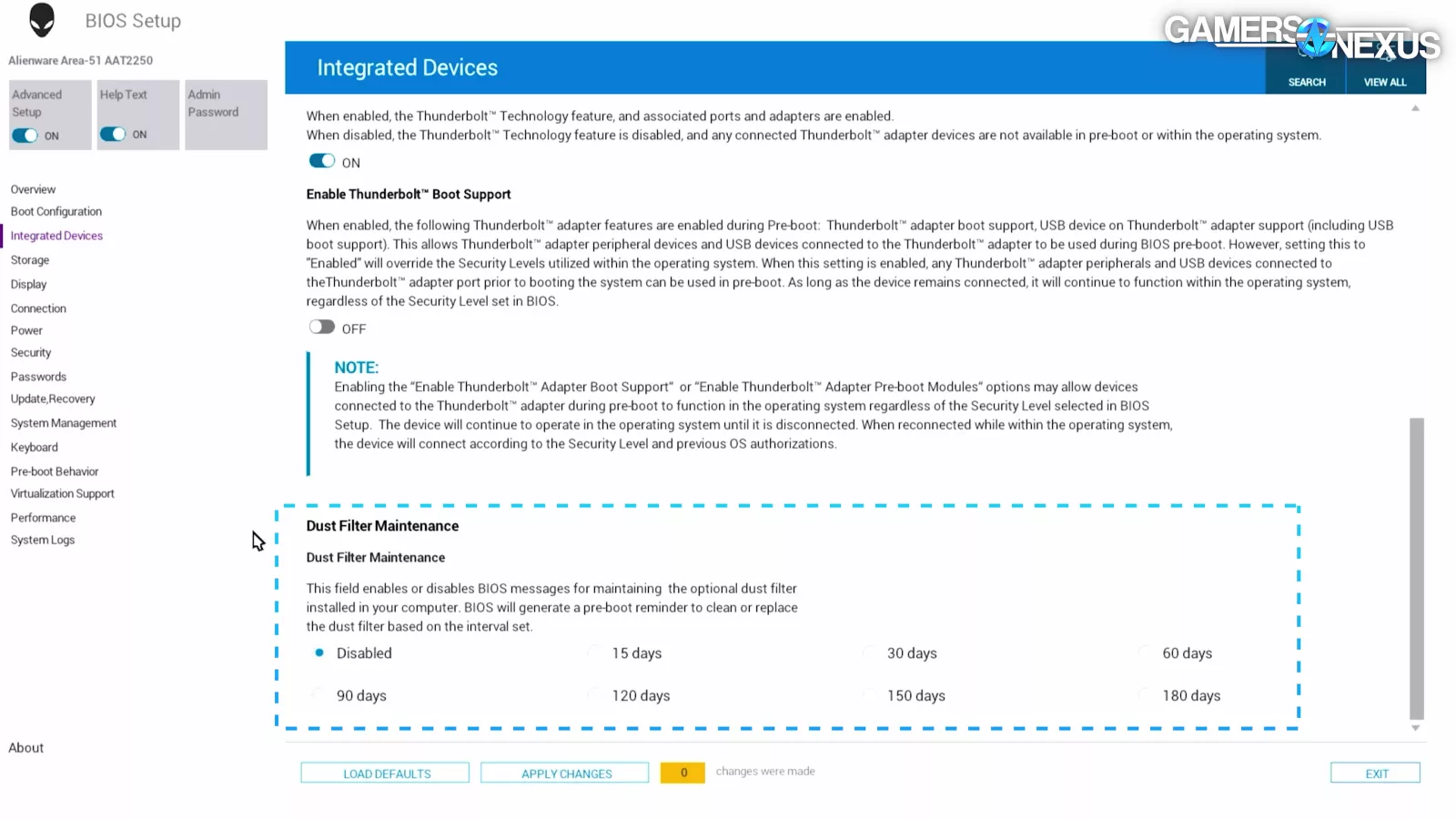
The BIOS is Dell customary with easy sections and a simple structure. Mildly fascinating is the mud filter upkeep reminder setting, however it’s Disabled by default. This could possibly be fairly cool if utilized correctly.
Fortunately, XMP and resizable BAR have been turned on, so a number of factors for that.
In any other case, there have been no oddities within the BIOS settings.
Alienware Space-51 Conclusion

Alienware’s Space-51 is massively improved over Alienware’s predecessor methods. The construct high quality is healthier. The corporate additionally moved over to standardized elements.
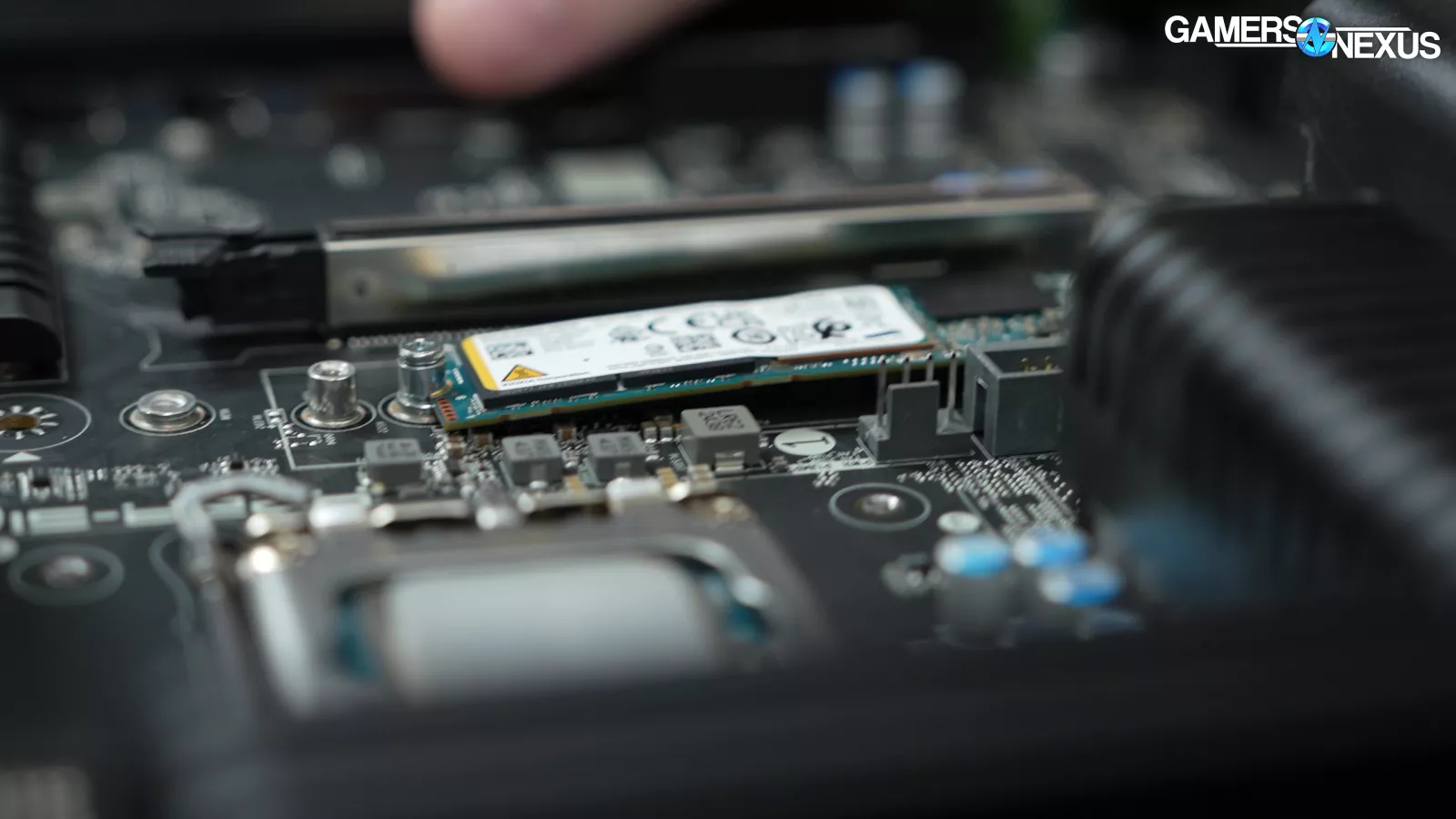
The most important mark in opposition to the system that takes it down from an general constructive assessment to 1 with extra criticisms is de facto that SSD. If we noticed that a lot of a bend on an SSD, we’d personally choose to interchange it, even when it was working at that second, to keep away from any potential information loss.
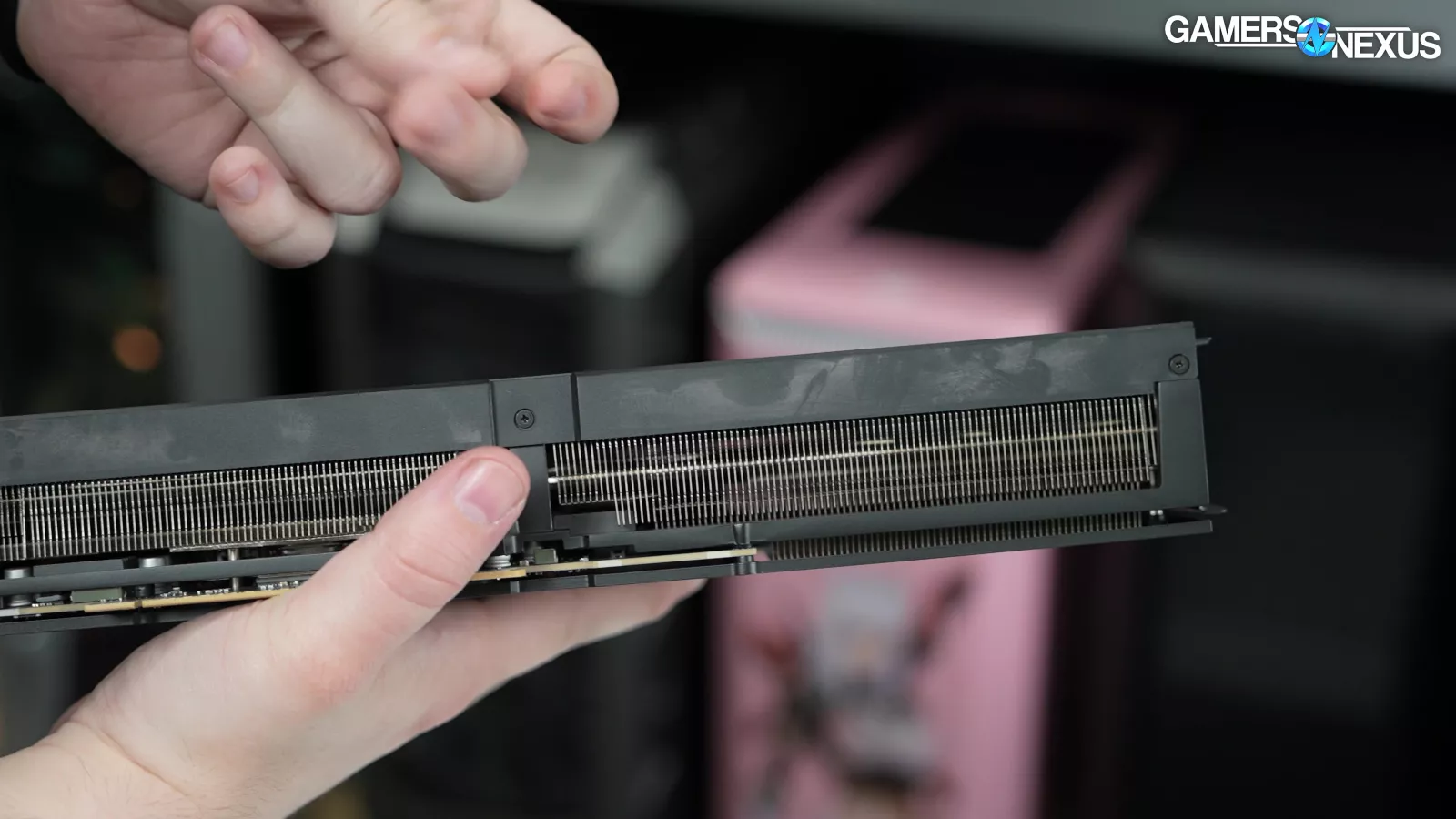
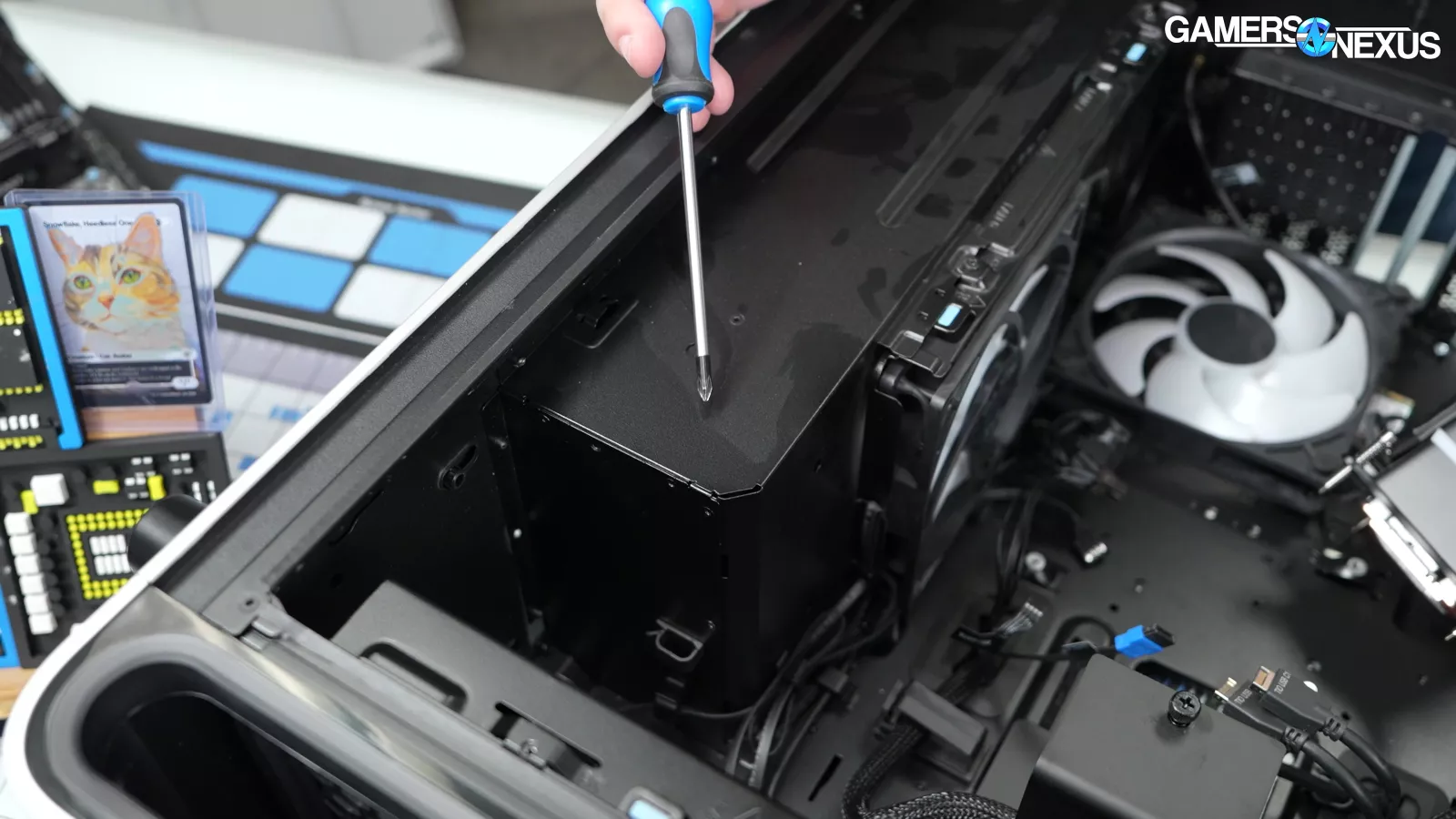
The mud and the grime have been additionally fairly gross all through the system and it’s a problem we’ve seen in previous Alienware methods. The corporate has not improved right here. What we discovered is that as you utilize the PC, the mud loosens up and will get into the system itself. There’s no motive this technique must be this soiled out of the field. We don’t usually see that from different distributors.
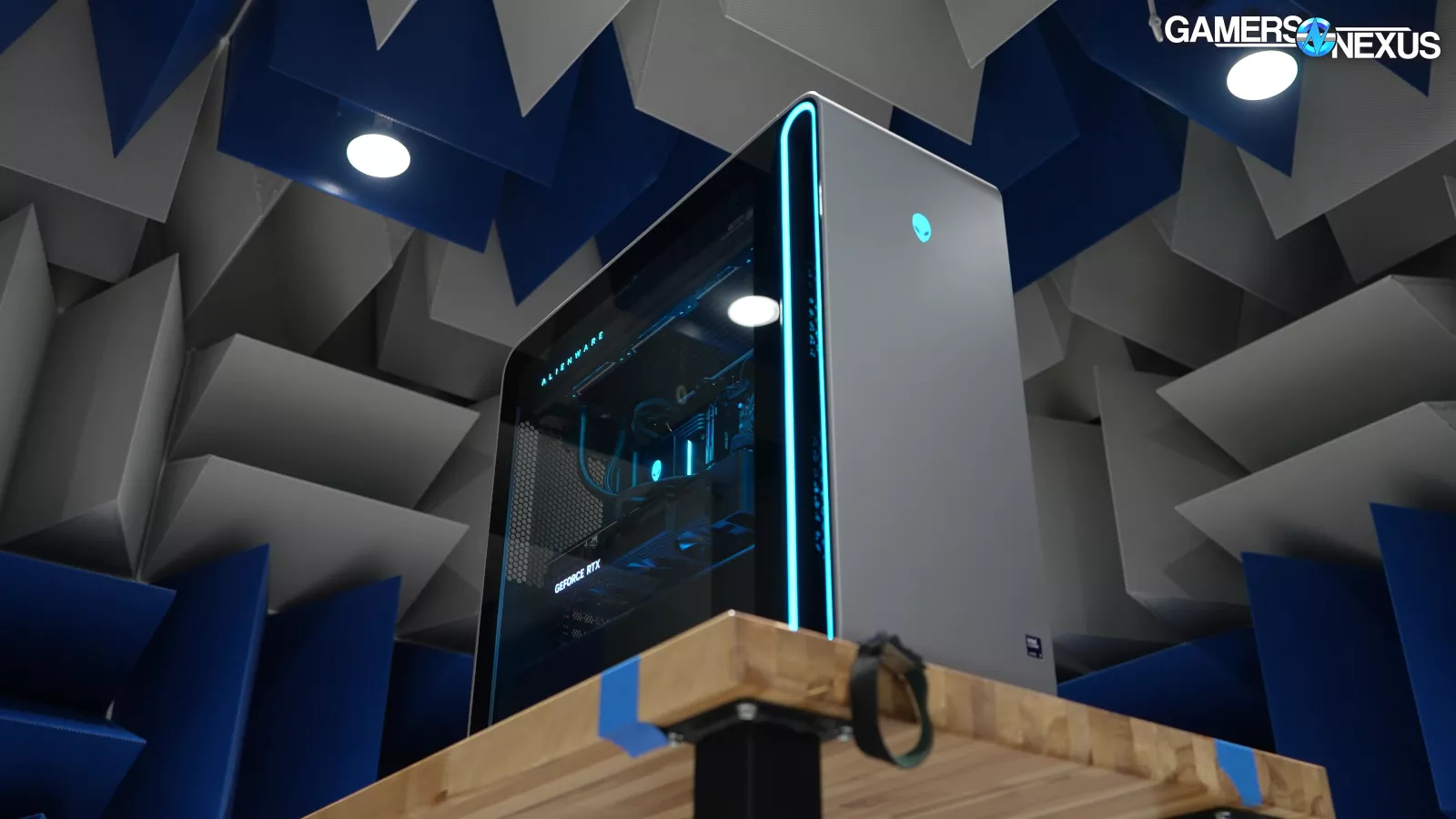
These are 2 marks in opposition to the system regardless of being general constructive on it in any other case. The value can also be 50% over DIY value. As a reference, the Thermaltake View series system that we previously reviewed was roughly 7% over DIY half prices. We’ve checked out another methods prior to now, like a few of Maingear’s stuff, which cost round 30% over DIY elements. So the 50% is de facto excessive and that sort of kills it on worth alone for us regardless of all the different enhancements.
In a market the place it’s a roll of the cube whether or not competitors is even competent, some quantity of individuals can pay further simply to know that it really works. The construct high quality is sweet and the bloatware isn’t that unhealthy.
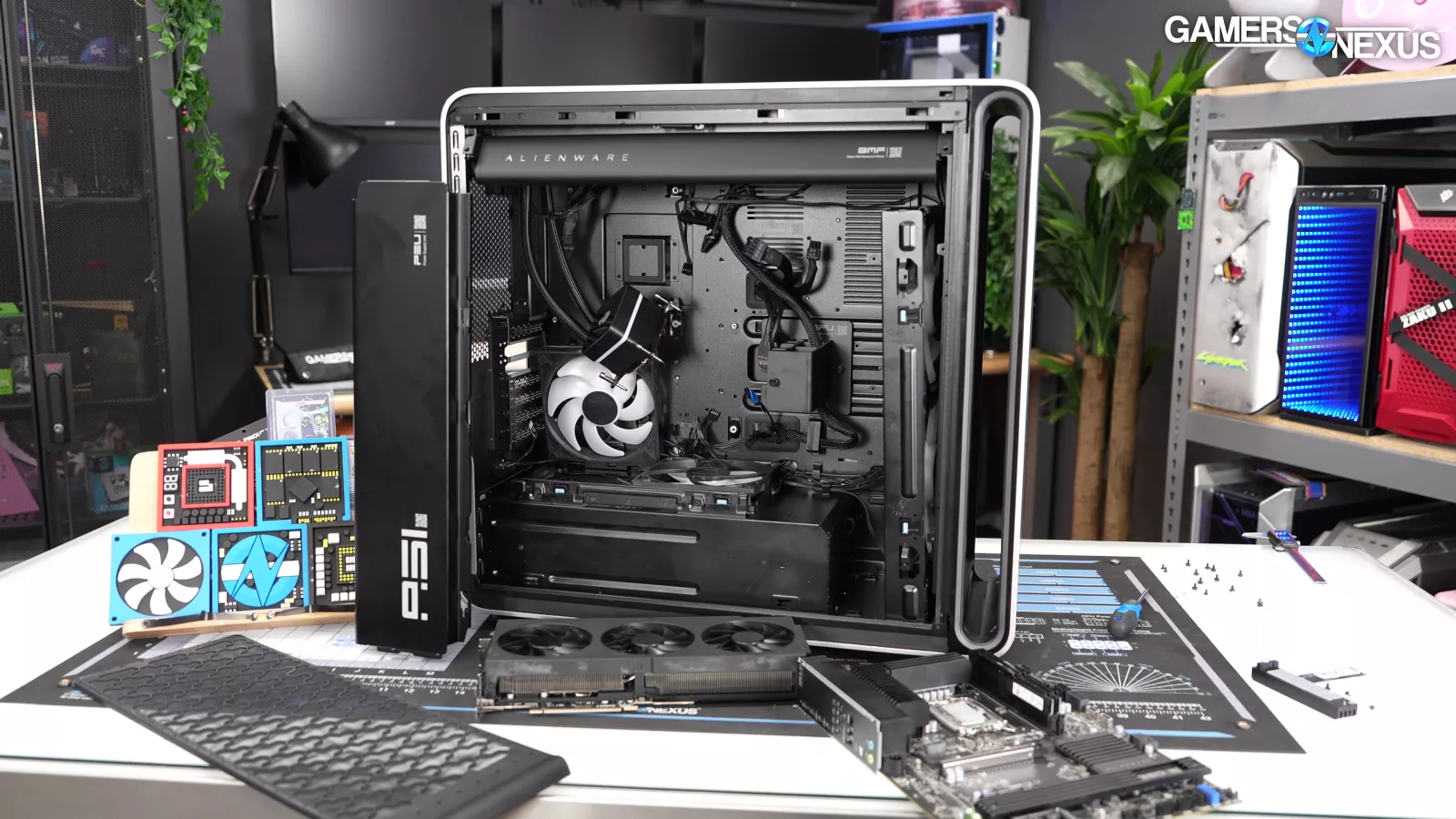
Alienware clearly took among the criticisms in regards to the former Aurora desktops critically. The case is heavy and considerably elaborate, however it’s really sort of considerate in some locations. The half choice is area of interest and will not have a transparent improve path, however it’s not proprietary, in order that places fault on Intel greater than Alienware this time, although we’d wish to see one thing like a 9800X3D (learn our review) possibility. ATX12VO is uncommon, however it’s an precise customary that has effectivity enhancements over common ATX12V. If Alienware sticks with this however lands on a extra upgradeable platform sooner or later, they could have the premise of a great formulation.
The value is the worst half. We have been capable of finding some various pre-builts with related elements for a couple of $700 – $900 improve over DIY value, which might make these cheaper, however we’re working to get these in to verify they’re any good.
In any case, it’s really a great laptop, and unironically, Alienware can get the “It’s-better-than-Dell” award. It’s technically a Dell, however now we simply must see if Dell can enhance its precise Dell identify product lineup for gaming. We might change the identify of the award to “It’s-better-than-Origin.”