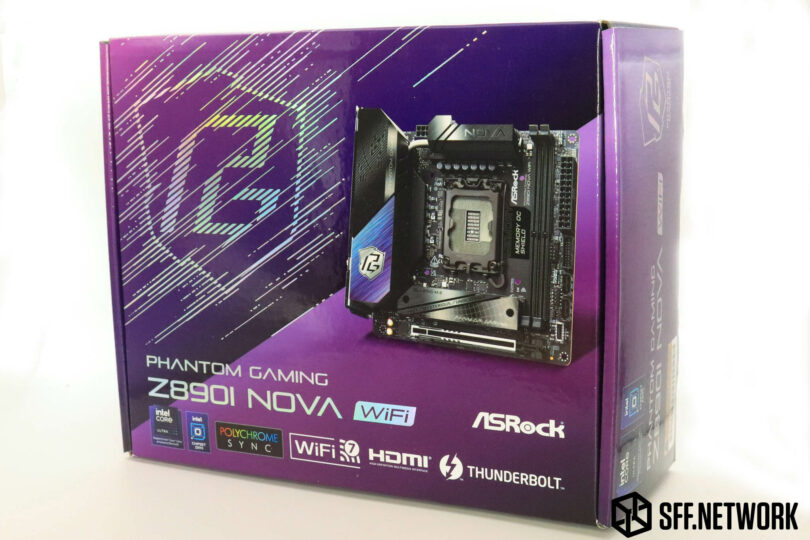
ASRock’s Z890I Nova WiFi Overview / Review – Intel Core Ultra Debuts on ITX – SFF.Network Leave a comment
Nova – Derived from the Latin phrase “Novus”, that means new. That is the second technology of Nova branded boards from ASRock, nonetheless that is certainly the primary M-ITX variant. Of be aware to those that are accustomed to ASRock’s product traces, it appears that evidently the Phantom Gaming branding is taking some what of a step again on this new technology of boards – resulting in a extra “skilled” somewhat than “gamer” aesthetic for these merchandise.
Because the ASRock Z890I Nova WiFi helps a brand new technology of Intel processor, let’s shortly run over this. I’ll do a deeper dive into the architectural modifications in an upcoming overview of the processor itself.
Intel’s Core Extremely 200 breaks with the “i” moniker – which changed “Core(2)” many, a few years in the past. There are 5 SKUs obtainable at launch, beginning off with the Extremely 9 285K, a 24 thread processor (8 Efficiency Cores and 16 Effectivity Cores), all the best way right down to the 14 thread (6 P Cores, 8 E Cores) Core Extremely 5 245KF. One factor to notice is that Intel, after 22 years, has dropped their HyperThreading know-how, that means that the core rely equals the thread rely.
All of the SKUs obtainable at launch have a 125W base TDP, with the 9 and seven SKUs boosting as much as a claimed 250W, and the 5 sequence maxing out at 159W. A extra in depth spec sheet is out there on Intel’s website.
I’ll be testing the ASRock Z890I Nova WiFi with the highest of the road Intel Core Extremely 9 285K, kindly offered to SFF Community by ASRock. Being that it is a NZ$1100 / US$570 processor, that is very a lot appreciated – and never one thing we may fund ourselves.
SFF Community is run by volunteers and funded by our subscribers. Please take a look at our subscription options and merch store for those who’d prefer to assist the SFF perspective within the PC market!
And as at all times, earlier than making a call on a product, take a look at different critiques from different retailers for a extra thorough and full image of the product.
Earlier than we delve into the overview, I wish to remind readers of our overview philosophy because it differs from most others. Product choice within the Small Type Issue world is primarily pushed by compatibility with efficiency being a secondary concern. In layman’s phrases, you purchase the product that appears like it should suit your construct and cope with the implications afterwards. As such, I shall be focusing much less on uncooked efficiency than I’ll on high quality, packaging, and design.
ASRock despatched us the Z890I Nova WiFi as a overview pattern with no mandates or expectations, nor did they exert any stress. I at all times acknowledge an organization that’s in search of an trustworthy overview somewhat than an advertorial. My very own private bias going into this overview is a common liking of ASRock’s dedication to the SFF world, in addition to possession of a number of ASRock merchandise through the years, as a consequence of their traditional good worth proposition.
Specs
Observe: The under desk is copied verbatim from ASRock’s product page.
| CPU Support | – Helps Intel® Core™ Extremely Processors (Collection 2) (LGA1851RL-ILM) – Helps Intel® Hybrid Expertise – Helps Intel® Turbo Increase Max 3.0 Expertise – Helps Intel® Thermal Velocity Increase (TVB) – Helps Intel® Adaptive Increase Expertise (ABT) – Built-in NPU for devoted AI acceleration |
| Chipset | – Intel® Z890 |
| Reminiscence | Twin Channel DDR5 Reminiscence Expertise – 2 x DDR5 DIMM Slots – Helps DDR5 non-ECC, un-buffered reminiscence as much as 9866+(OC)* – Helps Clocked Unbuffered DIMM (CUDIMM) – Max. capability of system reminiscence: 128GB* – Helps Intel® Excessive Reminiscence Profile (XMP) 3.0x*1DPC 1R As much as 9866+ MHz (OC), 6400 MHz Natively. 1DPC 2R As much as 6800+ MHz (OC), 6400 MHz Natively. |
| BIOS | – 256Mb AMI UEFI Authorized BIOS with GUI assist |
| Graphics | – Intel® Xe LPG Graphics Structure – 1 x HDMI 2.1 TMDS/FRL 8G Appropriate, helps HDR, HDCP 2.3 and max. decision as much as 4K 120Hz – 2 x Intel® Thunderbolt™ 4, assist HDCP 2.3 and max. decision as much as 8K 60Hz / 5K 120Hz** Intel® UHD Graphics Constructed-in Visuals and the VGA outputs might be supported solely with processors that are GPU built-in. Helps two 4K shows or one 8K show Solely the CPU’s embedded graphics might be displayed via Thunderbolt™ ports. If you wish to show to a Thunderbolt™ monitor, please use CPU fashions with embedded graphics. |
| Audio | – 7.1 CH HD Audio with Content material Safety (Realtek ALC4082 Audio Codec) – Nahimic Audio |
| LAN | – 5 Gigabit LAN 10/100/1000/2500/5000 Mb/s – Realtek RTL8126 |
| Wi-fi LAN | – 802.11be 2×2 Wi-Fi 7 Module – Helps IEEE 802.11a/b/g/n/ac/ax/axe/be – Helps 2.4GHz/5GHz/6GHz* frequency band – Helps 320MHz channel bandwidth with 6GHz* frequency band – 1 antenna to assist 2 (Transmit) x 2 (Obtain) variety know-how – Helps Bluetooth 5.4 – Helps MU-MIMO* Wi-Fi 7 (6GHz band) shall be supported by Microsoft Home windows® 11. The provision will depend upon the totally different regulation standing of every nation and area. It is going to be activated (for supported nations) via Home windows® Replace and software program updates as soon as obtainable. |
| Slots | CPU: – 1 x PCIe 5.0 x16 Slot (PCIE1), helps x16 mode* Chipset: – 1 x Vertical M.2 Socket (Key E), helps kind 2230 WiFi/BT PCIe WiFi module – 15μ Gold Contact in VGA PCIe Slot (PCIE1)* PCIE1 helps PCIe riser playing cards to increase one x16 slot to x8/x8 or x8/x4/x4 slots. Helps NVMe SSD as boot disks |
| Storage | CPU: – 1 x Blazing M.2 Socket (M2_1, Key M), helps kind 2280 PCIe Gen5x4 (128 Gb/s) mode* – 1 x Hyper M.2 Socket (M2_2, Key M), helps kind 2280 PCIe Gen4x4 (64 Gb/s) mode* Chipset: – 1 x Hyper M.2 Socket (M2_3, Key M), helps kind 2280 SATA3 6.0 Gb/s & PCIe Gen4x4 (64 Gb/s) modes* – 2 x SATA3 6.0 Gb/s Connectors* Helps Intel® Quantity Administration System (VMD) Helps NVMe SSD as boot disks |
| RAID | – Helps RAID 0 and RAID 1 for SATA storage gadgets – Helps RAID 0, RAID 1, RAID 5 and RAID 10 for M.2 NVMe storage gadgets* Requires further M.2 NVMe growth playing cards to assist RAID 10 |
| USB | CPU: – 2 x Thunderbolt™ 4 Kind-C (Rear) Chipset: – 1 x USB 3.2 Gen2x2 Kind-C (Entrance) – 6 x USB 3.2 Gen2 Kind-A (Rear) – 2 x USB 3.2 Gen1 (Entrance) – 2 x USB 2.0 (Entrance)* All USB ports assist ESD Safety |
| Connector | – 1 x Thermistor Cable Header – 2 x Addressable LED Headers* – 1 x CPU Fan Connector (4-pin) (Good Fan Pace Management)** – 1 x Chassis Fan Connector (4-pin) (Good Fan Pace Management)** – 1 x AIO Pump Fan Connector (4-pin) (Good Fan Pace Management)*** – 1 x 24 pin ATX Energy Connector (Hello-Density Energy Connector) – 1 x 8 pin 12V Energy Connector (Hello-Density Energy Connector) – 1 x Entrance Panel Audio Connector (15μ Gold Audio Connector) – 1 x USB 2.0 Headers (Helps 2 USB 2.0 ports) – 1 x USB 3.2 Gen1 Headers (Helps 2 USB 3.2 Gen1 ports) – 1 x Entrance Panel Kind C USB 3.2 Gen2x2 Header (20 Gb/s)* Assist in whole as much as 5V/3A, 15W LED Strip ** CPU_FAN and CHA_FAN1 assist the fan energy as much as 2A (24W). *** AIO_PUMP helps the fan energy as much as 3A (36W). AIO_PUMP can auto detect if 3-pin or 4-pin fan is in use. |
| Rear Panel I/O | – 2 x Antenna Ports – 1 x HDMI Port – 2 x Thunderbolt™ 4 Kind-C Ports (40 Gb/s for USB4 protocol; 40Gb/s for Thunderbolt™ protocol)* – 1 x Optical SPDIF Out Port – 6 x USB 3.2 Gen2 Kind-A Port (10 Gb/s) – 1 x RJ-45 LAN Port – 1 x BIOS Flashback Button – 1 x Line Out Jack (Gold Audio Jack) – 1 x Microphone Enter Jack (Gold Audio Jack)* Helps USB PD 3.0 as much as 5V@3A (15W) charging |
| Software program and UEFI | Software program – ASRock Motherboard Utility (Phantom Gaming Tuning) – ASRock Phantom Gaming LAN Software program – ASRock Polychrome SYNC* UEFI – ASRock EZ Mode – ASRock Full HD UEFI – ASRock My Favorites in UEFI – ASRock Auto Driver Installer – ASRock Prompt Flash*These utilities might be downloaded from ASRock Stay Replace & APP Store. |
| Equipment | – 2 x SATA Information Cables – 1 x ASRock WiFi 2.4/5/6 GHz Antenna – 1 x ARGB Splitter Cable – 1 x Thermistor Cable – 3 x Screws for M.2 Sockets |
| Type Issue | – Mini-ITX Type Issue: 6.7-in x 6.7-in, 17.0 cm x 17.0 cm – 10 Layer PCB – 2oz Copper PCB |
| OS | – Microsoft Home windows® 11 64-bit |
| Certifications | – FCC, CE – ErP/EuP prepared (ErP/EuP prepared energy provide is required) |
Unboxing
ASRock is leaning closely on a purple color scheme this technology – an fascinating pivot from the black/crimson of outdated.
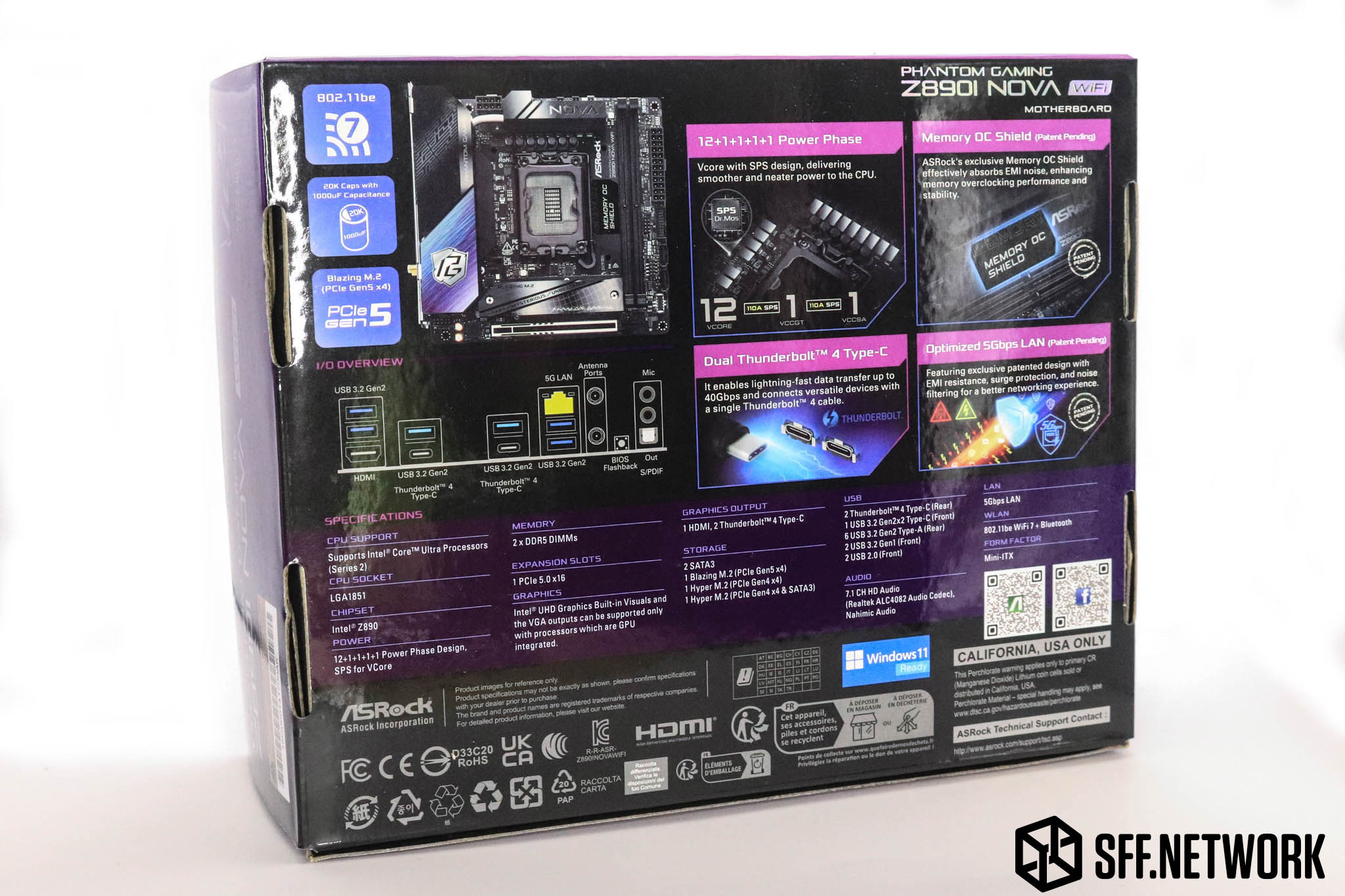
The same old specs and advertising factors are to be discovered on the again of the field – we’ll contact on a few of these gadgets because the overview progresses. Let’s get into it!
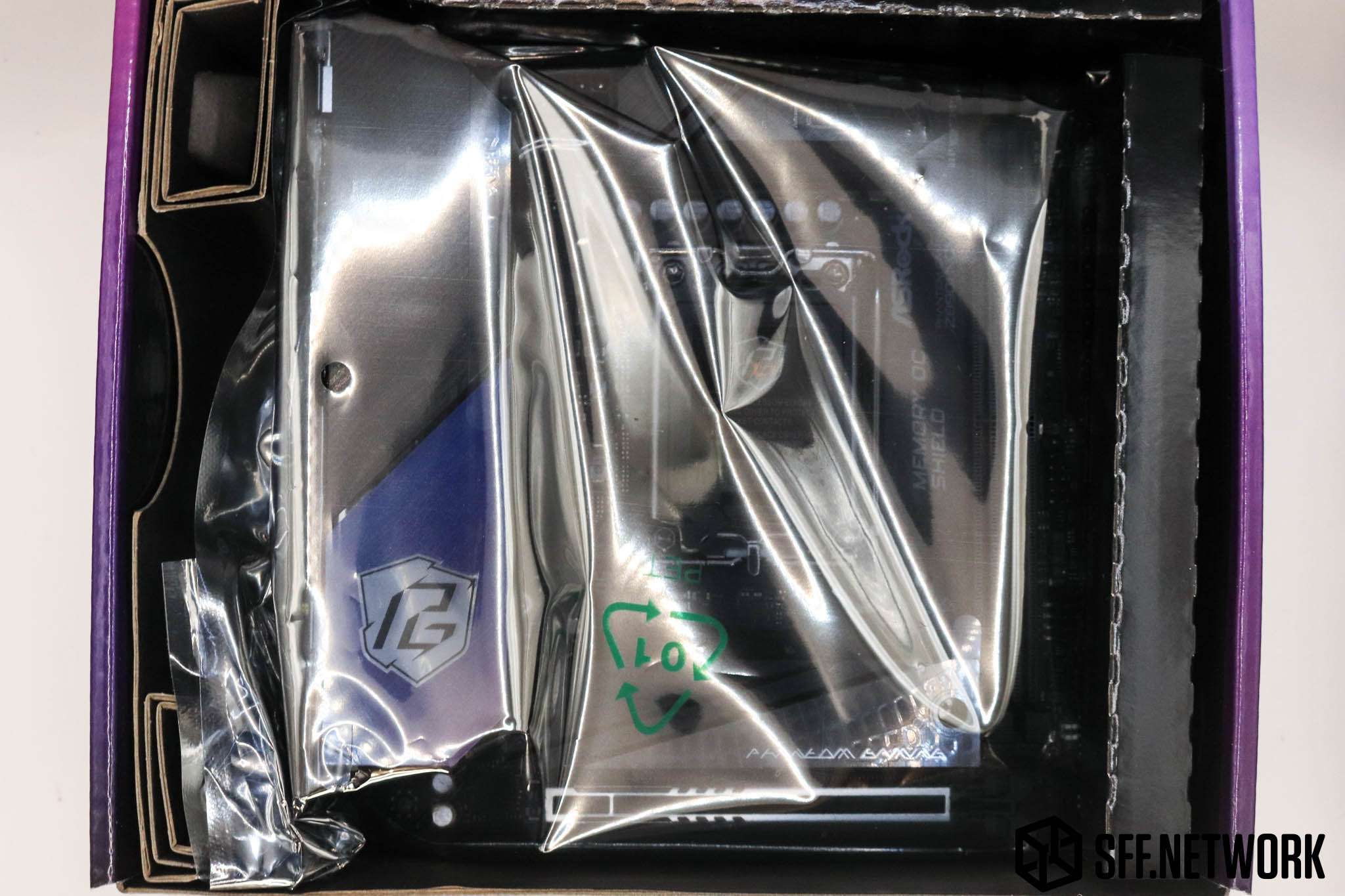
No padding between the board and the highest of the field – hopefully the field has been handled with care in transit!
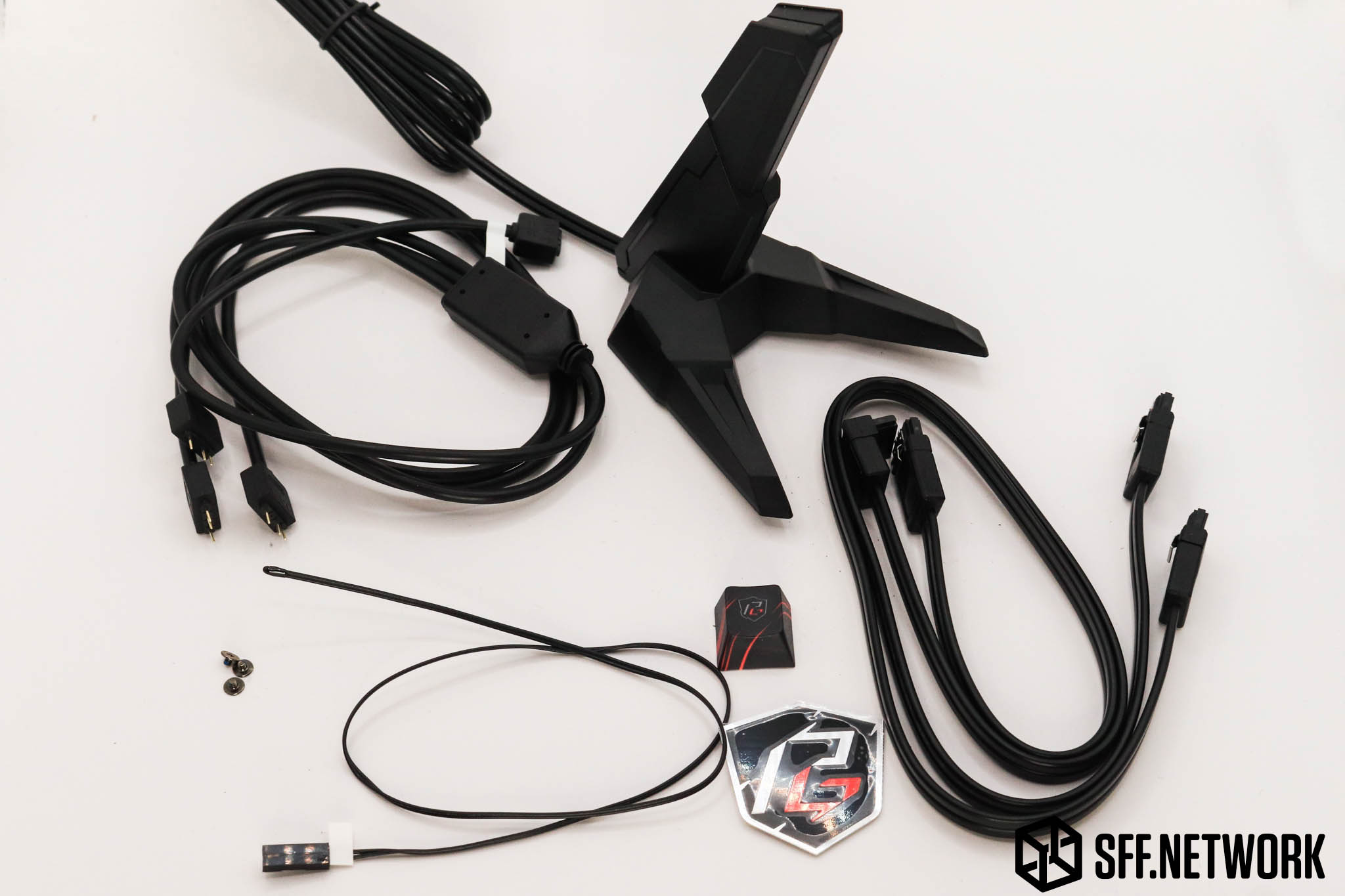
Earlier than I have a look at the ASRock Z890i Nova WiFi, a fast have a look at the included equipment is required. From prime left, in a clockwise style;
- Addressable RGB splitter cable supporting 3 gadgets from a single header
- WiFi Antenna (seen right here in assembled type)
- A pair of SATA cables for many who want extra storage than the board’s 3x M.2 slots can assist (or spinning rust)
- A steel Phantom Gaming case badge
- Above which is a Phantom Gaming keycap – fascinating addition
- A thermal probe that connects to a header on the motherboard
- A trifecta of M.2 mounting screws
Overview
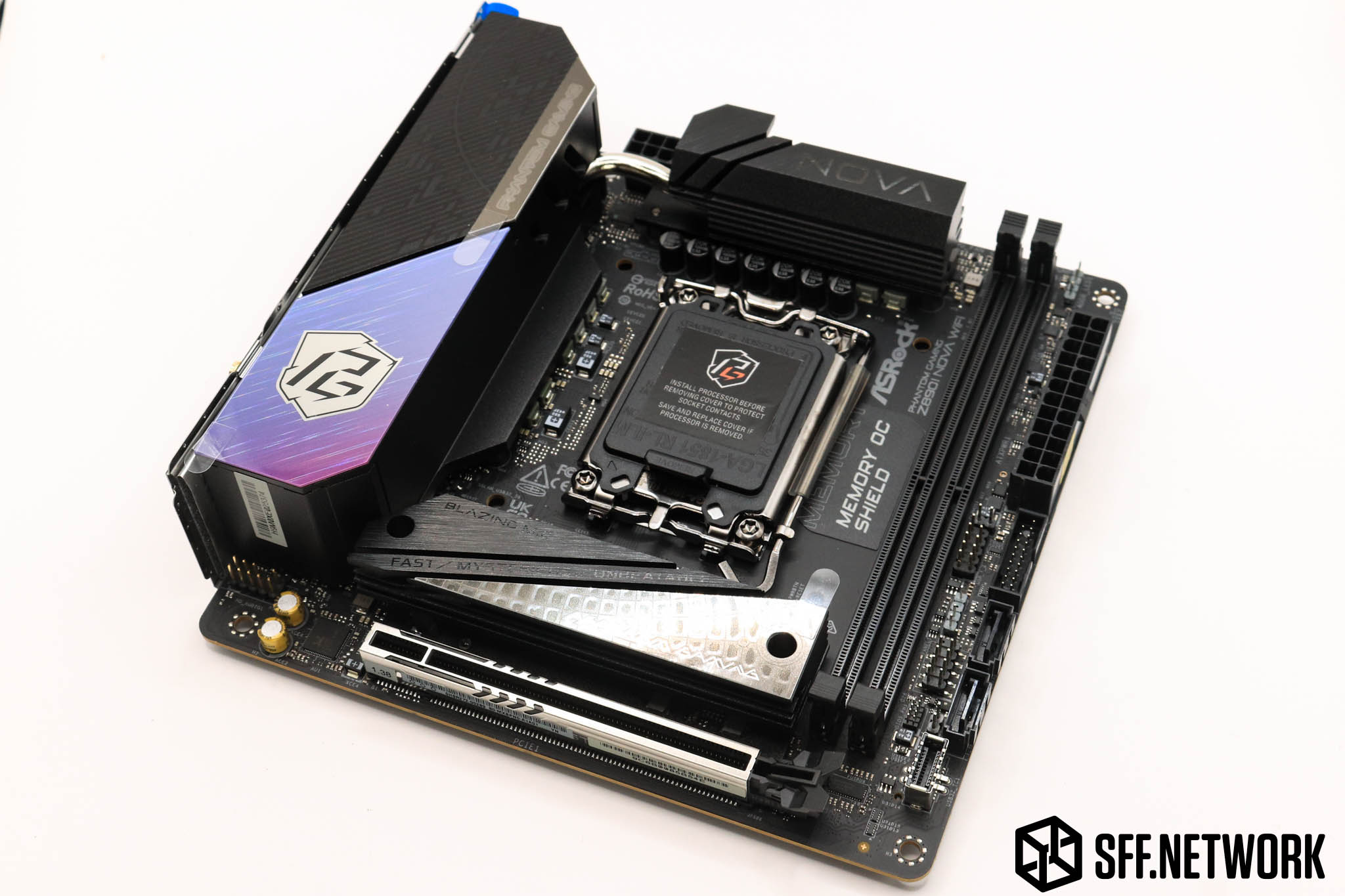
Our first have a look at the ASRock Z890i Nova WiFi, a modern trying board. The general aesthetic is much less aggressive than the earlier technology Z790i Lightning WiFi, albeit with the addition of a considerably iridescent purple accent piece. The board’s structure is typical – not a lot has modified on this facet throughout M-ITX for the previous few generations. The truth is – apart from a pair small particulars, this board would slot straight right into a customized cabled system from the final 3 or so generations without having to regulate the cables in size or place!
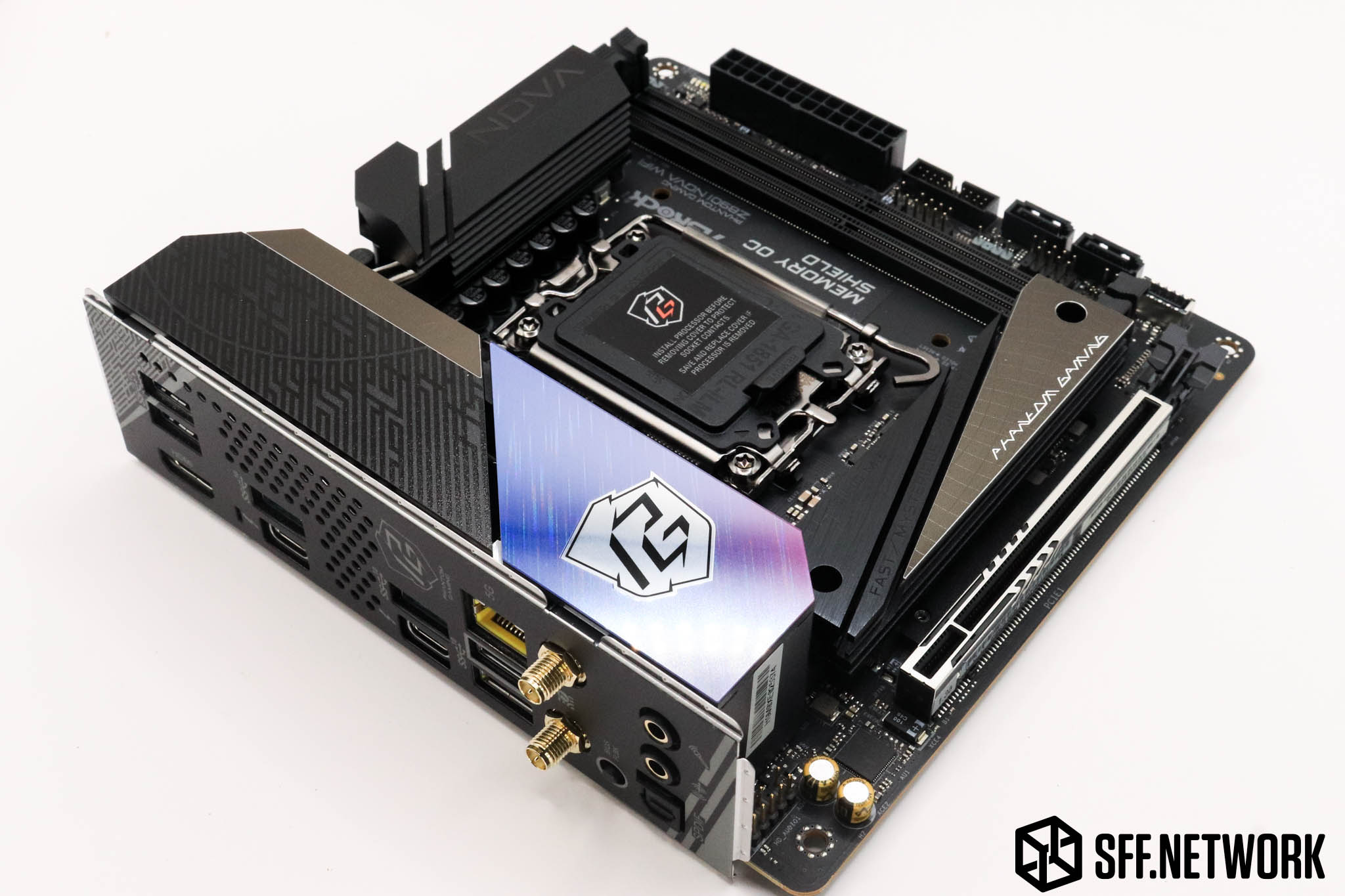
The iridescent impact on the IO cowl/heatsink is a cool impact, and stands out!
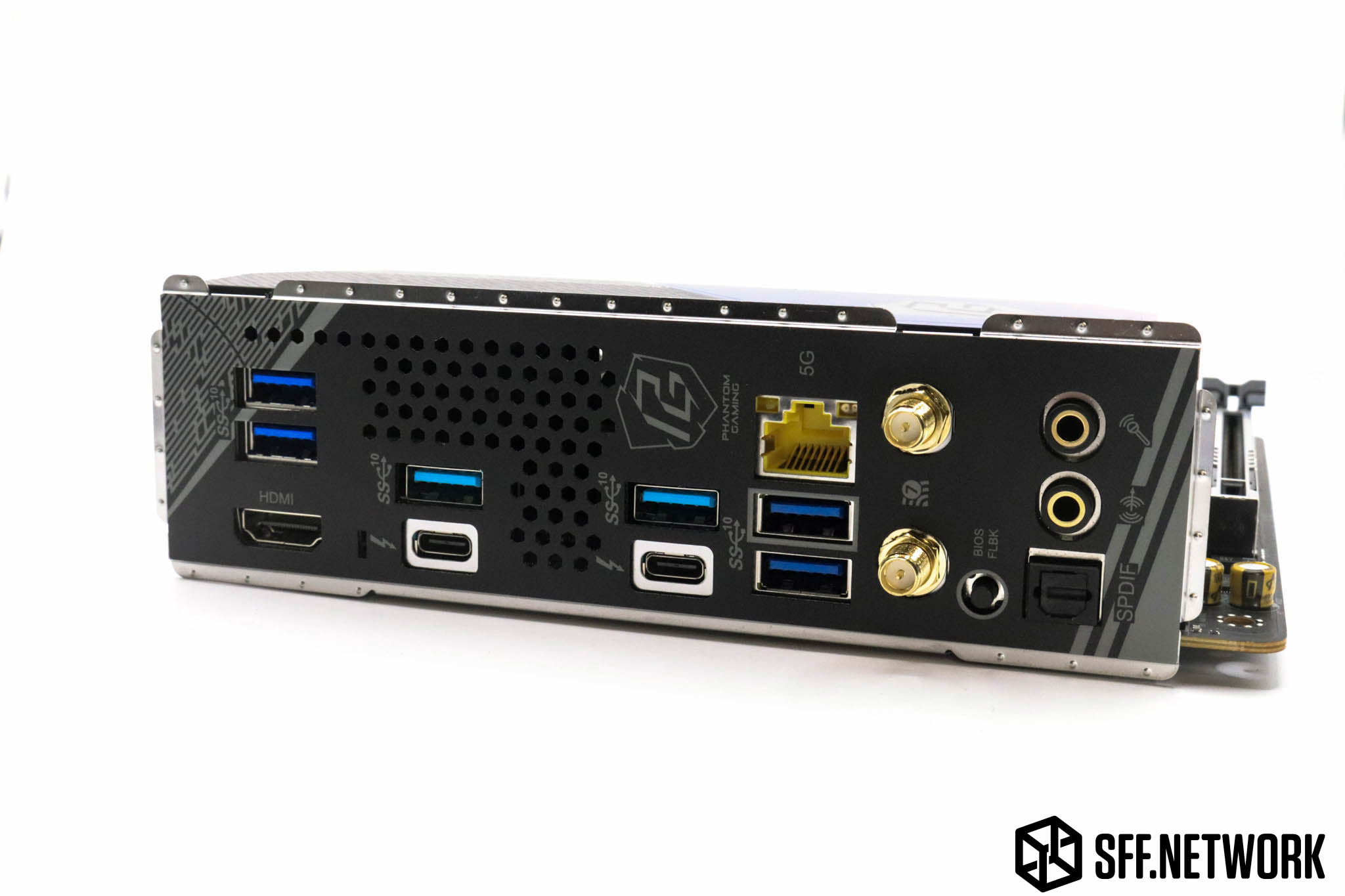
The IO protect, like on most high-end motherboards these days, is completely affixed. Whoever got here up with this concept initially deserves a Nobel Peace Prize – the quantity of occasions I’ve forgotten to pop the IO protect right into a case pre-board set up would justify it alone. As a substitute of rattling off the port itemizing and specs; take a look at the diagram from ASRock’s digital User Manual:
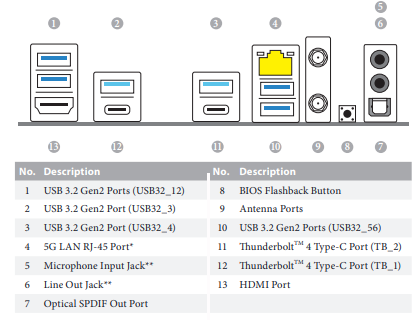
One characteristic to notice – the BIOS Flashback button. By utilizing the topmost of of the USB ports denoted as #10 within the above screenshot, you’ll be able to flash the BIOS on the board… even and not using a CPU being put in! While it appears odd to have a button right here for a once-in-a-blue-moon process, it certain beats pulling aside a correctly densely packed SFF system to carry out this process with an inside header or button.
Between the product launch and the time I made it to testing the ASRock Z890I Nova WiFi, the BIOS model had been up to date 4 occasions by ASRock – from 1.38, via 2.06, 2.09, 2.13 and on to a Beta 2.14 launch. To make sure correct testing, I used this BIOS Flashback operate to replace the board’s BIOS to V2.13 previous to first boot (Beta 2.14 was not out after I first arrange the system). While flashing a BIOS with nothing besides a blinking LED for maintaining a tally of the standing is terrifying, the flash labored with out fault, a lot to my reduction.
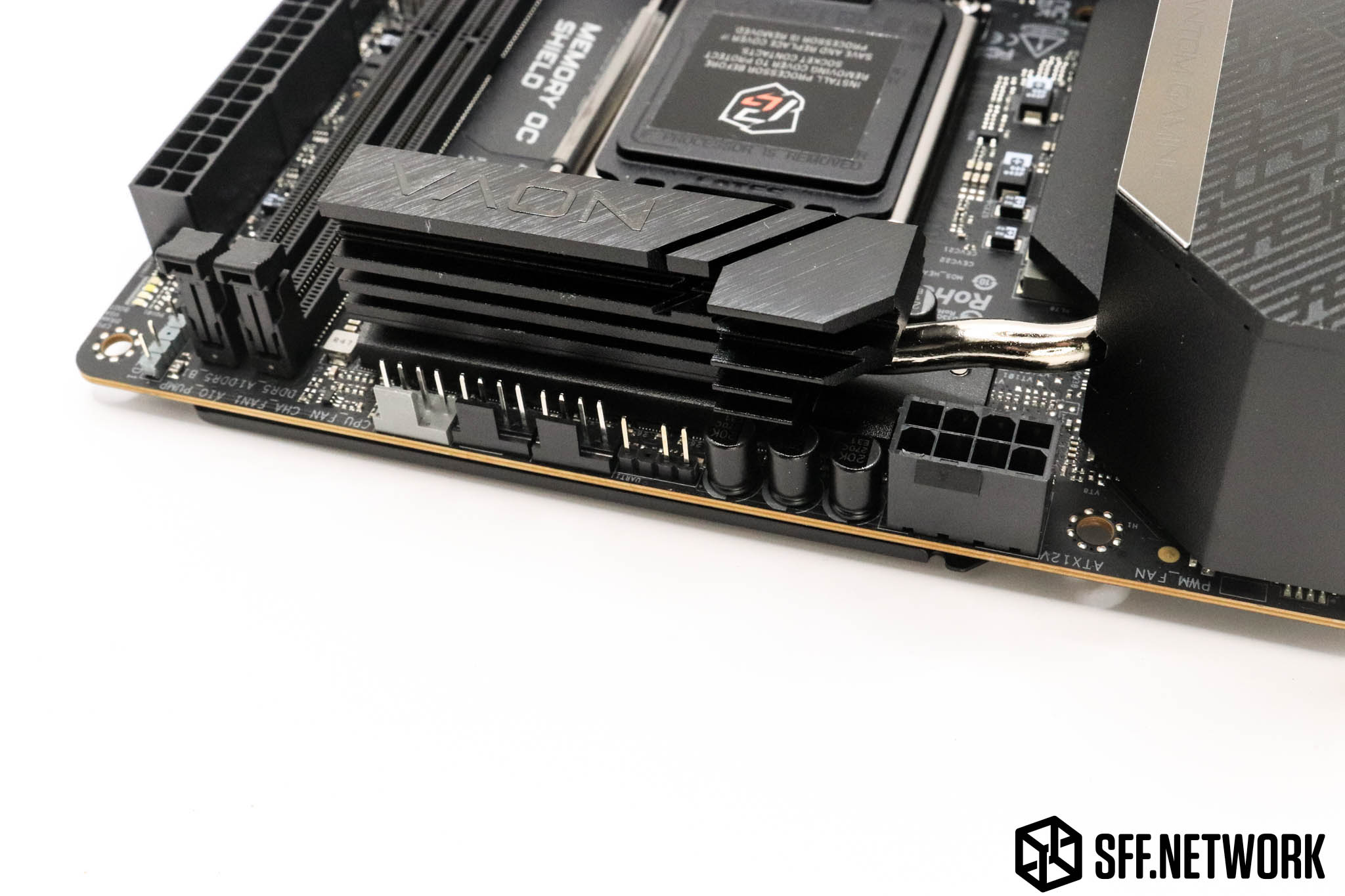
To the highest of the board, the place we are able to see a bunch of headers! From the left of the RAM slots – the three pin addressable LED header (in gray), a trifecta of fan headers, – AIO_PUMP, CHA_FAN1 and CPU_FAN, a UART header and at last the ATX12V socket.
The fan header to which you join your cooler is necessary – not just for the very best fan management in use (i.e. the CPU fan will by default react to the CPU temperature), but additionally for present provide functionality. The AIO_PUMP header can present 3 Amps of energy, up from 2 Amps of the opposite headers. While most closed loop coolers draw nowhere close to the utmost present of any of those headers – the Xigmatek Frozr-O II 360 I exploit in testing attracts a peak of 0.3 Amps, there might some heftier pumps on the market.
Between these headers and the brand new Intel LGA1851 socket is the VRM portion of the motherboard cooling system, linked through heatpipe to the rear IO cowl to assist in cooling. Whereas the brand new Core Extremely technology of processors is purported to make use of much less energy than earlier generations (we’ll take a look at this later within the article), the VRM resolution right here remains to be a hefty 12+1+1+1 configuration, with 110 Amp VCore functionality. Regulating this degree of energy has its’ drawbacks, as any MOSFET will produce warmth in use, and normally proportional to load.
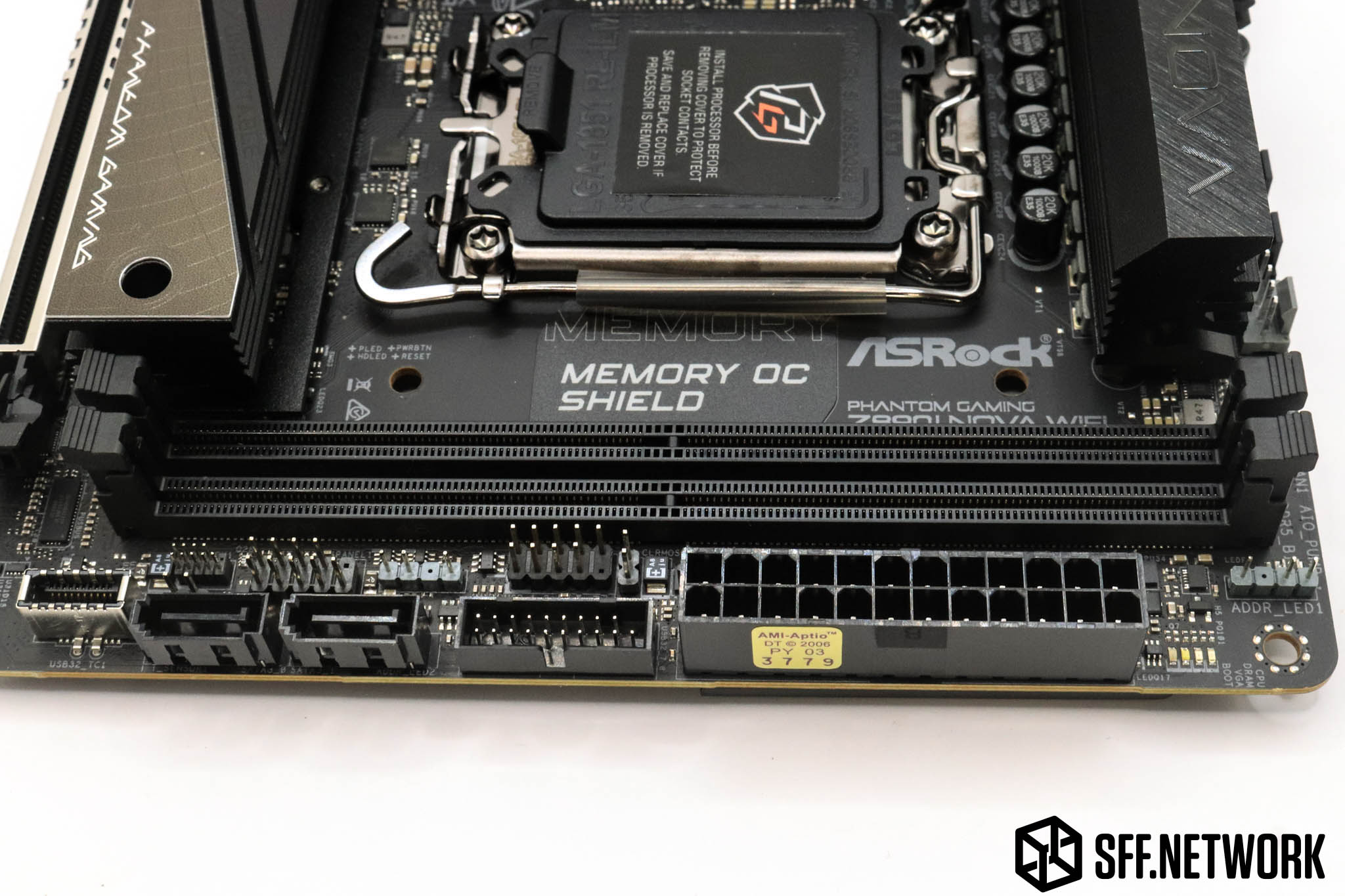
To the entrance of the board, which carries the identical structure because the earlier technology Z790 board. From the left, a entrance panel Kind C USB 3.2 Gen2x2 Header – fortunately changing into extra widespread on fashionable PC instances, a two pin thermistor header above the left of the SATA ports, and the entrance panel header to the correct of that. The ultra-fine pitch header above the thermistor header isn’t marked within the person handbook, however the marking of BIOS_PH1 is seen on the board itself, denoting that that is the BIOS programming header. Persevering with on, one other gray addressable LED header is current, adopted by a USB2.0 and USB3.2 Gen 1 header. The subsequent two pin header is for clearing CMOS – an fascinating alternative by ASRock to incorporate the BIOS Flashback button on the rear IO, however not a transparent CMOS button. Subsequent up is the ATX 24 pin, and at last the topside gray addressable LED header talked about beforehand.
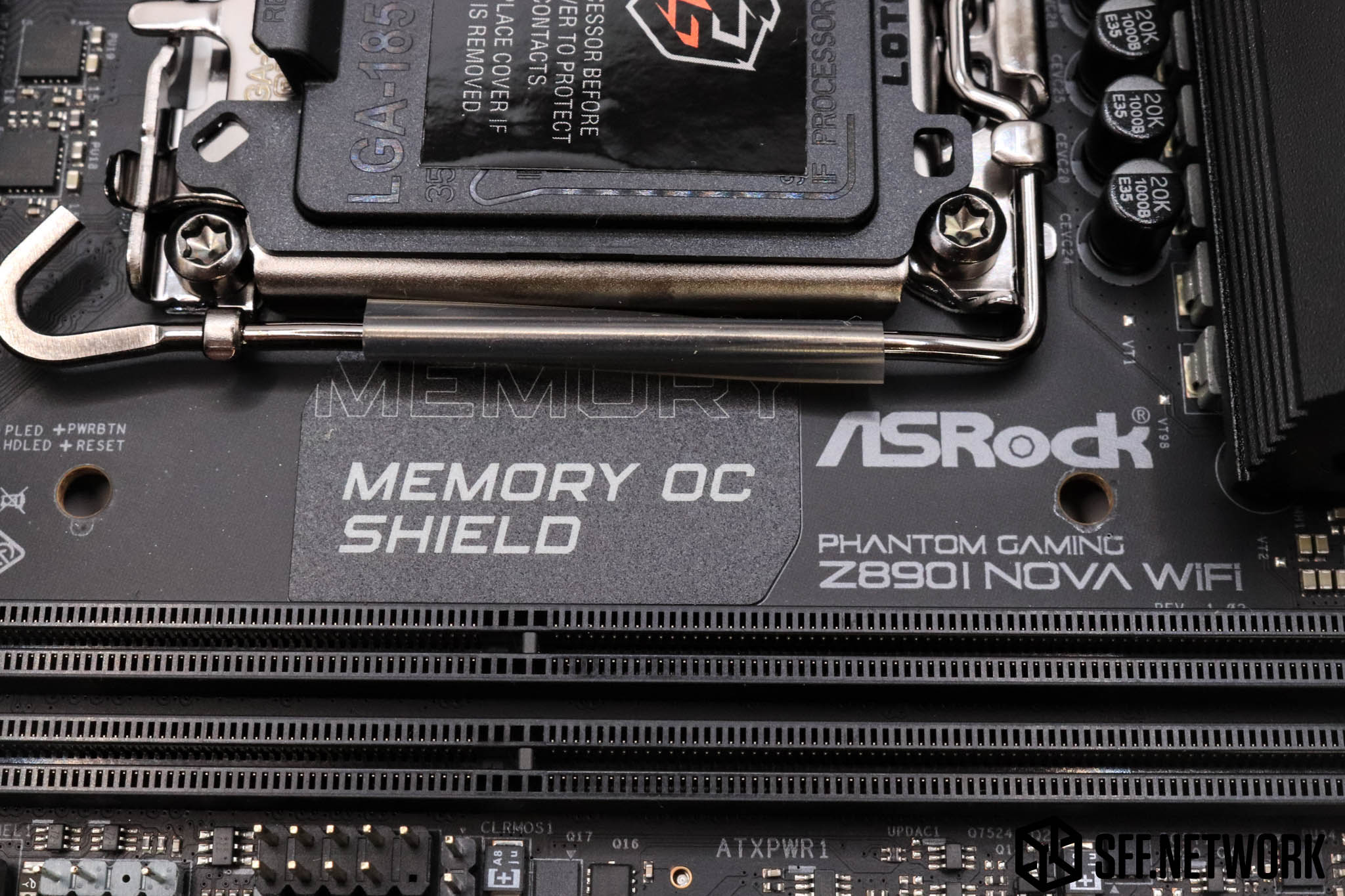
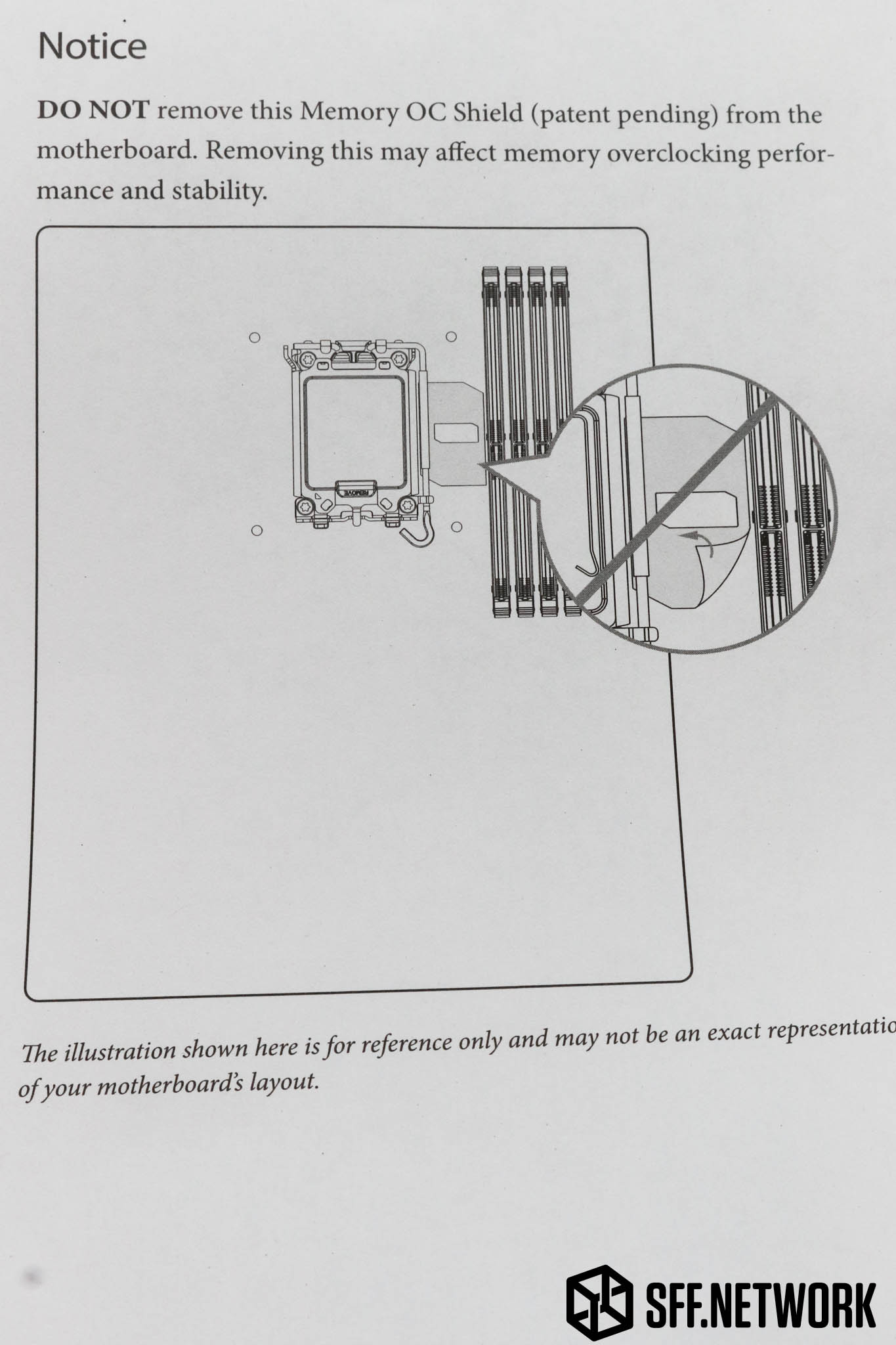
A flowery sticker! This seems to be some type of metallised sticker including shielding to a number of the reminiscence knowledge lanes inside the PCB. I dare not unstick this, even the handbook is obvious on this:
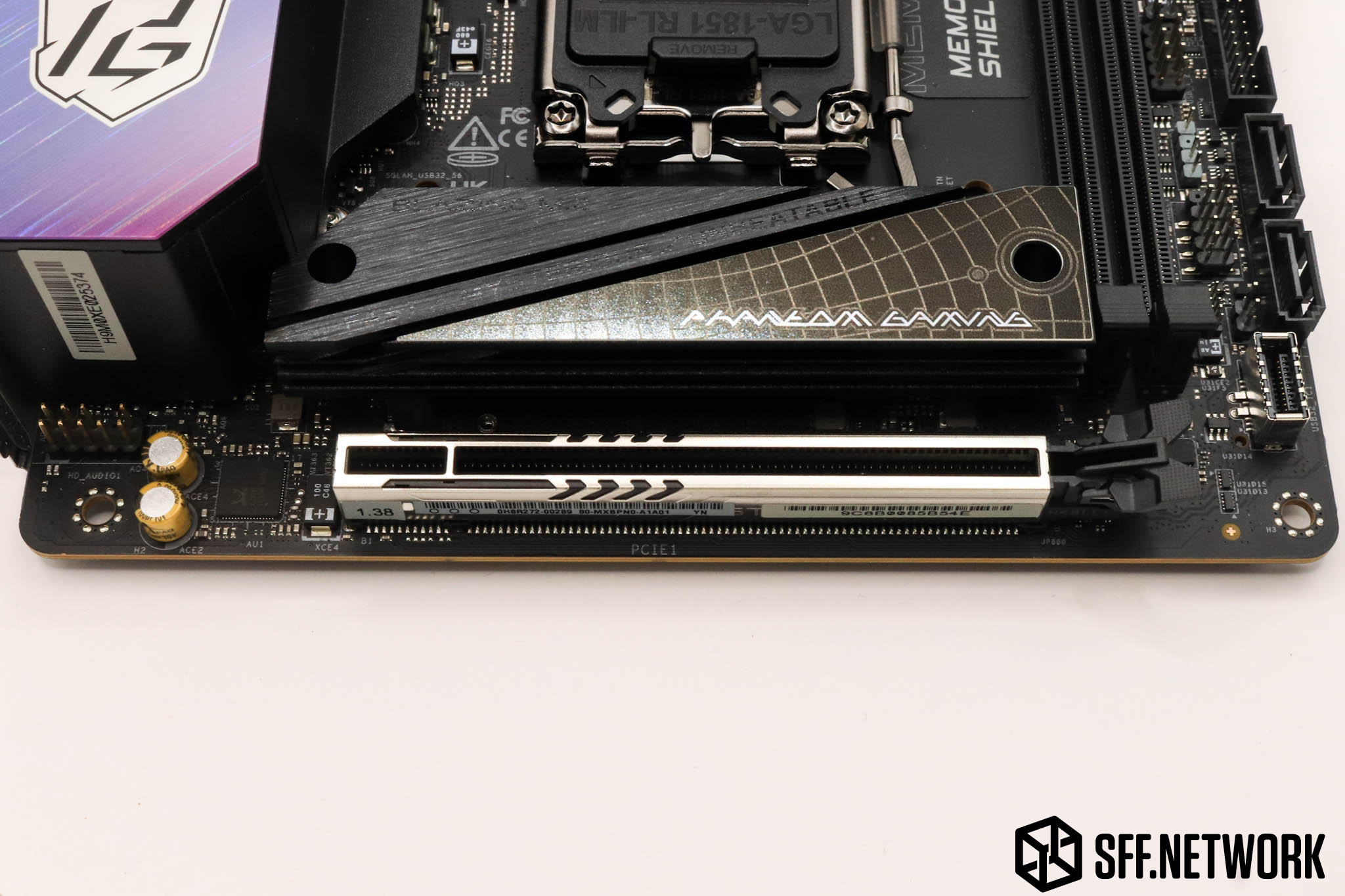
Right down to the underside of the board, the place the armoured PCI Categorical slot resides. The steel framework across the slot is just about a traditional possibility on any fanatic board these days. To the far left is the standard FP_Audio header.
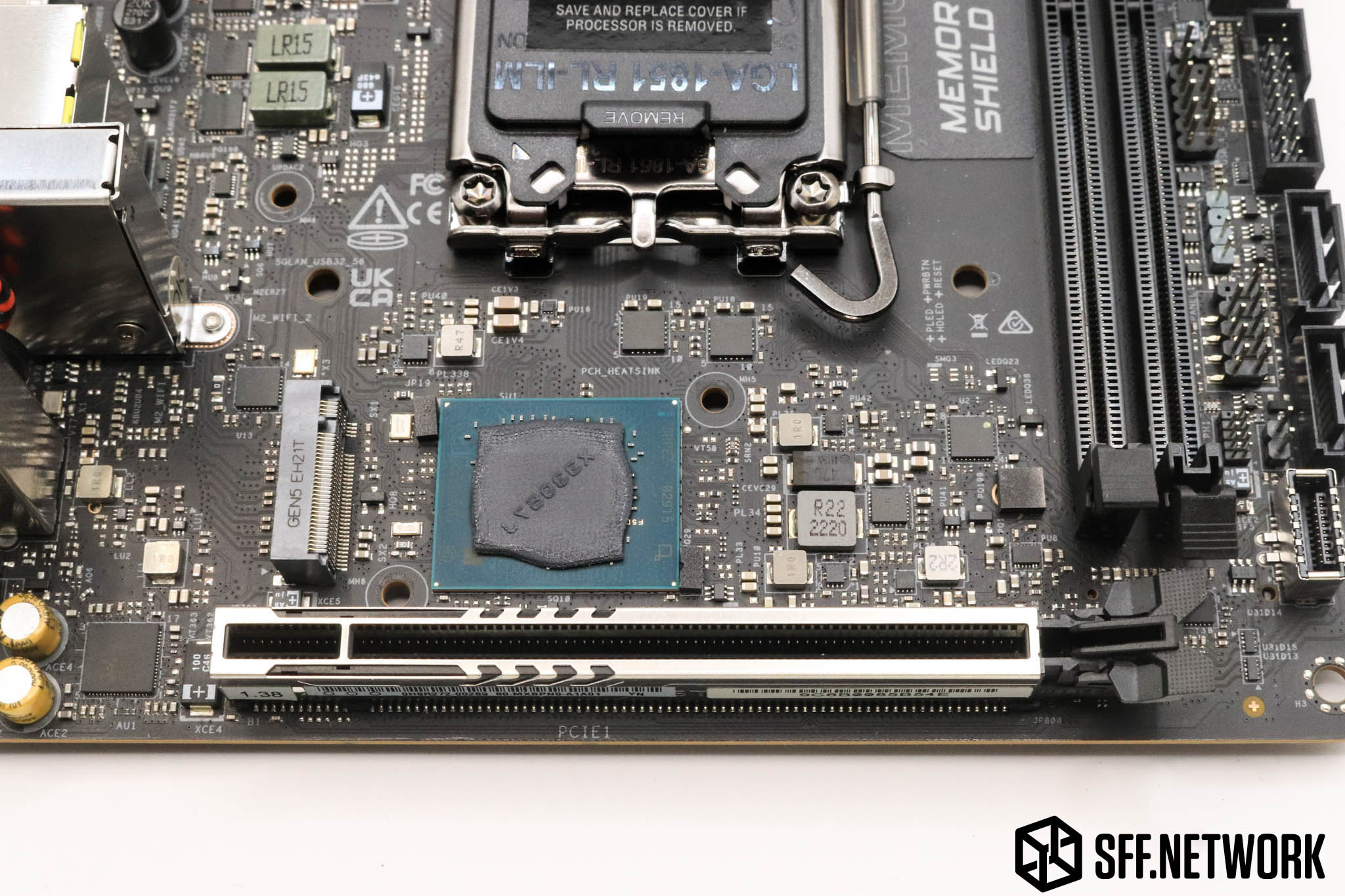
Above the PCIe slot is the first M.2 slot, sitting on prime of the PCH. We’ll dig down into this in a bit.
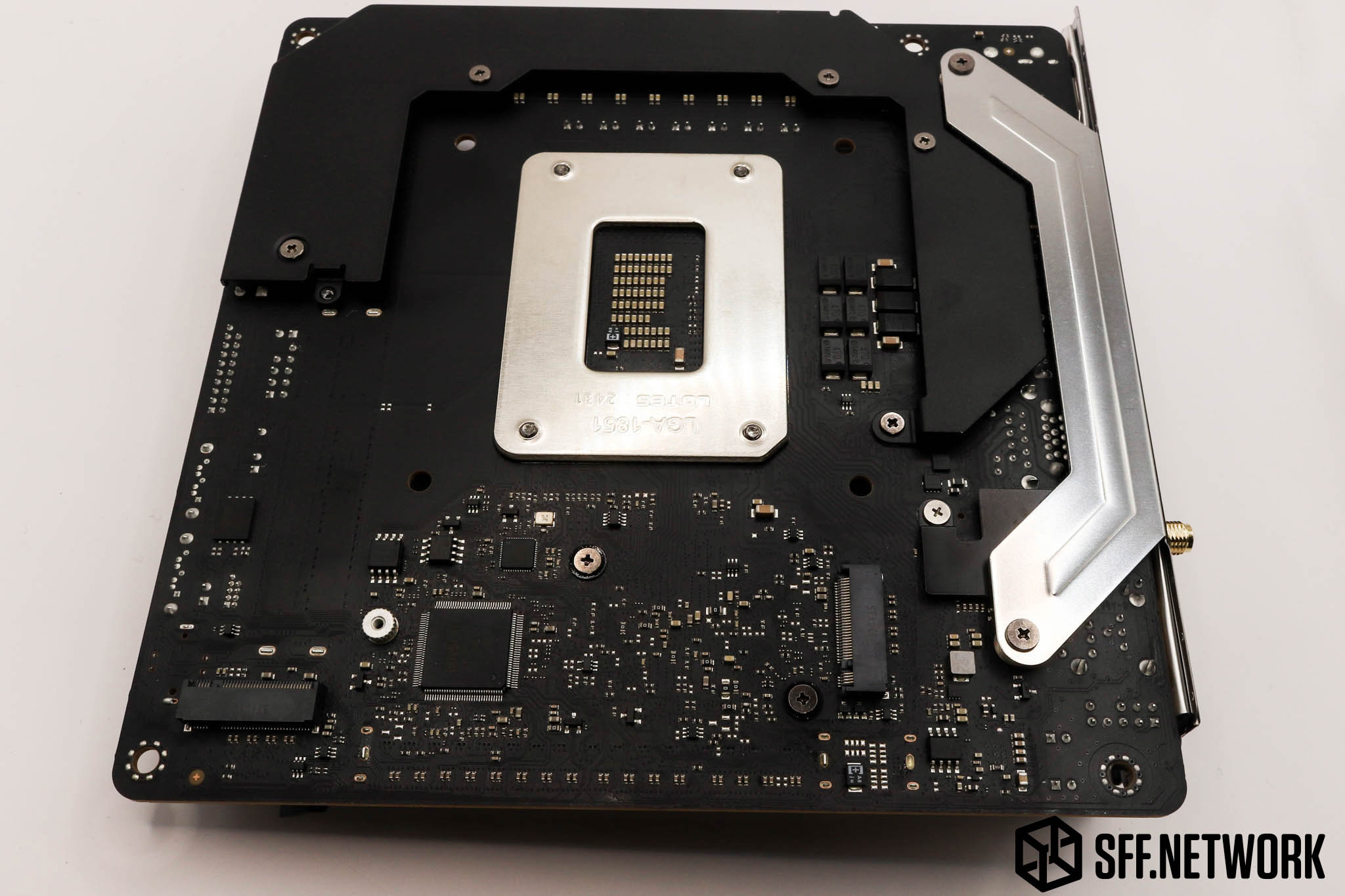
Underneath the board, we are able to see the opposite two M.2 slots – for a complete of three. These aren’t heatsinked like the first slot, and being within the location they’re, we’d suggest utilizing cooler working drives in these slots, lest a meltdown happen!
The rear IO protect mounts to the underside of the board with the shiny metal portion.
The black part of heatsink lies beneath the facility provide circuitry. One factor to notice, the backplate for my Xigmatek Frozr-O II 360 AIO cooler fouled this heatsink plate! I needed to gently trim three corners off to allow the backplate to repair. Your state of affairs might fluctuate, however one thing to remember.
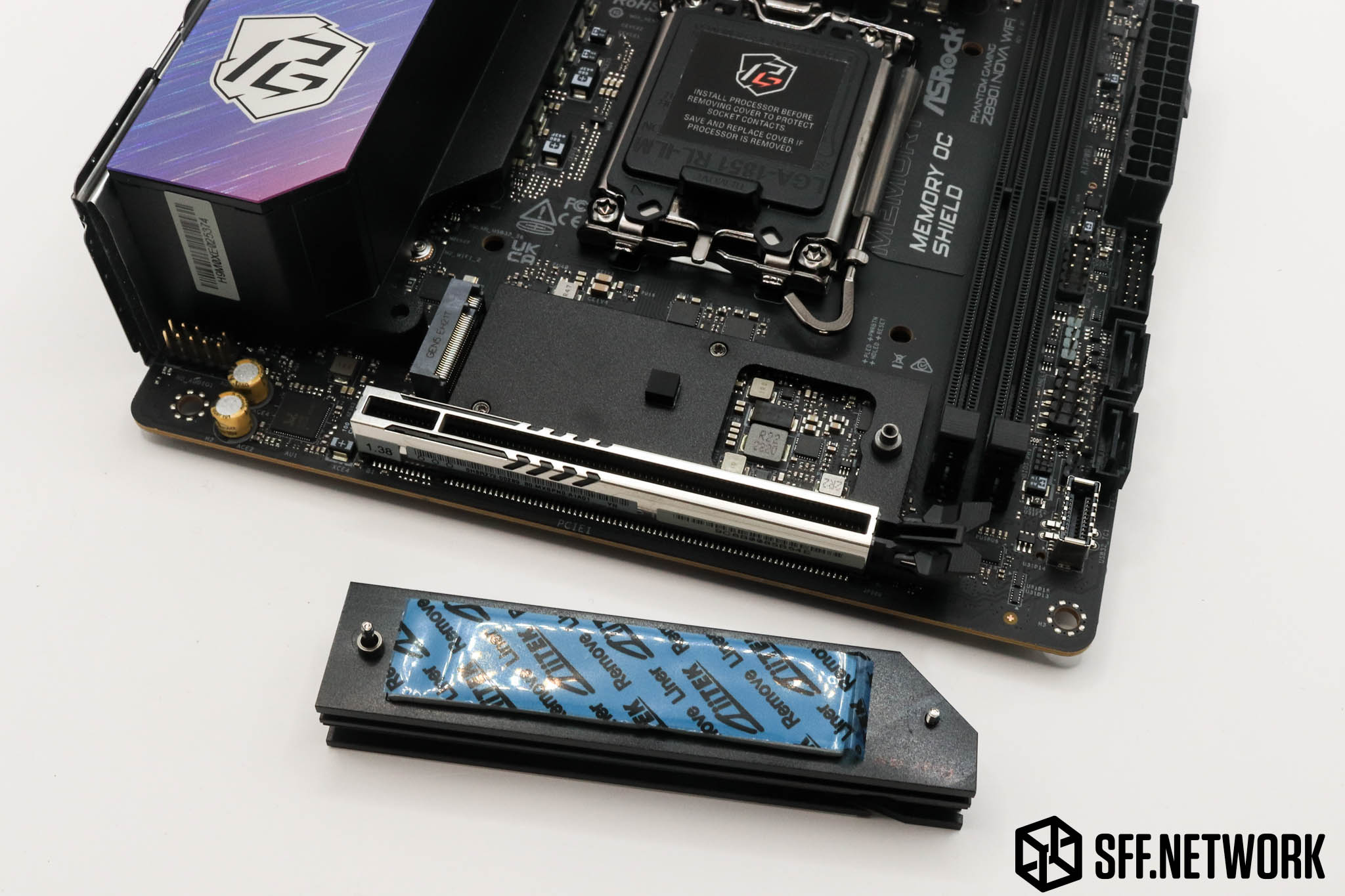
Pulling the M.2 heatsink reveals the slot, and a second layer of heatsink sitting on the PCH (chipset).
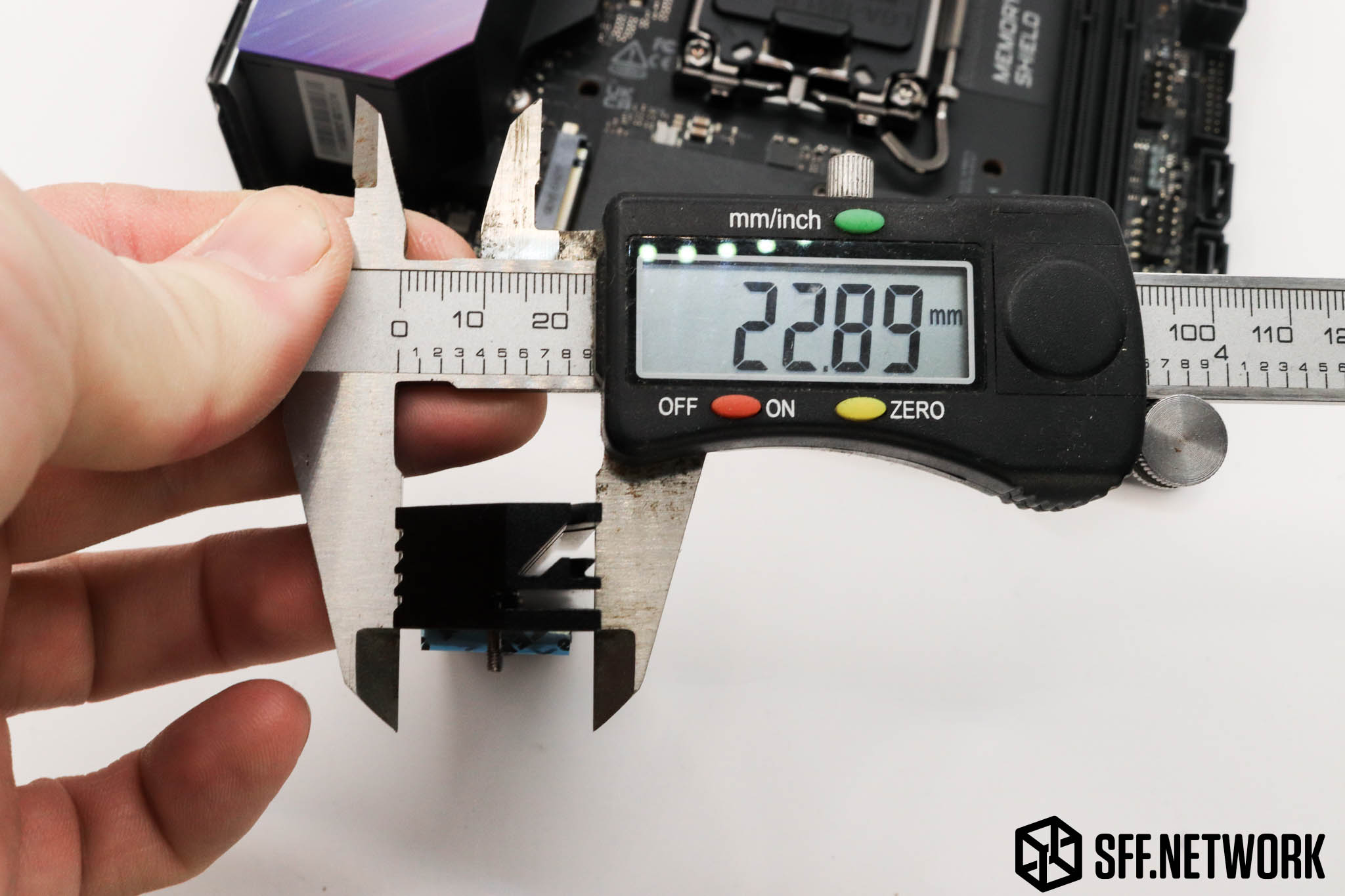
The heatsink measures in at just below 23mm large,
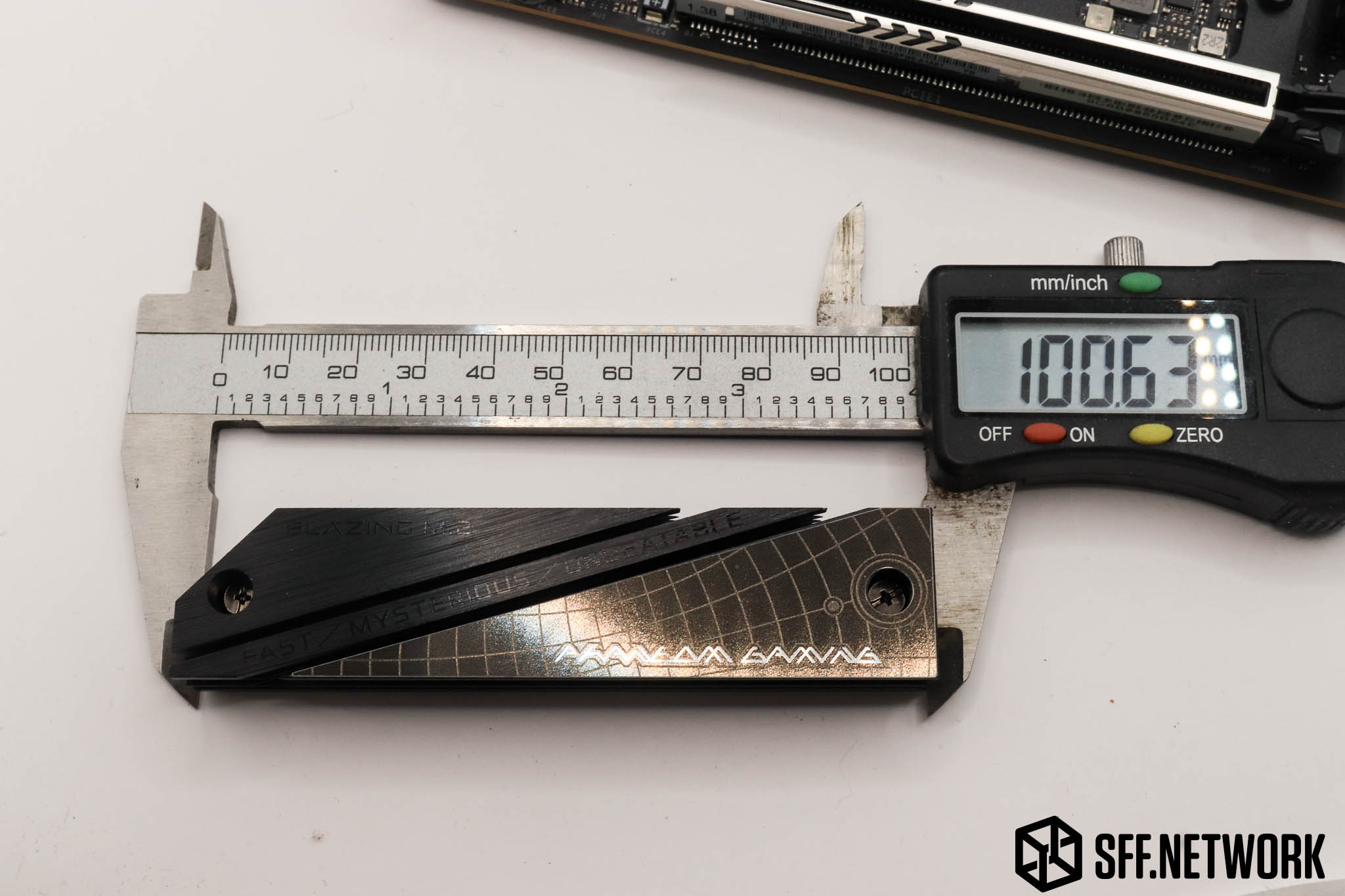
and simply over 100mm large. This heatsink additionally measures in round 14mm thick, over 4 occasions thicker than the equal heatsink on ASRock’s Z790 board, making it clear how sizzling at this time’s excessive finish M.2 drives run.
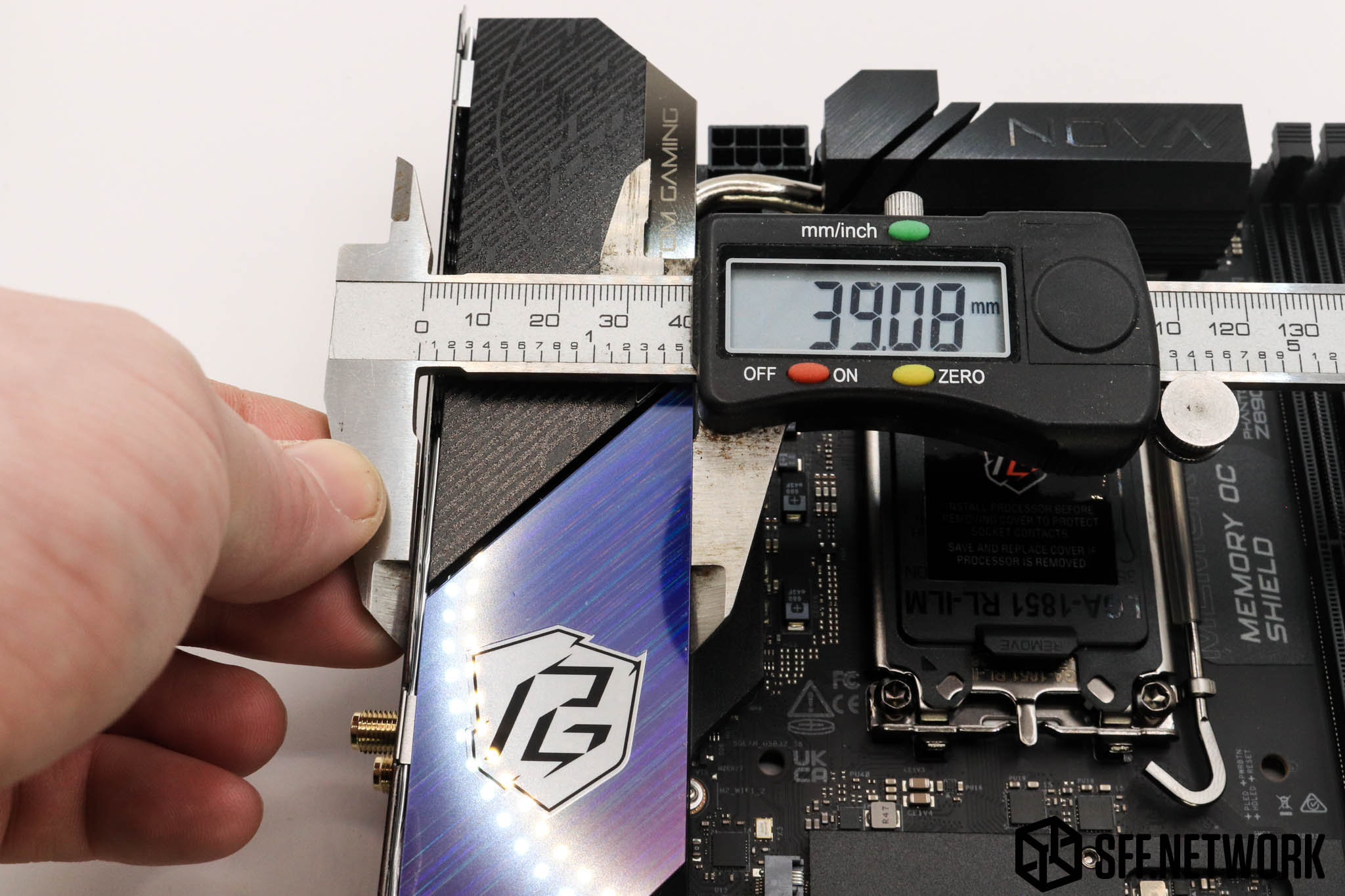
The rear IO cowl / heatsink intrudes 39mm into the chassis,
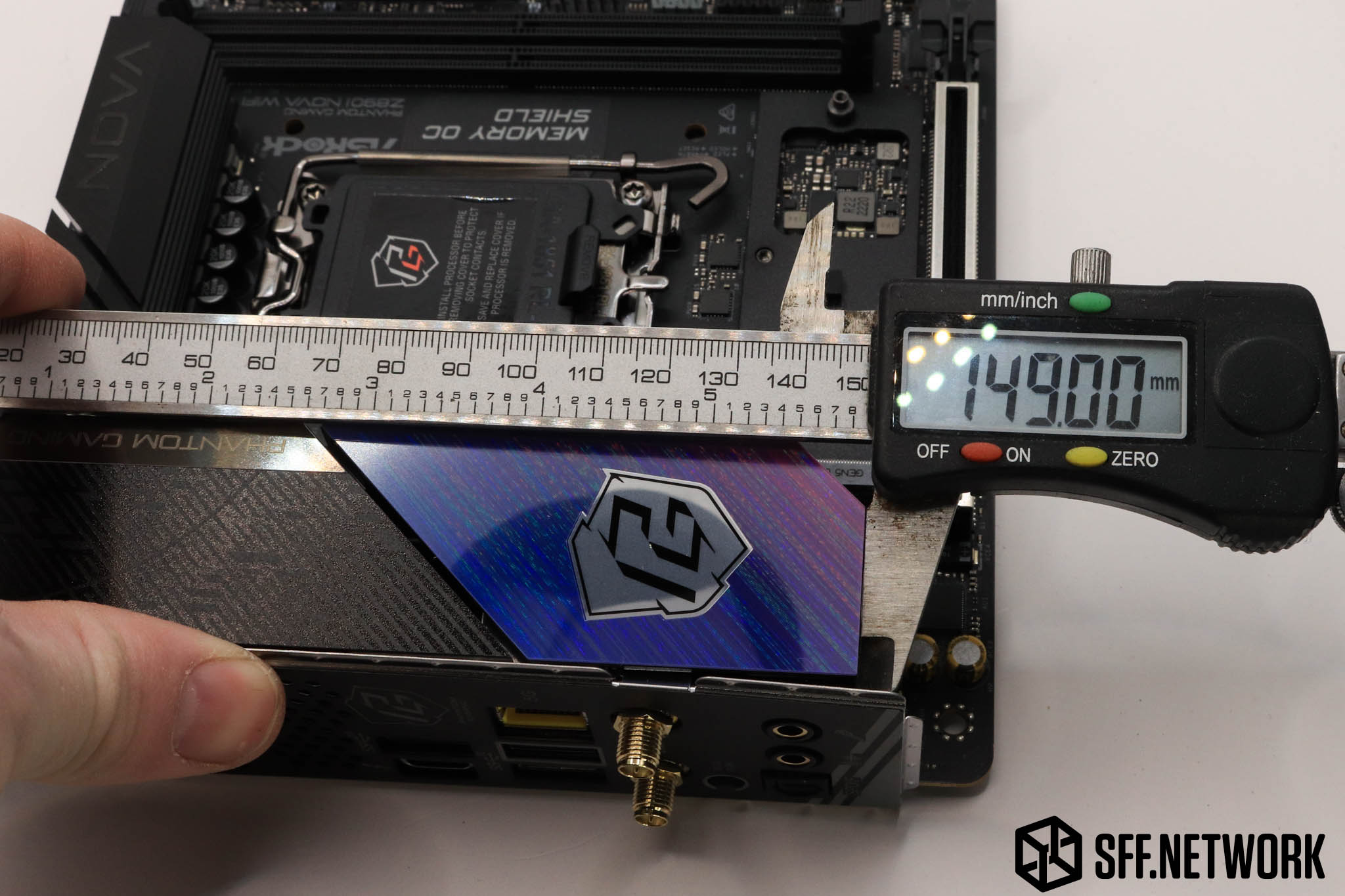
and measures in at 149mm lengthy. That’s a chunky little bit of aluminium!
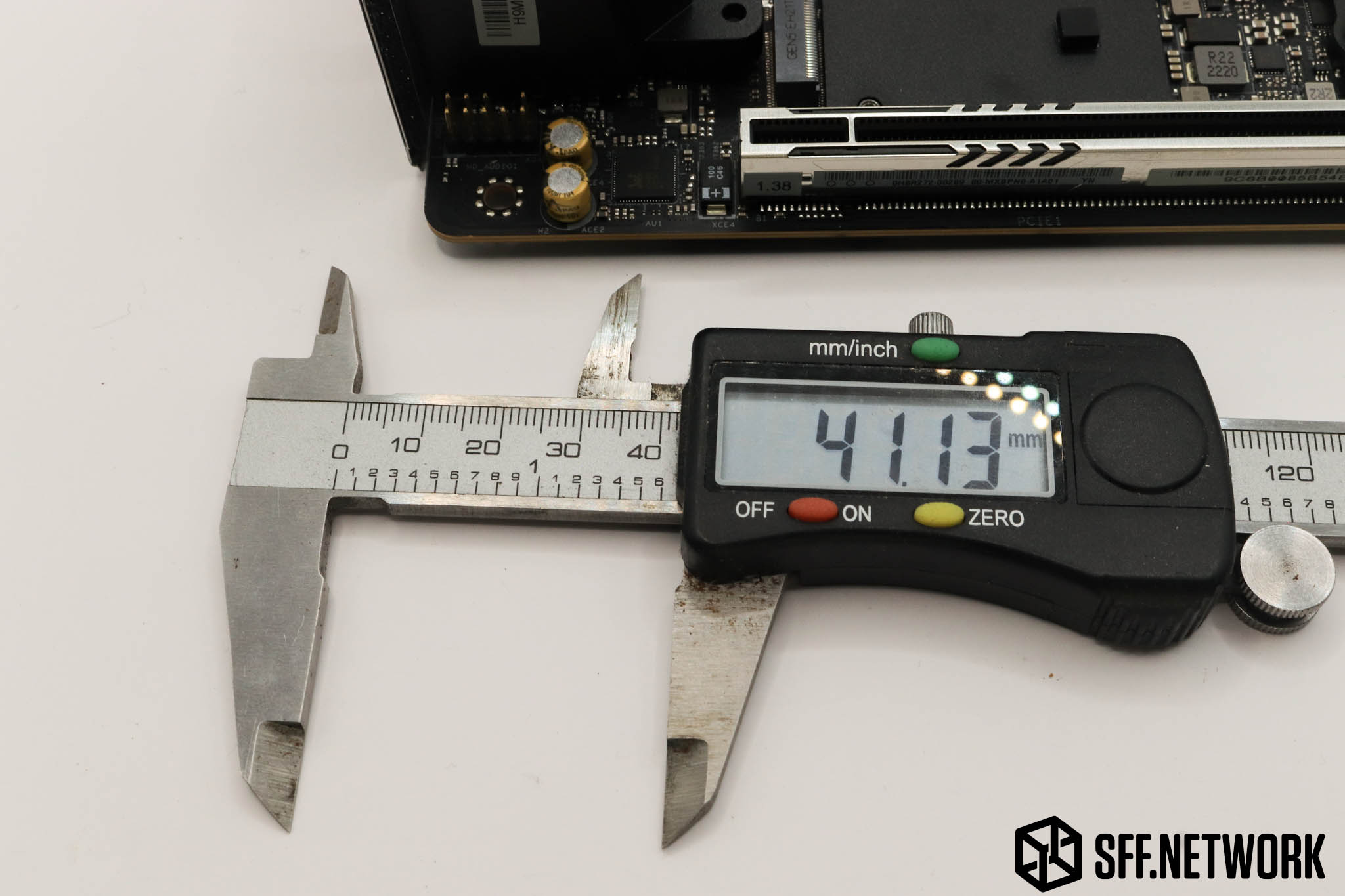
The peak of this measures in at simply over 41mm.
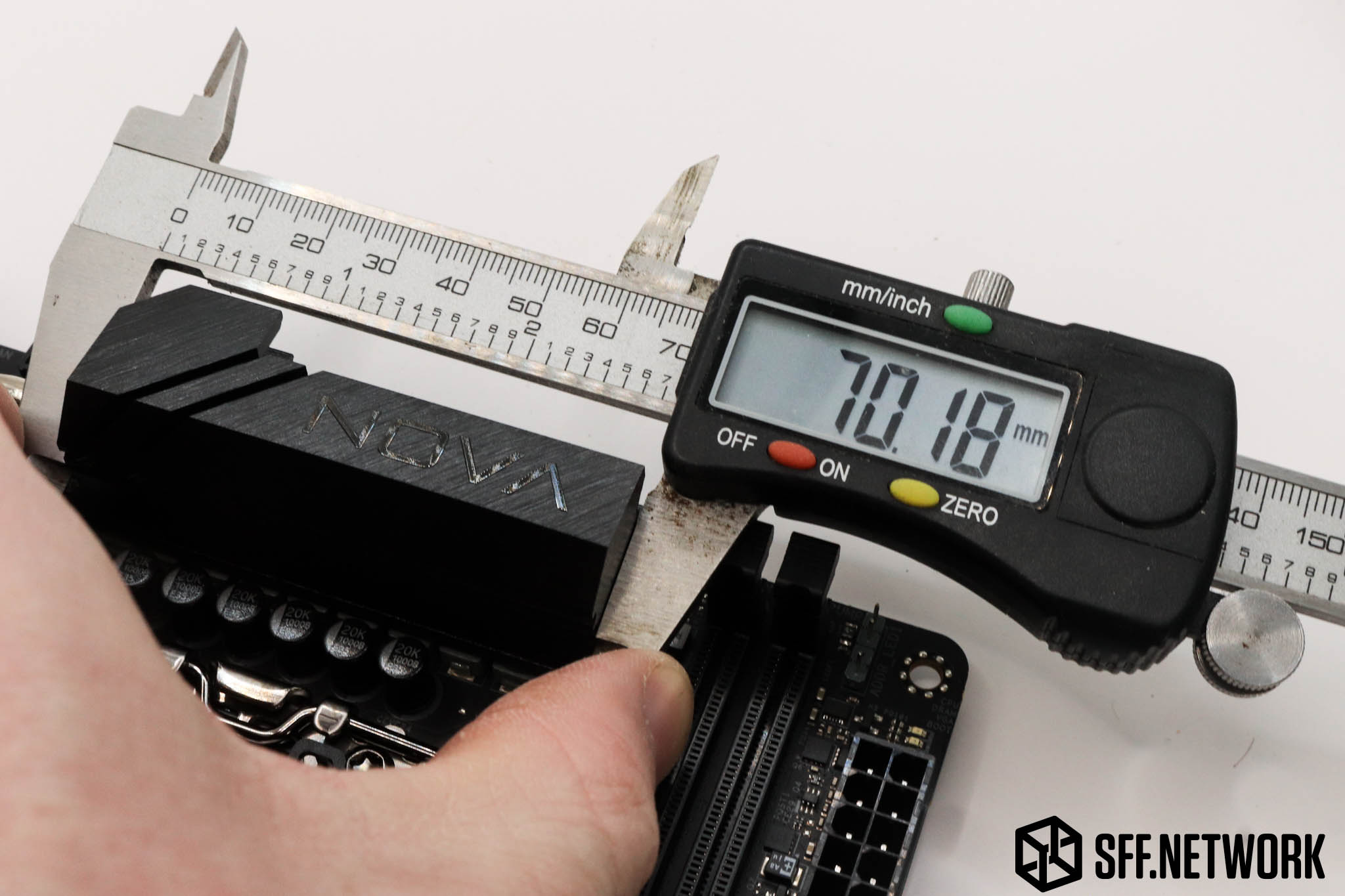
The VRM heatsink is round 70mm lengthy,
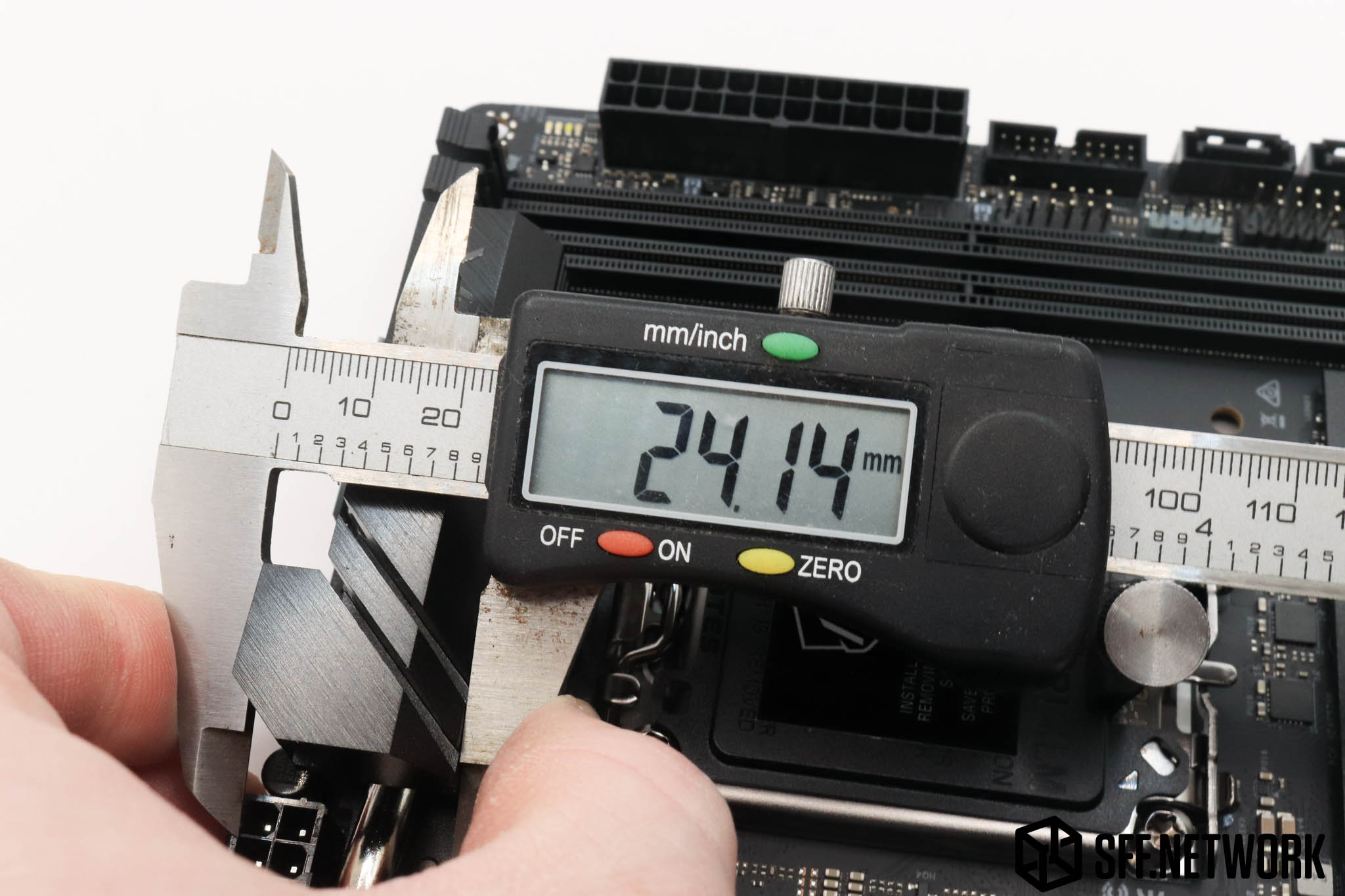
and 24mm large.
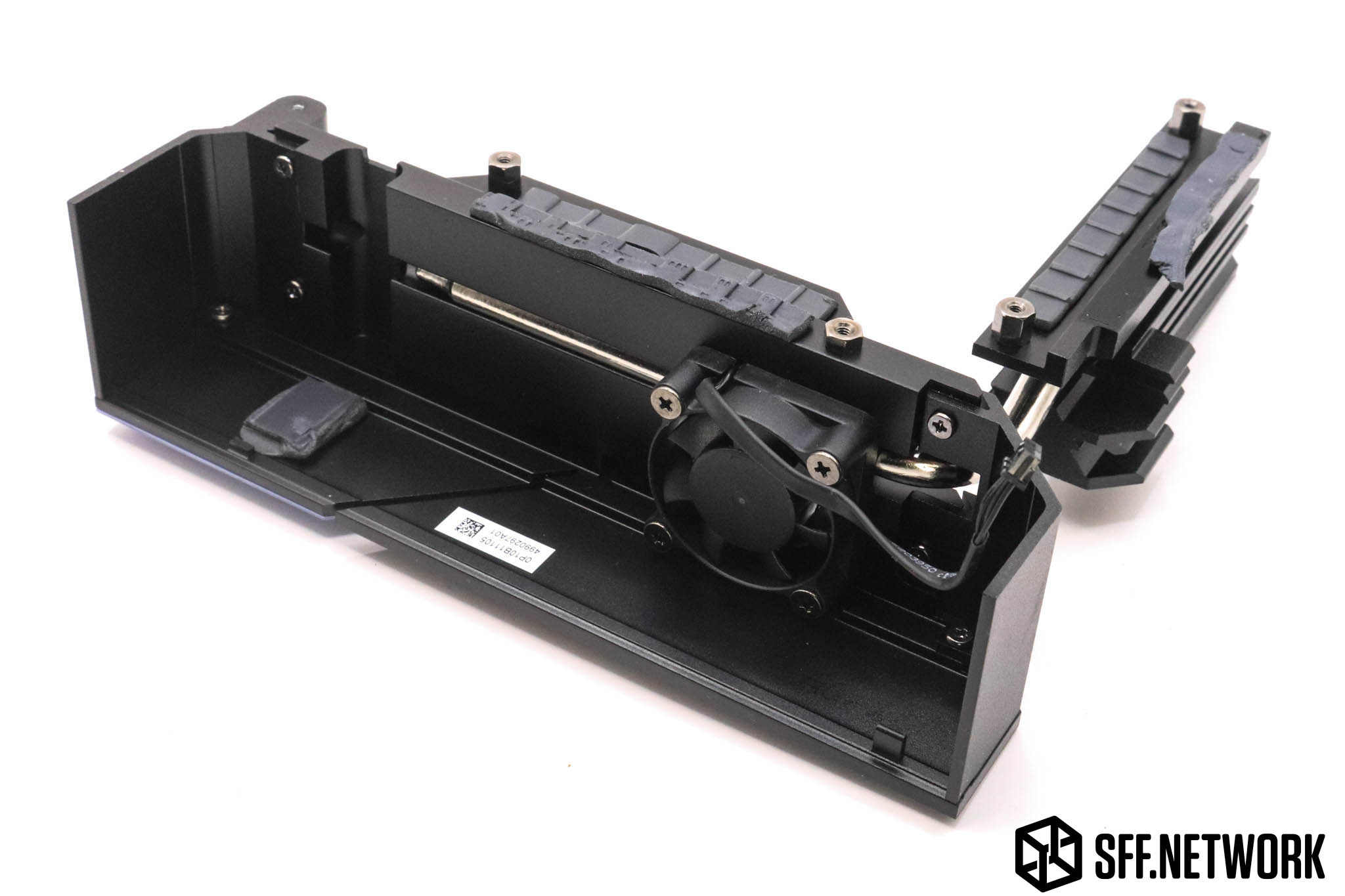
Eradicating the rear IO cowl/ heatsink, we discover an itty bitty cooling fan! Additionally of be aware is the thermal pad on the interface between the WiFi card and the duvet. Does the WiFi card run sizzling? Alas, no energy consumption figures might be discovered for the cardboard.
A lone nickel-coated heatpipe connects the CPU VRM and IO cowl heatsinks, sharing the warmth load.
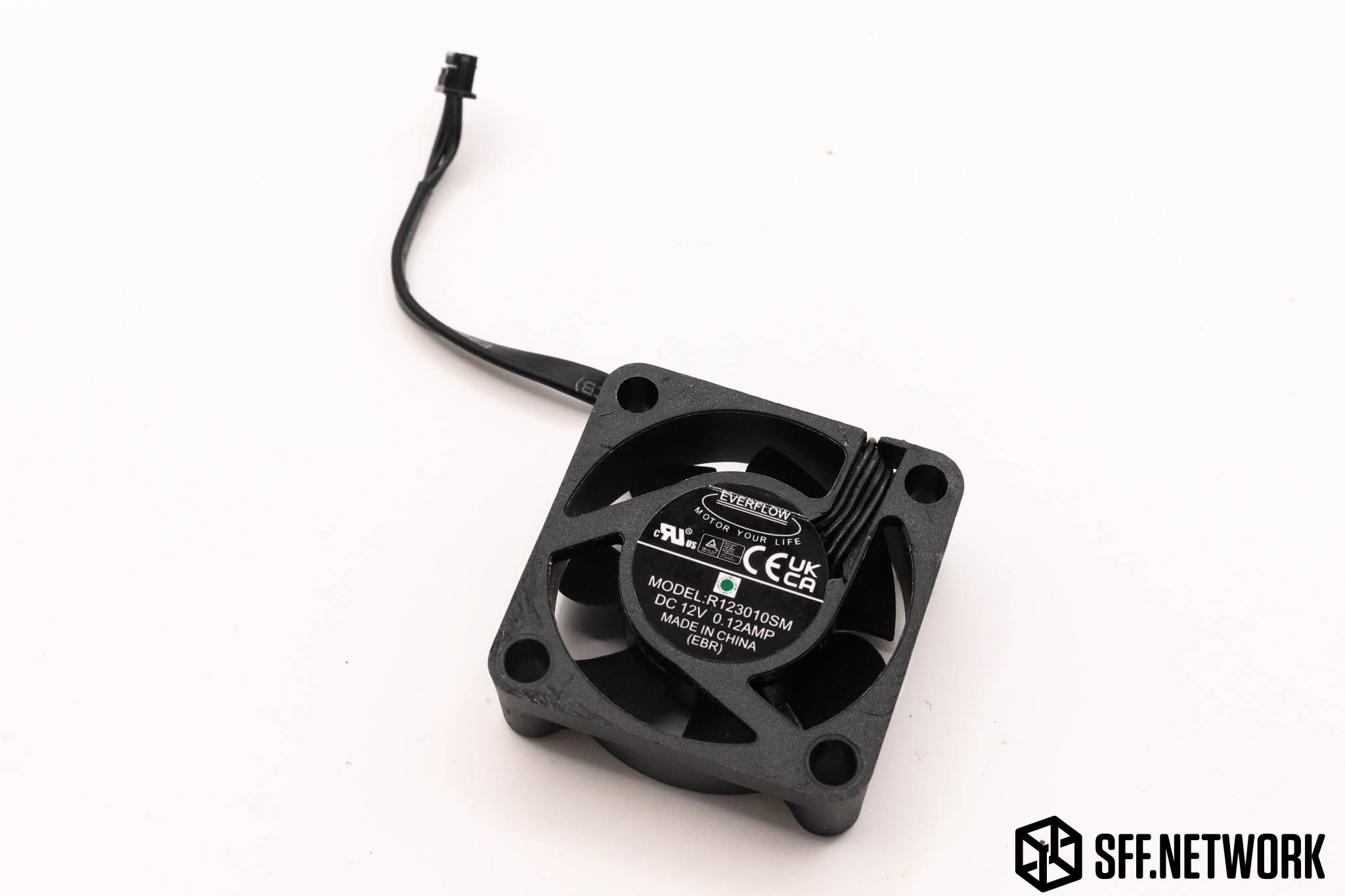
The pre-fitted fan is a 30x30x10mm unit from Everflow. Powered by a 4 pin PWM connection (albeit with a smaller header), this fan appears to be a customized specified unit for this board. Delving into Everflow datasheets, the closest mannequin I may discover is the R123510SM, a 31dB(a) fan at max velocity. Hopefully this fan is close to inaudible in use!
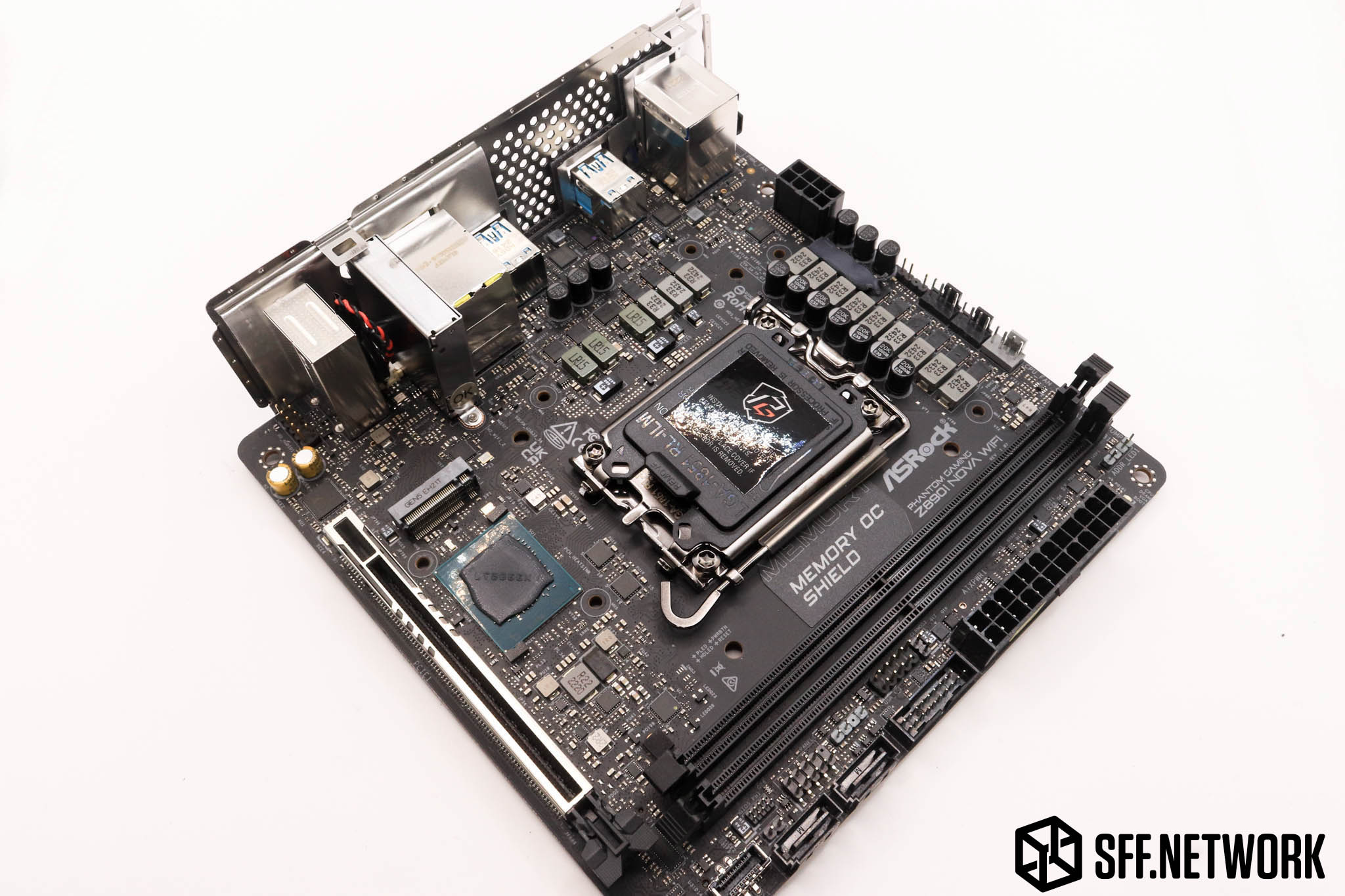
It’s bare! (Sorry for these people with content material filters on their connections.) Eradicating all of the heatsinks reveals the naked board, trying extra like boards of outdated. Bear in mind when boards didn’t need huge heatsinks on every thing?
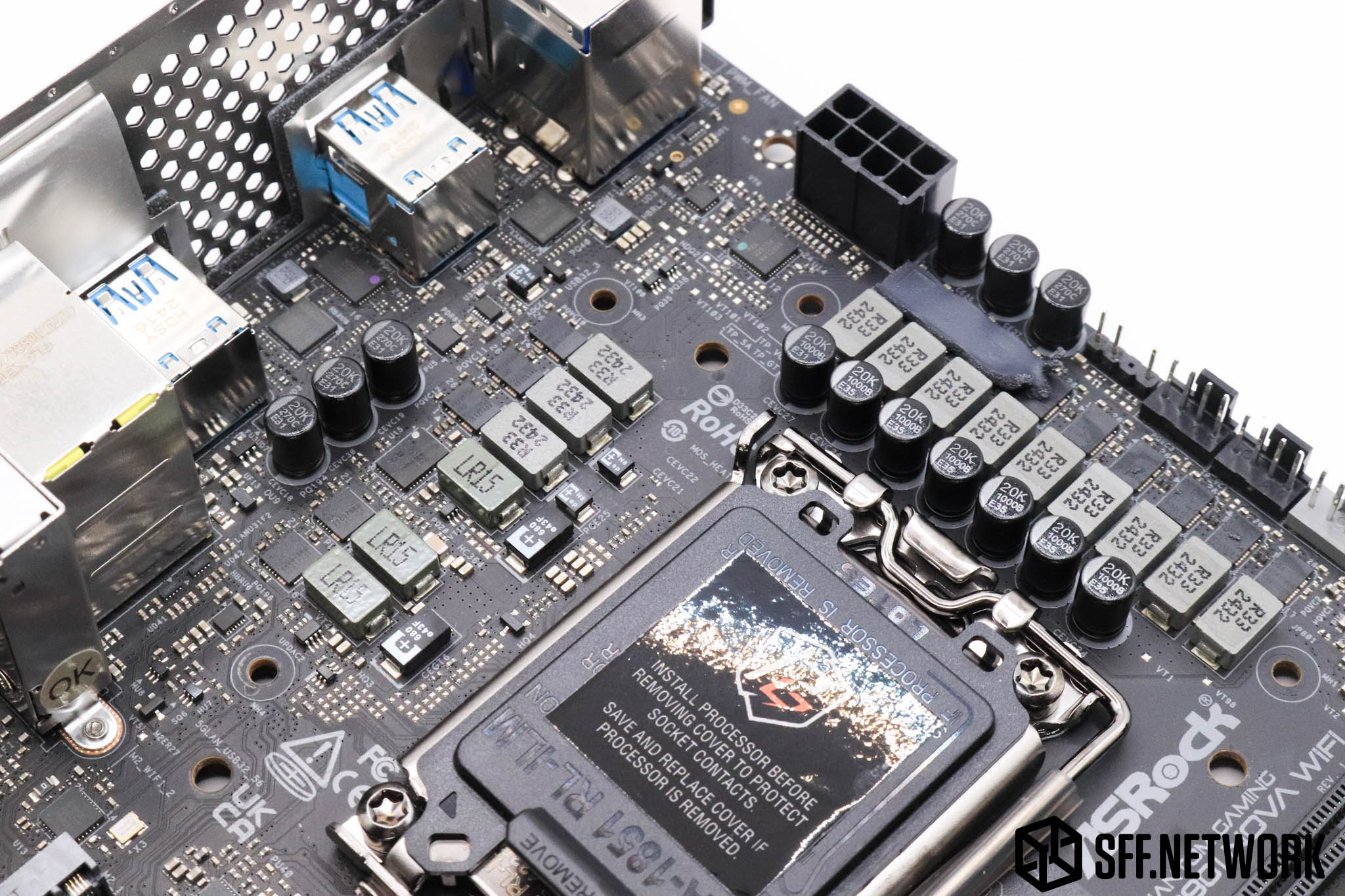
Ignore the torn thermal pad – woops! The facility provide phases are specified by the standard style. ASRock markets the board as having a 12+1+1+1+1 energy part configuration, with a 110 Amp SPS VCore capability.
Base Efficiency
Not everyone seems to be assured sufficient to tweak all the required settings to get probably the most out of their system, so in our preliminary testing, I’ll go away all of the settings at their defaults – besides XMP for the reminiscence, and the Home windows Energy Plan.
Earlier than we get into the benchmark outcomes, it’s necessary that we be aware that efficiency ought to improve over time, with BIOS updates and Home windows updates that optimise for this new technology of processor.
Check {Hardware}
Benchmarks
With out having one other LGA1851 board to check in opposition to, the next outcomes are only for enjoyable, and aren’t meant to be comparable versus different outcomes from us, or from different media retailers. In all cases, greater scores are higher.
UL Procyon
Introducing UL’s Procyon benchmark suite to our overview course of. The Procyon Picture Enhancing Benchmark makes use of Adobe Lightroom Traditional and Adobe Photoshop in a typical picture enhancing workflow
that features batch processing and picture retouching. The benchmark begins by importing Digital Adverse (DNG) picture recordsdata into Adobe Lightroom Traditional and making use of varied presets. Some pictures are cropped, straightened and modified. Within the second a part of the take a look at, a number of edits and layer results are utilized to {a photograph} in Adobe Photoshop. The benchmark rating is a measure of how shortly the system performs these duties.
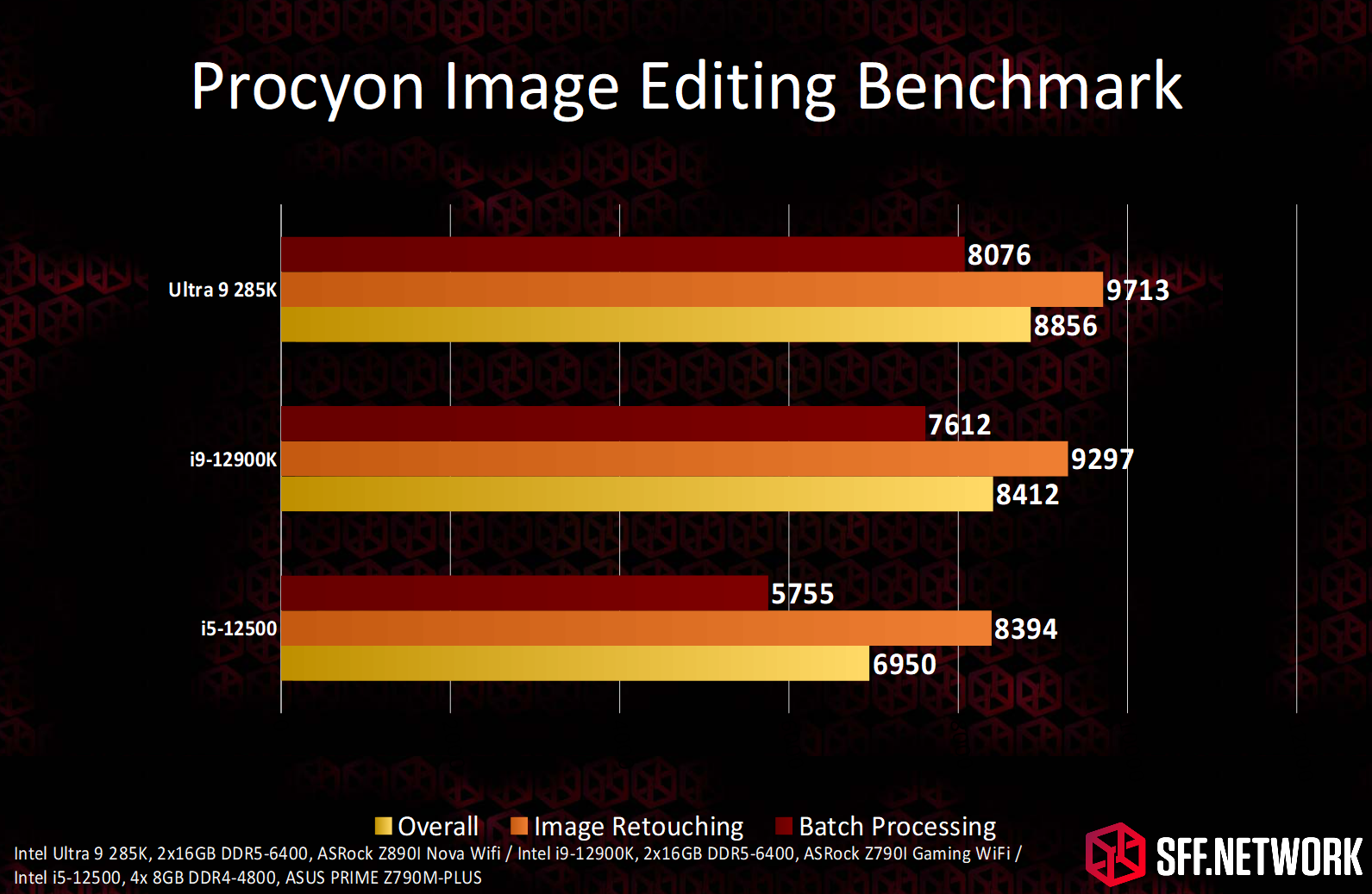
No surprises right here!
V-Ray
V-Ray is rendering software program produced by Bulgarian software program developer Chaos. The benchmark itself is a standalone program, available from their website.
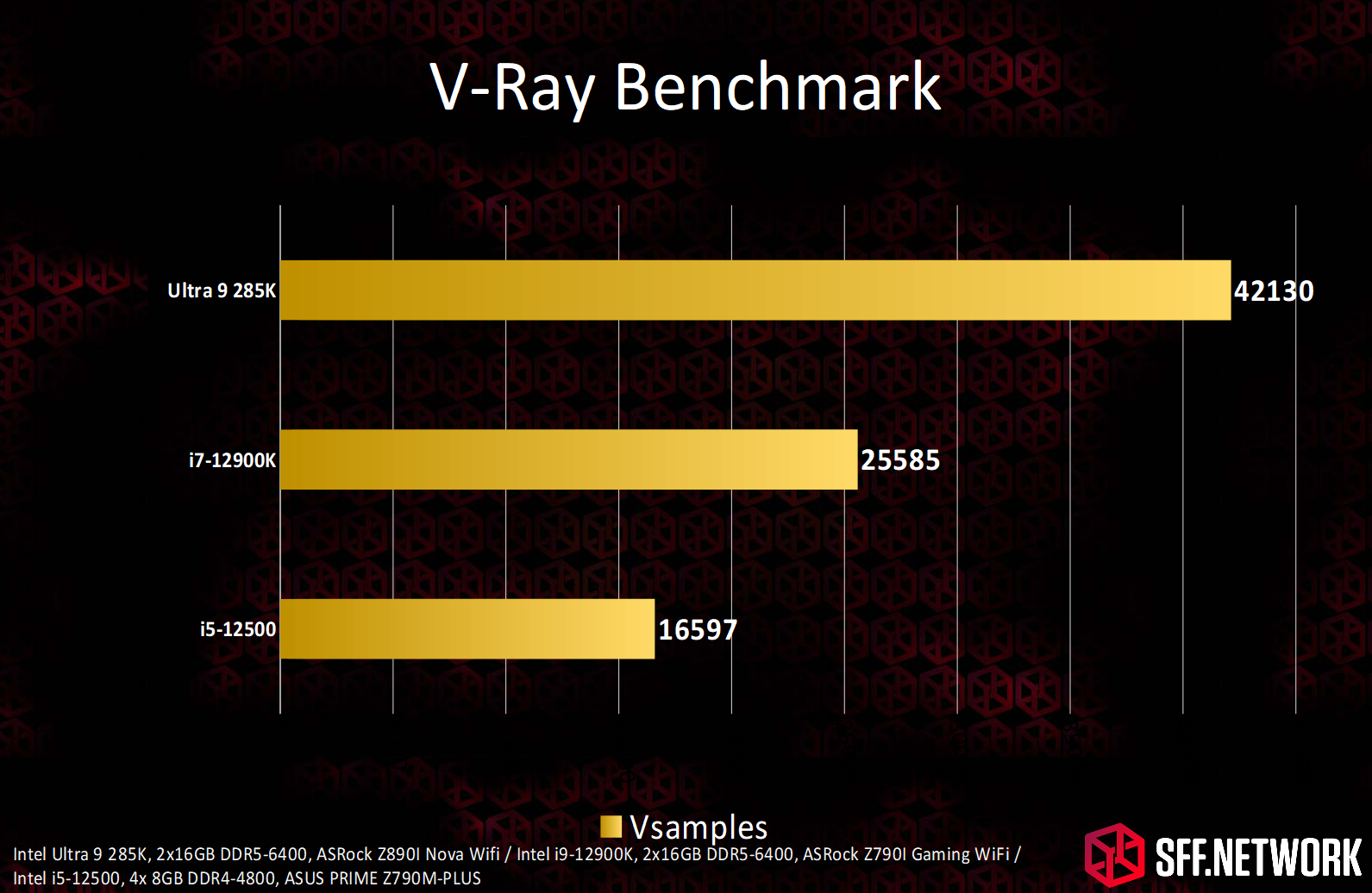
A really sizeable efficiency improve by the 285K right here, so for these utilizing the V-Ray software program, an improve could also be so as!
3D Mark
3DMark is an business customary benchmark, having been on the core of many take a look at and overview suites for over 25 years. On this occasion, we’re utilizing the Metal Nomad DX12 benchmark on the default settings offered by the software program.
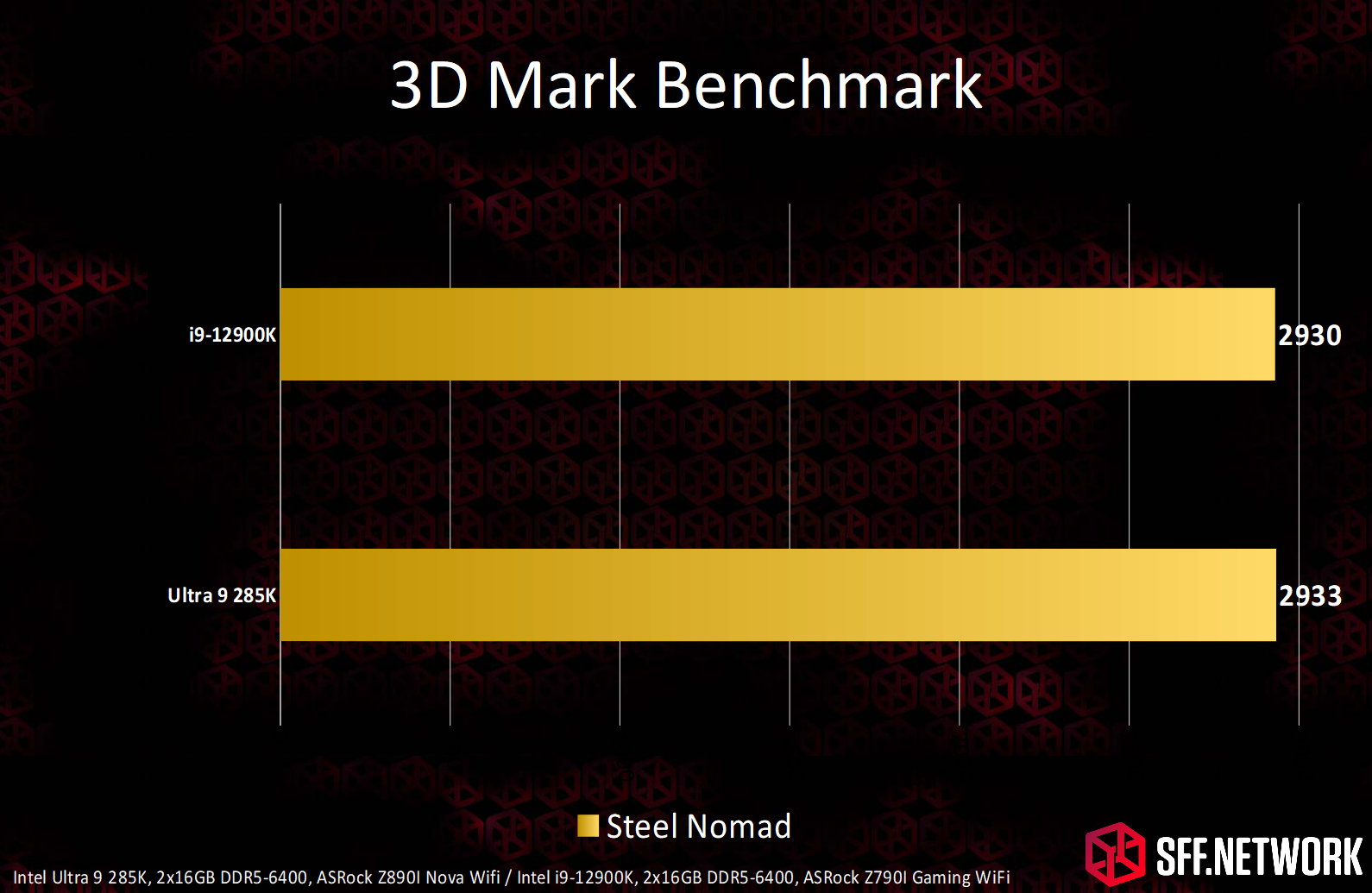
No efficiency distinction between the 2 excessive finish processors, denoting that that is positively a GPU restricted end result.
Blender
Blender is a free and open supply 3D creation suite. It helps the whole thing of the 3D pipeline—modelling, rigging, animation, simulation, rendering, compositing and movement monitoring, even video enhancing and sport creation. – Blender website, about page.
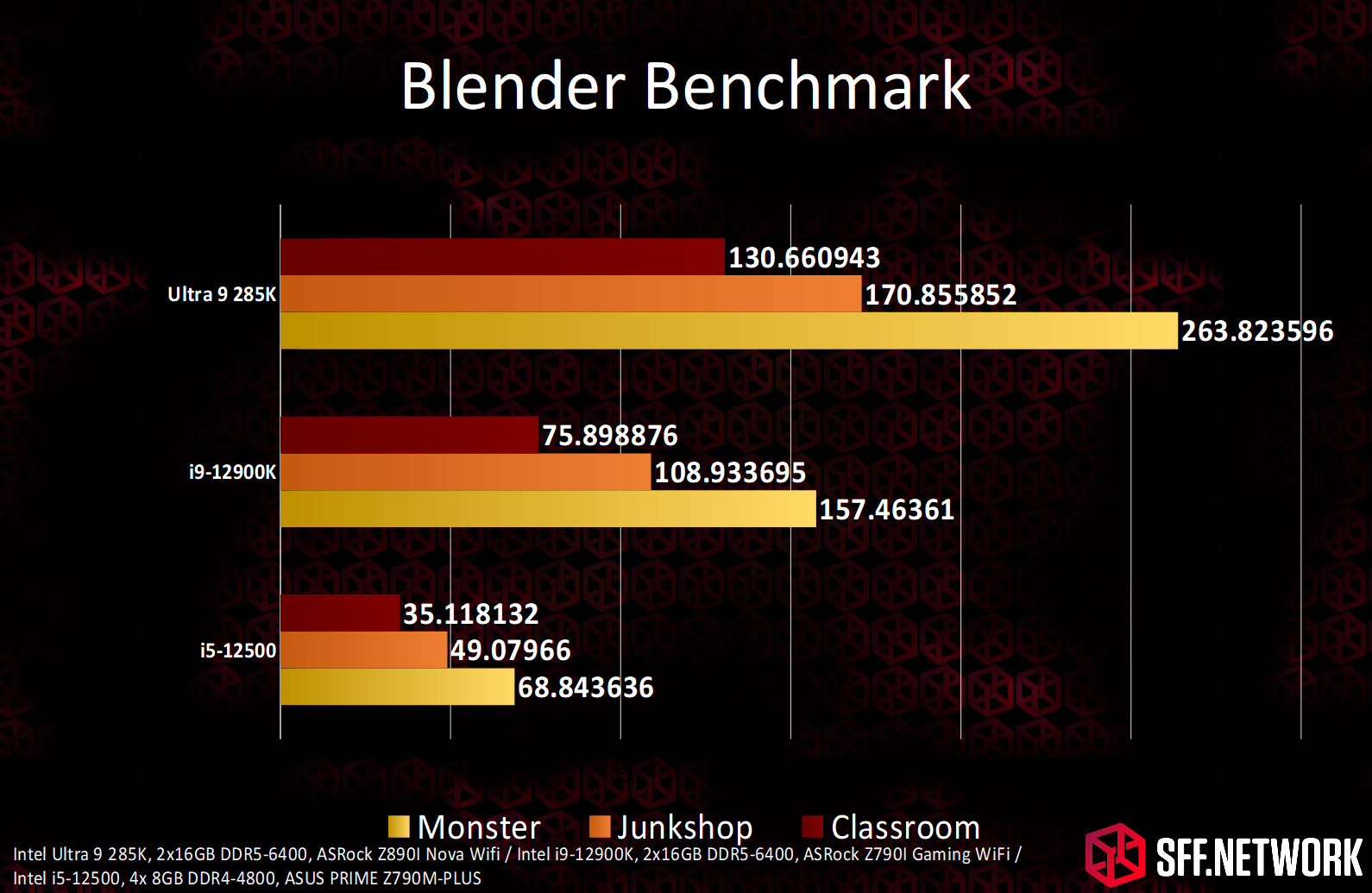
A number of decimal locations! Efficiency as anticipated.
CPU-Z
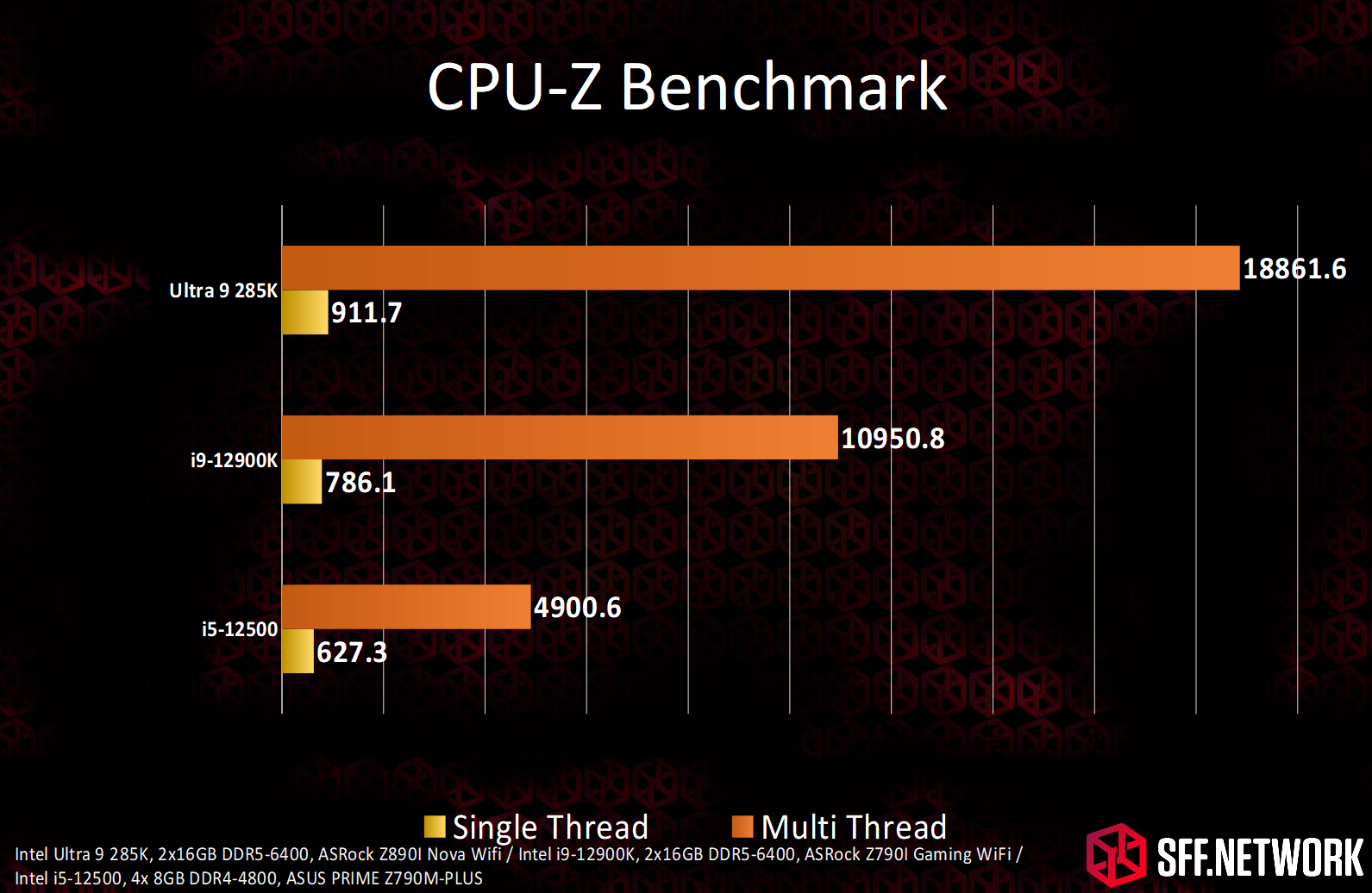
Small will increase in Single Thread however a hell of a rise in Multi Thread, as is to be anticipated.
Energy Consumption
Utilizing the aforementioned default settings, we are able to take a look at fundamental energy consumption of the take a look at system. Understand that every system construct shall be totally different, particularly in case your GPU and CPU are totally different fashions to those we used. If we overview additional LGA1851 motherboards, this knowledge will present an fascinating comparability as to the effectivity of the boards’ energy circuitry.
Underneath full CPU load, the system pulled 312 Watts on the wall (for readability, my native energy is 230V). HWMonitor reported a 221 Watt bundle energy consumption. Utilizing an “amp clamp” on the EPS 12V cable, I recorded 21.42 Amps of present – making for 257 Watts heading into the facility phases.
Temperatures
Underneath sustained CPU load, HWMonitor reported the height temperature of the VRM part as 93°C with a sustained 88°C with an 18°C ambient atmosphere. Presently, the PCH peaked at 74°C.
Market Contemporaries
With out trying on the various merchandise obtainable, it’s tough to type a full and truthful opinion of a product. On the time of writing, the next boards can be found with the Intel Z890 chipset within the M-ITX type issue. Pricing is through NewEgg.com, PBTech NZ, and/or ComputerLounge NZ, previous to any specials or rebates.
| Board | ASRock Z890i Nova WiFi | GIGABYTE Z890I AORUS ULTRA | MSI MPG Z890I EDGE TI WIFI | ASUS ROG STRIX Z890-I GAMING WIFI |
| Value | US$299.99 |
(US$424 at time of writing) |
(US$717 at time of writing) |
|
| Max Marketed Reminiscence Pace | 9866+ OC | 8800 OC | 8600 OC | 8800+ OC |
| Energy Phases |
12+1+1+1+1 110A SPS for VCore |
8+1+2 105A SPS for VCore |
10+1+1+1 |
10+1+2+1 110A SPS for VCore |
| Rear IO USB |
2x Thunderbolt 4 / USB4 Kind-C 40GB/s 6x USB 3.2 Gen2 Kind-A Port (10 Gb/s) 8 Whole |
1x Thunderbolt 4 / USB4 Kind-C 2x USB 3.2 Gen 1 Kind-A 3x USB 3.2 Gen 2 Kind-A 6 Whole |
2x Thunderbolt 4 / USB4 Kind-C 40GB/s 7x USB 3.1 Gen2 Kind A Port (10 Gb/s 1x USB 3.2 Gen 2 Kind-C Port (10 Gb/s) 10 Whole |
2x Thunderbolt 4 / USB4 Kind-C 40GB/s 1x USB 3.2 Gen 2 Kind-C Port (20 Gb/s) 3x USB 3.2 Gen2x2 Kind A Port (10 Gb/s) 2x USB 3.0 Kind A Port (5 Gb/s) 2x USB 2.0 Kind A Port (10 Gb/s 10 Whole |
| Ethernet |
Realtek RTL8126CG 5Gb/s |
Realtek 2.5Gb/s |
Intel Killer E5000B 5Gb/s |
Intel 2.5Gb/s |
| WiFi | WiFi 7 | Intel BE202 WiFi 7 | Intel BE1750x WiFi 7 | Wifi 7 |
| Audio | Realtek ALC4082 7.1 Ch | Realtek 7.1 | Realtek ALC4080 7.1 Ch | ESS® SABRE9260Q DAC vis ROG Strix Hive II |
| Rear IO Video Output |
1x HDMI
|
1x DisplayPort 2.1 1x HDMI |
1x HDMI | 1x HDMI |
| M.2 Slots |
1x Gen 5×4 128Gb/s 2x Gen 4×4 64GB/s 3 Whole |
1x Gen 5×4 M.2 128Gb/s 1x Gen 4×4 64GB/s 2 Whole |
1x Gen 5×4 128Gb/s 3x Gen 4×4 64Gb/s (one through “XPANDER” module) 4 Whole |
2x Gen 5×4 128Gb/s 2 Whole |
One factor to notice right here is that the ASUS and MSI boards should not obtainable on NewEgg, so direct worth comparability isn’t doable. Nevertheless, if we apply an approximate 30% lower in worth after foreign money conversion (as per the Gigabyte board), we are able to estimate that the MSI board can be priced round US$325 and the ASUS board can be US$550.
At time of writing, the ASRock Z890I Nova WiFi is the most cost effective Z890 M-ITX board in the marketplace, however is unquestionably not the bottom featured. Claiming the very best OC reminiscence velocity (succesful reminiscence modules however), the very best CPU energy part configuration, in addition to above common M.2 slot and USB port counts, the board does seem like nice worth, about on par for characteristic per greenback because the MSI MPG Z890I EDGE TI WIFI. The Gigabyte board lacks in M.2 slots, USB ports, ethernet and energy circuitry, with the one benefit to the board being a second show output.
Conclusion
By way of testing, the ASRock Z890I Nova WiFI held up completely, with nary a fault. With this being a brand new platform, we are able to anticipate efficiency and stability to nonetheless enhance as software program, working system and BIOS updates are launched. Being an early adopter to what’s successfully a brand new(ish) platform can have threat although, and we’ve got but to see whether or not Intel has learnt from the voltage points that plagued the final couple of generations, resulting in lifeless processors.
The ASRock Z890I Nova WiFi is a full featured board, providing nice worth for cash in comparison with its’ contemporaries. The truth is, with the inclusion of the 5Gbit ethernet NIC, above common M.2 and USB port counts, and equal prime CPU energy part circuitry, it’s laborious to think about the MSI or Gigabyte choices – with solely the far dearer ASUS ROG possibility justifying a re-evaluation as a result of inclusion of their distinctive entrance panel “dongle”, the STRIX HIVE II.
With the ability to flash the BIOS utilizing the Flashback characteristic, sans CPU, is a superb addition, particularly as new processors are launched, heading into the Extremely 300, Panther Lake, structure. To make sure finest efficiency, I used this characteristic earlier than putting in our take a look at processor for the primary time. Amusingly, ASRock has launched a subsequent BIOS revision since this.
The board shouldn’t be with out faults, nonetheless. The backplate of our Xigmatek Frozr-O II 360 cooler fouled the again of board heatsink. While this might be restricted to simply this cooler possibility, the backplate is of a somewhat generic and customary design, so I’d anticipate different coolers to come back afoul of this problem.
Aesthetically, the ASRock Z890I Nova WiFi is a fantastic product, so long as your color alternative is suitable with purple!
I’m going to proceed testing the ASRock Z890I Nova WiFi within the coming weeks, with outcomes and experiments being reported in our Discord server as I’m going. Examine the Discord hyperlink to your left to affix the server!
We’ve awarded the SFF.Community Beneficial award to the ASRock Z890I Nova WiFi with the next caveat;
We encourage readers to learn different critiques and protection on reviewed merchandise (and this is applicable to all the content material we produce) to make sure that legitimate and justified buying choices are made.

(And in black for the heathens studying in mild mode)