
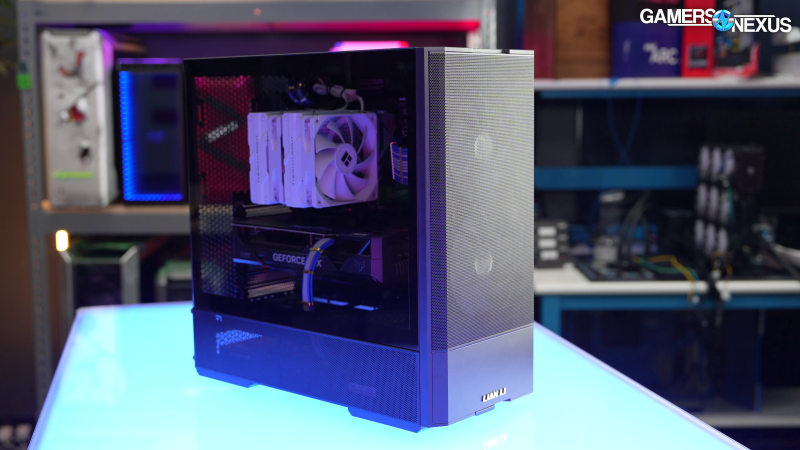
Lian Li Lancool 207 Airflow Case Review | Cable Management, Build Quality, & Benchmarks Leave a comment
The Lancool 207 is an train in compromise, however a few of these compromises didn’t have to exist.
We’re reviewing the Lancool 207 with our new case testing methodology. Earlier Lancool instances had been equally priced and likewise closely aggressive for thermals. Repeating that worth in 2024, with the gradual climb of pricing for every thing, exhibits a extremely aggressive Lian Li.
The brand new Lancool 207’s $80 MSRP comes near the (initially) $70 Lancool 215 that impressed us again in 2020.
We noticed the 207 at Computex earlier this year. We have noticed a number of adjustments to the case since that Computex exhibiting: the bizarre detachable plate on the backside of the entrance panel is gone, the underside consumption followers are standard slightly than reverse-blade, and the aspect panel vent is smaller. None of those adjustments are significant from a client perspective. The detachable plate by no means had an assigned operate apart from to probably be “DLC” add-ons, the underside consumption followers look principally the identical, and the useful space of the aspect vent hasn’t modified.
Lian Li Lancool 207 Specs
| Dimensions (DxWxH) | 455.6mm x 219mm x 456mm |
| Coloration | Black / White |
| Motherboard Help | ATX (Width = 240mm) / Micro-ATX / Mini-ITX |
| Enlargement Slot | 7 |
| Storage | 2 x 3.5” HDD or 2.5″ SSD |
| GPU Size Clearance | 410 mm |
| CPU Cooler Top Clearance | 167 mm |
| PSU Help | ATX (Below 160mm) |
| Radiator Help | High: 240mm / 280mm/ 360mm |
| Fan Help | Entrance: 140mm x 2 (pre-installed)High: 120mm x 3 or 140mm x 2Bottom: 120mm x 2 (pre-installed)Rear: 120mm x 1 |
| Mud Filter | Backside x 1 |
| I/O Ports | USB 3.0 x 2USB 3.1 Kind C x 1Audio x 1Power Button x 1 |
| MSRP | Black – US$79.99White – US$84.99 |
Specs copied from producer supplies, please learn overview for our personal measurements and opinions
We just like the Lancool 207, and we now have a whole lot of good issues to say about it, however we think about the ability provide scenario to be plagued with oversights. Total, we’re optimistic — so we’ll begin with the fundamentals and positives, then spend some severe time speaking concerning the unlucky cable administration and energy provide scenario.
For the fundamentals: The case pulls aside in 3 main panels, together with the standard left and proper sides and a decrease quarter-panel that’s perforated for consumption into what would historically be the PSU shroud. Somewhat than elevating the ground and pulling via that, Lian Li pulls via the rear and sides. This permits the ground to be accessible for arduous drives and SSDs. Even with a 3.5” drive put in, there’s nonetheless loads of room between it and the sunken followers to tug air via.
The panels are additionally exceptionally sturdy for a case of its worth. The highest panel snaps into place with heavy-duty studs and makes use of folded-over columns of metal to bolster it. This avoids that low-cost stamped metal wobble we see on some sub-$100 instances — and on Corsair’s $200+ 6500 cases.
This additionally seems to be a direct response to issues we found with the Lancool 216, the place there was round a half-a-centimeter despair within the high panel. They’ve fastened that subject right here.
The entrance panel additionally makes use of a folded-over metal, which doubles as a catch for the magnets on the high of the simply detachable filter. This could make it trivial to scrub. We’ve at all times been advocates for ultra-fine mesh panels slightly than mud filters, as these serve the identical objective as a mud filter, however are significantly better for airflow.

All the entrance panel will be eliminated, however there isn’t any cause to take action. Should you do it anyway, the I/O cables have been screwed all the way down to the nook of the panel for pressure reduction.


The porosity on the again of the case can be at insane ranges for principally good causes: We sometimes see a lot smaller holes with thicker metal, leading to lots much less breathability. As a result of this case is absolutely optimistic strain, we don’t want to fret a lot about mud ingress from the rear of the case. It’ll get pushed out naturally. This exhibits an consideration to element that illustrates Lian Li really understands why you’d make choices like denser holes for consumption and wider for exhaust.

There’s one missed level, although: The very backside of the rear of the case will function consumption, not exhaust, as it’s individually chambered for the shroud-top followers. Lian Li needs to be filtering these or utilizing ultra-fine mesh.
Total, Lian Li has come a good distance since we criticized a few of its older instances for airflow and is absolutely beginning to present a mastery of thermal design with the small particulars.

The one fit-and-finish subject we seen had been some imperfections and scratches within the infinity mirror fan hubs, however these aren’t seen whereas the followers are spinning.


The motherboard tray is offset from the usual, creating an ATX-sized indent. Because of this the case is totally not suitable with any so-called “E-ATX” boards and that there is solely about 1cm of clearance behind the motherboard tray, however it additionally signifies that compatibility with motherboard edge connectors is superb. Lian Li additionally claims that the offset higher aligns the GPU with the underside consumption followers, however cable routing is the extra tangible profit.
Entrance I/O is extraordinarily primary: 2x USB 3.0 Kind-A ports, 1x USB 3.1 Kind-C port, 1x audio jack, and the ability button. The flat, versatile Kind-C cable particularly is the least annoying one we have ever labored with. The case additionally has a handy all-in-one entrance panel connector, however we might really slightly have the old school two-pin connector right here, because it’s only for the ability button. There isn’t any reset button. Usually, these would mix energy, reset, and energy LED.


The case has two vibration-damped drive mounts within the ground for a single 3.5” or 2.5” drive every. The drive mounting holes are suboptimal: SATA cables must be bent at an uncomfortable angle to suit and the two.5″ mounting holes might simply have been moved to alleviate this.

Every pair of followers has 1x four-pin fan connector and 1x three-pin ARGB connector, and the 2 followers inside every pair are linked by proprietary connectors. We’ll begrudgingly settle for this as a compromise because it cuts the variety of fan cables in half. The draw back is that it is impractical to interchange or reconfigure particular person followers, contributing to a bigger draw back of getting to undergo Lian Li for replacements if one breaks. The entrance and backside mounts aren’t suitable with any sizes apart from those which might be preinstalled (140mm entrance, 120mm backside). On high of that, the entrance mount is constructed round Lian Li’s 30mm-thick followers, and all 4 inventory followers are connected with radiator screws. Should you nonetheless wish to exchange any, Lian Li consists of 16 further screws sized for 25mm-thick followers. All of that is non-standard and can be unfamiliar to skilled builders. It’s workable, however it can impose atypical limitations on fan compatibility if you wish to change them. For example, you’d sometimes have 120mm choices the place 140mm followers set up. Right here, that’s not the case. The upside is that there’s one much less set of rails obstructing consumption at the price of flexibility, so Lian Li goes for the centered airflow strategy.

Lian Li describes the 207 as a “compact M-ATX-sized case with ATX compatibility,” which is simply true by Lian Li requirements. The Lancool 207 is the scale of a traditional mid-tower; it has virtually precisely the identical dimensions as a Fractal North. In truth, it’s actually not a lot totally different than a lot of the instances within the comparability picture above. The SilverStone 515XR is an instance of a really compact ATX case, or the Easy-Bake Cooler Master Q500L.
Now to the ability provide:
The 207 has an uncommon format with the PSU rotated 90 levels and positioned on the entrance of the case slightly than the rear. Because of this there is a 160mm measurement restrict for PSUs, however even our regular 150mm unit was cramped. With out dropping out of the ATX spec, 150mm is concerning the smallest you’ll sometimes get.
Due to the rotation, cables are pointed on the tool-less aspect panel and must bend sharply to route. Utilizing flat cables helps, however this can be a scenario the place you’ll want to contemplate how the cables in your energy provide are sleeved. We’d additionally strongly suggest sticking to 150mm slightly than utilizing the utmost 160mm below the spec. We’d additionally strongly suggest modular energy provides for this case.
The PSU shroud is successfully a fan mount, and even if you happen to might discover a method to stick further cables below it, it’d intrude with the consumption followers and your entire level of the design.
All of this might solely be an inconvenience, besides that the metal aspect panel is tooless. Should you’re utilizing bulkier cables with individually braided sleeves like in our instance, it’s attainable to decide on energy provide and cable combos that make it practically unimaginable to snugly shut the aspect panel. It’s attainable, and we did it with our cumbersome sleeved cables to show that, however this took a very good period of time to handle and flatten.
We’d strongly suggest flat cables just like the ones shown in the 207 at Computex. The extra equipment and PCIe energy cables you run, the extra issue you’ll have managing the cables on this specific case.
Screws for the aspect panel would have helped this by permitting extra tolerance for cable bulge.
The guide illustrates putting in a Lian Li EDGE PSU, which seems to be prefer it might assist; nevertheless, the 207 is $80, and the most affordable EDGE PSUs price at the very least $130 to $140. It’s a mismatch of the most probably purchaser for the case if Lian Li expects most to make use of these energy provides.
The illustration additionally exhibits the EDGE PSU being put in fan-side-up, which is not an formally supported choice for different energy provides. The same old association of mounting holes requires putting in commonplace ATX PSUs fan-down within the 207, with solely 1cm of clearance above the desk.
In one other main concern, in Lian Li’s quest to maneuver the ability provide, it has neglected each cabling and cooling issues. With the underside filter put in, which we’ll come again to, the ability provide is given mere millimeters to breathe with a bottom-oriented fan. We don’t presently run energy provide thermals throughout our testing; nevertheless, this may trigger the ability provide to warmth up, objectively, and it might outcome within the PSU fan operating at the next RPM (if it’s a energy provide that bases fan velocity on any inner temperatures).
Eradicating the filter functionally doubles its respiration room, however finally, we predict this can be a main design shortcoming. Lian Li’s pursuit of minimizing the case measurement has restricted its space for energy provide consumption. That is making us think about operating a thermocouple wire to our energy provide for future case opinions.


The PSU filter is one other small design fault: It’s best to carry the case to take away the filter, which isn’t a dealbreaker, however may very well be fastened with a extra accessible tab.


On the cable administration aspect on the again of the case, the attachment factors for the built-in velcro straps are angled in order that the straps curl over as they’re inserted, which is a a lot larger high quality of life enchancment than it appears like. The guide describes supposed cable paths, most of that are apparent, however there are particular routes for 24-pin STRIMER cables and for CPU 8-pin cables. The 8-pins are held in by plastic hooks, however the hooks would possibly work higher in the event that they had been flipped. There is not a recommended path for GPU energy cables within the guide. That is one thing we might have preferred to see for brand new builders.

As for vertical GPUs, the enlargement slots are bridgeless, so different vertical GPU add-in kits may go, however Lian Li particularly markets its universal 4-slot bracket. As demonstrated at Computex, utilizing this vertical bracket will block the underside consumption followers, and we do not suggest it.

It could technically be attainable to get a 280mm radiator put in within the entrance of the case, however it’d have to have precisely the appropriate gap placement. Lian Li does not declare any formal radiator assist wherever besides the highest of the case, and we agree. 120mm-wide rads match extra simply than 140mm-wide ones, which can make the CPU energy cutouts troublesome to achieve.
Lian Li Lancool 207 Thermals

As we have lined, it is inconvenient and pointless to interchange the 207’s inventory followers. Nonetheless, we had a few alternate configurations we needed to check that did not contain altering the followers. We additionally did a go with the small mesh part on the metal aspect panel taped off. The underside consumption followers have a bigger part of mesh accessible on the opposite aspect of the case, in addition to a wide-open vent on the rear, so we suspected that taping off this little vent would not matter a lot.
The 207 is without doubt one of the most cost-effective instances on our charts presently. Out of our latest opinions, it lands between the $100 SilverStone 514X and the $68 515XR. We additionally retested the older Lancool 216, which continues to be accessible for round $100. When it comes to fan format, the 207 is most much like the costlier Antec Flux Professional.
We solely ran primary exams in “commonplace mode” on the 216. There’s additionally an “air cooling mode,” however in our unique overview, we discovered that this helped GPU thermals whereas concurrently hurting CPU thermals with our bench {hardware}. Test our Lancool 216 review for extra element on alternate configurations, together with an exterior fan bracket connected to the again of the case.
GPU Full Load Thermals – Noise-Normalized

The 207 is a loud case with all followers at full velocity, however we’ll begin with noise normalized outcomes. For this testing, all case followers are lowered to achieve a goal noise degree of 27 dBA measured at 1 meter in our hemi-anechoic chamber, with CPU and GPU fan speeds managed and fixed.
We’ll begin with noise-normalized GPU thermals since these backside followers ought to assist there.
The GPU temperature averaged 42 levels above ambient, 47 on the reminiscence, and 55 hotspot. That is one diploma higher than the 216 in every class, however nonetheless shut. Impressively, the Fractal Torrent stays the chief on this specific take a look at. That’s not at all times true, however it’s right here. It has its personal backside consumption followers that feed the GPU immediately, which assist.
We’ve not at all times seen a profit from shroud-top consumption followers, however instances just like the 207 and the Flux Pro that decide to constructing the case round that idea do present good outcomes. If something, it is a testomony to the 216’s cooling that it comes so near the 207 with none shroud followers.
The Antec Flux Pro‘s common GPU temperature was about one diploma cooler than the 207’s.
There isn’t any contest versus the 514X and 515XR, which fall on the exact opposite finish of the chart. The 207 is in a distinct class in some ways, however Lian Li has priced it so aggressively that we now have to make the comparability; it undercuts the 514X and is simply $12 over the 515XR.
Fractal’s Pop Air is one other price-competitive case, however lands on the backside of this chart. It’s nonetheless a very good case, and when it’s one sale, it’s impressively low-cost, however the 207 is thermally superior.
CPU Full Load Thermals – Noise-Normalized

Right here’s the CPU noise-normalized chart: Immediately, the Lancool 207 is tied for chart chief in CPU thermals. The typical all-core CPU temperature was 41 levels Celsius above ambient and 44 levels on simply the P-cores. The 216’s numbers spherical in a different way, however its outcomes had been near-identical to the 207’s and inside error. The 216 was considered one of our all-time finest performers for noise-normalized CPU cooling after we initially reviewed it, in order that’s excellent news for the 207. The 207 technically tops our up to date chart inside error of the 216, however the Antec Flux Professional can be inside a one-degree margin. The Flux Professional is at the very least $180, although.
Compared to the extra carefully price-matched 514X at 48 levels all-core and 515XR at 53 levels all-core, the 207 has an enormous lead. To date, the 207 seems to be like one other Lancool with an unbeatable price-to-performance ratio.
CPU Full Load Thermals – Full Velocity

At full velocity, the 207 appears like a server rack. The 41.6dBA outcome ties the 216. The 216 is one of the best performer when allowed to brute power its efficiency by fan velocity, roughly tying the 207 after we take away its entrance panel to check restrictions. With the panel, the 207 ran at 41.6 levels for P-cores, or about 2 levels hotter than and not using a entrance panel. So far as restrictions go, that’s fairly good: The panel isn’t considerably hurting efficiency, in contrast to another instances we’ve examined. Should you purchase the non-compulsory filter, that will change.
Utilizing two layers of gaffer tape over the small mesh part on the metal panel would have an effect on GPU thermals if something, so it is no shock that it had no impact on CPU thermals.
The 207 at 41.6 levels ties the Flux Professional for efficiency. Once more, although, the noise normalized outcomes are higher for case-to-case comparability.
GPU Full Load Thermals – Full Velocity

Now for GPU temperatures at full velocity. In the identical take a look at, the GPU was 38 levels above ambient. Taping the aspect panel vent did nothing. We expect that is just because the underside consumption followers have loads of different air flow accessible via the mesh on the alternative aspect of the shroud and the wide-open unfiltered vent on the rear of the case. If these inlets had been minimized, it might need mattered extra. It nonetheless doesn’t harm to have extra mesh in these areas, particularly if you happen to shove drives down there, however it simply didn’t matter for our GPU.
GPU thermals successfully tied the Flux Professional, however with some back-and-forth over the reminiscence and hotspot temperatures. It doesn’t matter what, although, the 207 sits alongside the Torrent and Flux Professional on the high of this chart. The 216 fell behind right here with a median GPU temperature of 43 levels above ambient, which continues to be wonderful, however not so good as the brute-force backside consumption of the 207.
GPU Full Load Thermals – Standardized Followers

Our standardized fan exams use three Noctua followers, at all times the identical ones: two 140mm entrance consumption, and one 120mm rear exhaust, all at 100% velocity. We often clarify the constraints of this testing. You’ll be able to study extra in our methodology piece here. This permits us to take away inventory followers as a variable and examine simply the enclosures. With instances just like the 207, the comparability is theoretical (because it does not make any sense to interchange the inventory followers), however individuals request it, so we needed to offer the info.
Our commonplace fan configuration was clearly worse for GPU thermals than the inventory configuration. With the usual followers, common GPU temperature was 43 levels above ambient, 48 levels for the reminiscence, and 56 levels for hotspot.
CPU Full Load Thermals – Standardized Followers

On the CPU with standardized followers, we measured CPU temperatures at 38 levels above ambient all-core and 42 levels for the P-cores, inside error of the top-scoring Torrent. Mesh fronted instances with easy front-to-back airflow patterns do effectively on this take a look at, and the 207’s CPU thermals are notably good as a result of the entrance fan slots are biased excessive, sending extra air above the extent of the GPU backplate. We normally attempt to place the consumption followers for a greater stability with GPU thermals, however that is not an choice within the 207.
VRM & RAM Full Load Thermals – Noise-Normalized

The VRM and system reminiscence are positioned near the CPU in our take a look at system, so it is sensible {that a} case with good CPU thermals would have good thermals in these two classes as effectively. The 207 barely outperformed the Flux Professional for lowest reminiscence temperature at 21 levels above ambient, tied with the Torrent. VRM was tied with the Flux Professional at 27 levels, however that is tied on the high of the chart. The 216 was hotter for each sensors, 23 levels for the system reminiscence and 28 for VRM.
Lian Li Lancool 207 Conclusion

Just like the Lancool 215 and 216, the Lancool 207 is a well-built case with chart-topping efficiency whereas concurrently managing to be one of many most cost-effective instances on our charts. The instances that carry out equivalently are costlier, just like the Flux Pro, and the instances which might be in the identical basic worth class carry out worse, just like the 514X. Lian Li already has some sturdy competitors on this space, together with its personal 216, however the 207 is even cheaper than the 216.
Phanteks has its new cases from Computex popping out quickly and people ought to give the 207 some competitors, however they’re not right here but — they usually would possibly find yourself just a little costlier, however we’re unsure but.
The Fractal Pop Air stays a very good high quality ultra-cheap case when it’s on sale, which has been regularly recently, however it’s only a completely totally different class of efficiency. The 207 holds the brand new crown for one of the best efficiency for the value — nothing else that we’ve examined anytime lately is even shut once you issue within the worth. Lian Li’s 216 is the closest competitor, however is regularly round $100, making it $20 costlier than the 207.


The most important downside with the 207 is the cable administration and energy provide match: The issue with getting the aspect panel on over the PSU is doubtlessly an enormous impediment for some cable-heavy or thicker cable configurations and isn’t shared by any of the opposite instances we have talked about. Should you purchase this case, we suggest selecting a 150mm deep PSU slightly than 160 and choosing slimmer cables. Relying in your PSU and the cables you utilize, there is a severe threat that the aspect panel will not match and you will get irritated sufficient to ship the case again. Flat, slim cables have a greater likelihood of working.
That is its solely main subject that we encountered. Construct high quality of the panels is general wonderful, particularly on the worth, and thermal efficiency is among the many finest. The 207 will get a powerful, however caveated advice, with the caveat once more being associated to cable administration (particularly for much less skilled builders). Should you plan forward and have endurance to totally route cables, and if you happen to can keep on with a shorter PSU, we predict this case is without doubt one of the best available on the market for its worth. There aren’t a whole lot of well-built choices on this worth class.